Cheap prop firm challenges are attractive, particularly if you’re looking for funding without having to wager hundreds or thousands of dollars up front. However, real tradable conditions and low fees are not the same. Traders frequently become fixated on price while ignoring the rules that lead to the majority of failures when searching for the cheapest prop firm challenges. This comparison reveals where costs are hidden in risk limits and drawdowns, as well as what you pay and what you actually receive.
This article is for budget‐minded beginner and intermediate traders who want clarity on low-fee challenges and how rules affect your odds of passing. It is not for high-risk scalpers or traders who assume cheap means easy.
How Prop Firm Evaluation Challenges Work (in Plain Language)
A prop firm challenge is a test that you have to pay to take. You have to make money while following strict rules about risk. If you meet all of your goals without breaking the rules, you can get funded capital and share in the profits.
Cheap doesn’t mean easier:
- Lower fees often mean tighter drawdowns.
- Even disciplined traders can find daily limits hard to handle.
- Risk management gets harder when profit targets don’t change.
That dynamic leads many traders to blow cheap challenges not because they lack edge but because they misread the rules.
Overview of Well Known Cheap Prop Firm Challenges
Below we compare some of the more established inexpensive challenges, actual prices where available, and core rules that matter for passing odds.
The 5%ers
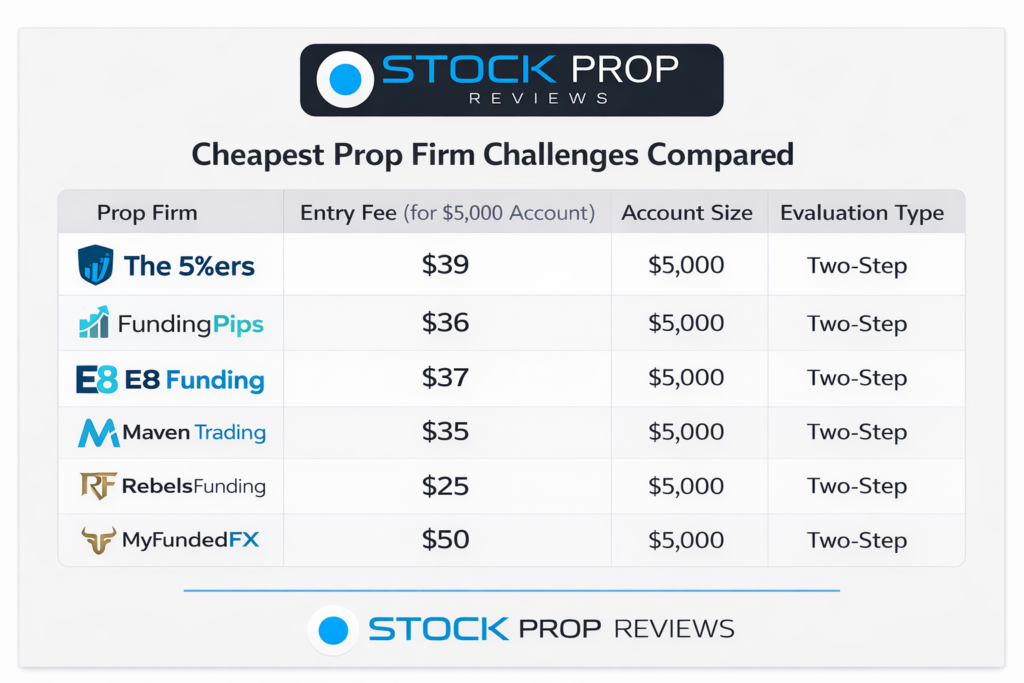
One of the oldest entry-level companies with low fees and the ability to grow. According to several lists of firms, evaluation fees start at about $39 for an account with $5,000 and a profit split of 80–100%. The daily drawdown limit is about 5% and the overall drawdown limit is about 10%.
People in the community often mention this company as a good, cheap choice with clear risk limits and fewer rules that have to be followed, like minimum days.
E8 Funding / E8 Markets
Another prop firm with low entry fees that start at about $37 for a $5,000 account. The limits on profit split and drawdown depend on the settings you choose. This model is popular because it lets you set drawdown ceilings and payout shares, but traders need to read the terms carefully because it is flexible.
FundingPips
Rated as one of the most affordable options with a $36–$42 range for a $5,000 challenge in many listings. Profit split and drawdown limits (5% daily / 10% total) are standard. FundingPips offers multiple paths including one-step, two-step, and instant models.
Maven Trading
Some vendors list Maven’s challenge at around $29-$45 after promo codes for a $5,000 account, with an 80% profit split and static drawdown. This firm’s rules tend to favor strategy freedom, allowing news trading and overnight holds that many cheap firms restrict.
RebelsFunding
RebelsFunding appears on price lists with starter challenge fees often under $25-$50 for a $5,000 account. Profit splits around 80% are common, with daily and overall drawdown rules that still catch traders unaware because they are often unaccompanied by scaling buffer explanations.
MyFundedFX
A frequently listed cheap prop firm challenges around $50 for a $5,000 account with standard risk rules and 80% profit share. This is typical of budget minded entrants that don’t forgive aggressive trading styles unless you read and follow the drawdown policy precisely.
Other Notable Cheap Models
Many combined lists mention models like Ryze Funding, which starts at $5 for micro accounts, or Limitless Funding, which costs about $42 for a $5,000 evaluation and has almost no daily drawdown in some cases.
Live and Futures Focused Alternatives
If you trade stocks or futures instead of forex, the rules about risk, fees, and what instruments are supported can change a lot.
Earn2Trade
The Trader Career Path (TCP) and Gauntlet Mini programs from Earn2Trade cost about $190 a month for a futures challenge with a 100% profit split and structured risk rules that include end-of-day drawdown calculations.
Apex Trader Funding
Apex is a less expensive futures option that costs about $167 a month. It has a one-step evaluation and pays out up to 90% once funded.
Price vs Rules: Why Cheap Can Mean Harder
People don’t pay enough attention to risk leverage.
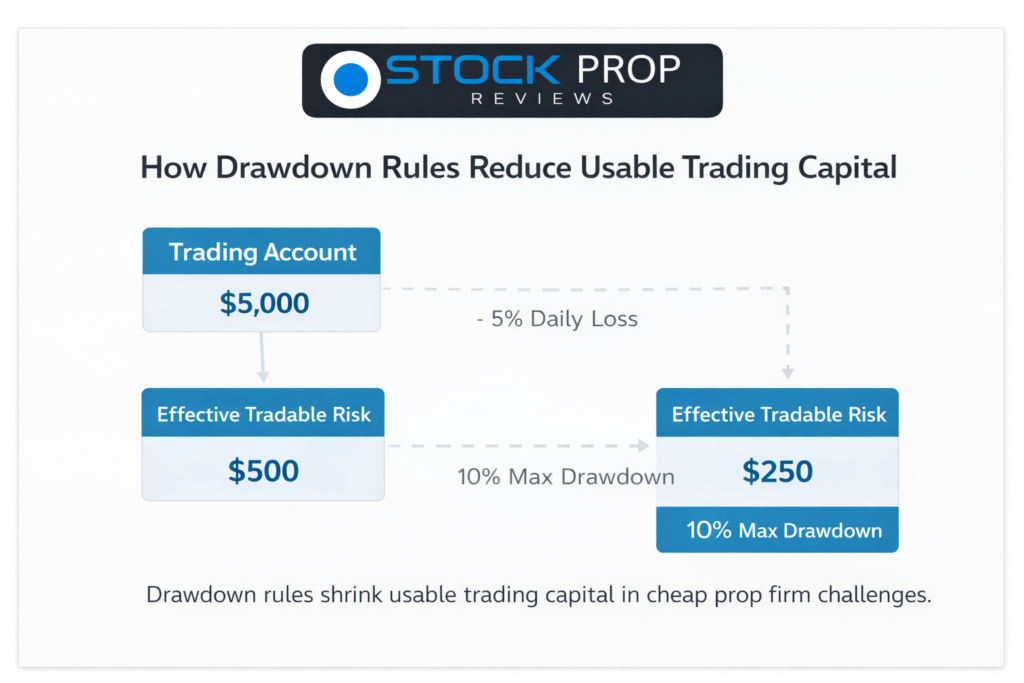
A cheap challenge doesn’t change the maths for drawdowns or profit targets.This means that your drawdown limit, not your account size, is what determines how much risk capital you can trade. Reddit traders say that max loss limits (daily and overall) often determine how much money you can actually use and ruin strategies that have a lot of variance.
Tighter daily loss rules, which aren’t reflected in prices, make it harder to meet profit targets than to fail challenges.
Traders with a lot of experience often say that if you don’t treat it as a risk control test and not a capital test, cheap entry plus tight risk rules leads to more failures.
Comparison Table: Fees and Core Rules
| Prop Firm | Typical Fee | Account Size | Profit Split | Daily Loss | Max Drawdown | Notes |
| The 5%ers | ~$39 | $5,000 | 80–100% | ~5% | ~10% | Simple, long-standing policy visible |
| E8 Funding | ~$37 | $5,000 | Variable | ~6–14% | Flexible | Customizable but check terms |
| FundingPips | ~$36–42 | $5,000 | Standard | 5% | 10% | Multiple models available |
| Maven Trading | ~$29–45 | $5,000 | ~80% | ~5% | ~10% | Allows news and holds |
| RebelsFunding | ~$25–50 | $5,000 | 80% | ~5% | ~10% | Tight rules catch traders |
| MyFundedFX | ~$50 | $5,000 | 80% | ~5% | ~8% | Starter friendly but strict |
| Ryze Funding | ~$5 | $500 | ~95% | ~5% | ~12% | Micro account but limited liquidity |
| Earn2Trade (futures) | ~$190/mo | Varies | Up to 100% | EOD rules | Structured | Focused on futures |
| Apex Trader Funding | ~$167/mo | Futures | ~90% | Intraday | Standard | Futures focus |
Prices change with seasonal deals, so make sure to check the company’s website for the most up-to-date prices.
What Competitors Don’t Explain Well
Risk Cost vs Fee Cost
Competitor lists show low fees, but they don’t explain how drawdown rules make it harder to trade with less money. For example, if you have a $5,000 account and a daily loss limit of 5%, your real tradable cushion for intraday swings might only be $250.
Consistency and Minimum Days Rules
Some companies want traders to meet certain minimum requirements or stay consistent beyond just making money and losing money. These rules are often hidden in small print, and traders fail challenges more often than they miss profit targets.
Common Trader Mistakes With Cheap Challenges
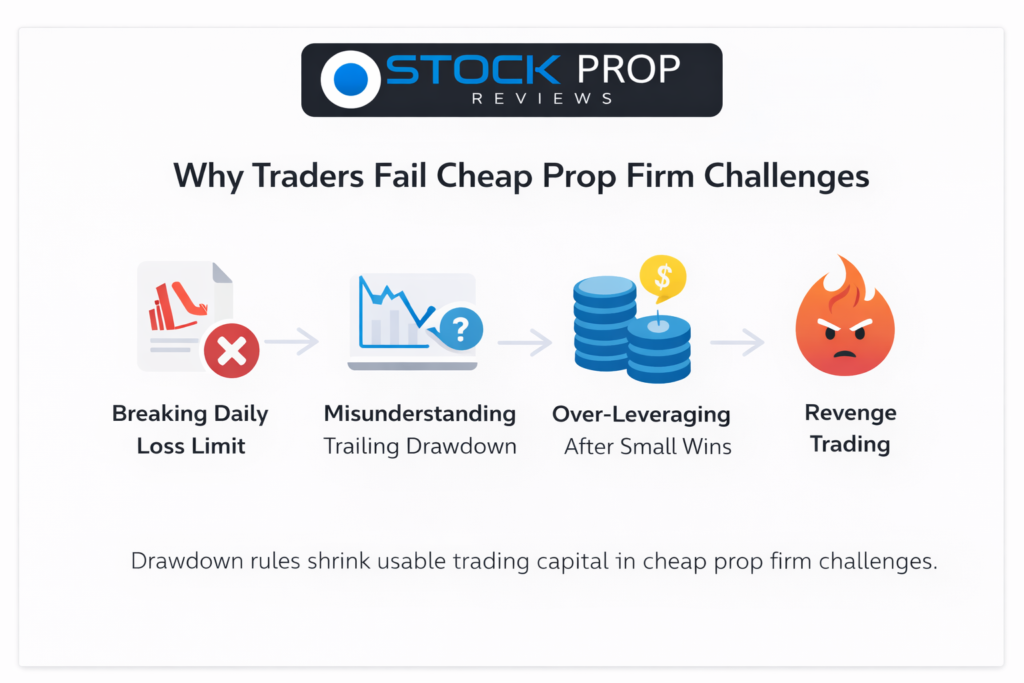
Cheap challenges punish
- : Moving up too quickly after small wins
- Not paying attention to daily loss limits
- Getting bigger after a small profit run
Community traders often mention the daily drawdown rule as the biggest invisible killer when compared to profit targets.
Blowing accounts repeatedly is often due to rule misinterpretation, not lack of edge.
Strategy Fit: Who Cheap Challenges Actually Work For
Suitable for
- Rule-based swing traders
- Algorithmic systems that respect fixed risk
- Discretionary traders with strict loss limits
Not suitable for
- Very high leverage scalpers
- Traders who trade news impulsively
- Anyone expecting “easy payouts”
Mid-Tier and More Established Comparisons
There is a trade-off, though, when fees are low. When you finally pass a challenge, it’s important to know that better-established companies like FTMO or The5%ers tend to have better payout records. Traders in the community often say that reputation and payout history are more important than saving a few dollars.
Comparing these with cheap ones adds context:
- A $100,000 challenge with FTMO costs around €540 (about $570+) and follows rules that most experienced traders know.
- The5ers has a high community tier rank because it has lower prices and a good history of paying out.
Where Cheap Challenges Fail Traders Most
Low prices make it easier to get in, but they don’t make it easier to evaluate. Most traders fail because
- They don’t break drawdowns by a small amount.
- They trade on a whim to reach their profit goals quickly.
- They don’t follow the rules for consistency that are hidden in documents.
This is in line with what prop traders say, which is that risk rules are more important than profit targets when it comes to failure.
TradeThePool Suggestion for Stocks
If the rules for futures or forex risk seem harsh, look into regulated stock prop firms that have clear risk logic instead of forex-only models. TradeThePool is one such example where rules and risk limits are clearly communicated to traders. Readers can get up to a 10% discount when purchasing through our TradeThePool link. This won’t fix bad risk control, but it helps you budget your evaluation cost transparently.
FAQs
Are the cheapest challenges harder to get through?
Yes. Lower fees usually come with tighter drawdowns, which make it harder to reach profit goals without breaking the rules.
Is it safe for beginners to do cheap challenges?
Only if they see them as tests of risk discipline and not quick ways to get money.
Is it worth it to pay more for companies like FTMO?
Yes, for many experienced traders, because reputation and the reliability of payouts are more important than saving $50. (Reddit)
Do low prices mean good value?
Not always. Price is important, but so are rule clarity, execution quality, and payout history.
Can traders who trade regularly always pass cheap challenges?
Even traders who are always on top of things can have problems if they don’t follow the rules, like daily loss limits.