Prop trading burnout is a state of mental and emotional exhaustion caused by prolonged trading stress, repeated losses, performance pressure and insufficient recovery. It can cause a reduction in concentration, impulsive decisions and traders to abandon previously successful strategies.
This guide is for new traders, prop firm challenge traders, funded traders and experienced traders who are struggling with the mental toll of trading. It is not a shortcut to profitability or a substitute for professional help when fatigue begins to interfere with daily life.
Burnout isn’t always caused by too many hours in front of charts. If every loss feels personal, every evaluation is financially important and every trading day brings pressure to perform, a trader can feel it after relatively short sessions.
The answer is more than a matter of discipline. Traders must identify the source of pressure, set realistic expectations and build a routine that allows them to recover between trading sessions.
What Is Prop Trading Burnout?
Prop trading burnout is a constant mental fatigue that is part of the deal of trading, often associated with a loss of motivation, emotional detachment, loss of focus, and loss of confidence in decision making.
The usual frustration from a losing trade will normally pass as the trader digests the result. Burnout is more permanent. It can affect multiple sessions, including when market conditions are favorable.
Several factors can contribute to burnout in prop trading:
- Evaluation pressure: Traders are under pressure to achieve profit targets without contravening rules related to drawdowns.
- Financial stress: Fees, resets, and other costs may pressure the trader to succeed quickly.
- Performance expectations: Traders can feel pressure to successfully justify their existence by making money
- Market uncertainty: It may seem uncertain to move ahead in the ever-changing condition of the market.
- Insufficient recovery: Watching the charts and dreading losses denies you mental relaxation..
Often these pressures work together. The trader loses an evaluation, buys another challenge straight away and goes back to the same routine without looking at what went wrong.
Burnout doesn’t mean you’re undisciplined or incapable of being a good trader. This implies their current workload or expectations or ways to cope may be stretched to breaking point.
Why Prop Trading Creates Psychological Pressure
Prop trading is the uncertainty of the market and the strict conditions of the account. The traders have to make decisions under uncertainty and follow some rules that can limit their drawdown, trading activity or eligibility for payout.
Profit targets encourage urgency
For example, say a trader has an evaluation account of $50,000 and a profit target of 10%. The firm’s rules state that the trader must make $5,000 in qualifying profit.
If there are a few slow sessions, the trader might feel there isn’t enough time to get to the target. They will start to take bigger positions or weaker set ups instead of waiting for something they know.
This adds extra risk. Larger positions magnify the effect of unfavorable price movements. Marginal trades raise exposure without necessarily enhancing the strategy’s expected outcomes.
Profit target is a condition of evaluation, not a justification for throwing away sound execution. If the target cannot be reached within the normal risk parameters of the trader then forcing trades may be more damaging than taking a slower result.
Drawdown rules amplify the impact of losses
It’s normal to lose a trade when trading, but when you lose a trade during a prop firm evaluation, you reduce your remaining drawdown allowance.
Say you are a trader who normally risks 0.5% on each trade. They get nervous hitting the loss limit on the account after 3 losses in a row. The next valid setup appears, but the trader hesitates, exits too early or takes a trade unrelated to the strategy to recover losses.
The problem is no longer just about the market. Fear of failure of execution begins to affect execution.
Drawdown rules can help foster good risk management, but an overemphasis on the remaining allowance can also lead traders to second-guess normal choices. The goal is to respect your limits, not let fear dictate every trade.
Repeated challenges create an emotional cycle
Some traders jump from evaluation to evaluation without understanding why the previous account failed. New challenges create new optimism, but the same problems of execution continue to arise. .
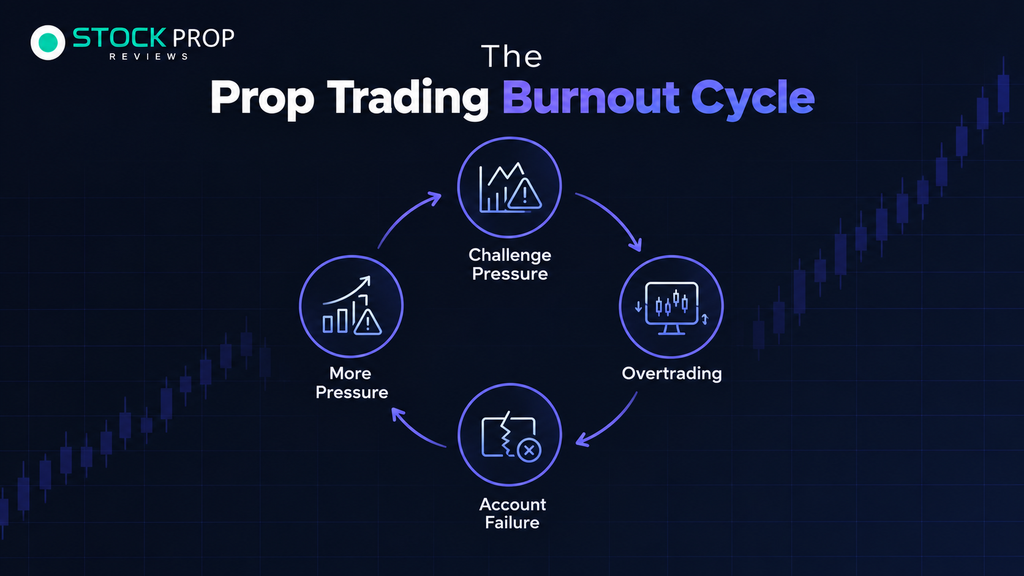
It is a cycle that often goes like this: buy another challenge, pressure to pass, take more risk, break the trading rules and fail again. The more you repeat, the more pressure you may feel financially and emotionally.
What is often missing is a proper review between attempts. A new account doesn’t automatically fix bad risk management, unrealistic expectations or revenge trading.
Trading follows some traders away from the screen
Burnout can occur even when the traders are not actively submitting orders. The mind can spend all day focused on the markets, constantly checking unrealized profit, replaying losing trades and comparing results with other traders.
The trader comes unhinged into his home, closes the platform, and will think until midnight of a missed entry around the next day’s open. Goodbye, sleep. Attention is reduced. The next session begins with a fading mental capacity.
This is especially relevant for scalpers and intraday traders whose strategies may already require intense concentration. More screen time does not necessarily mean better trading results. .
Warning Signs of Prop Trading Burnout
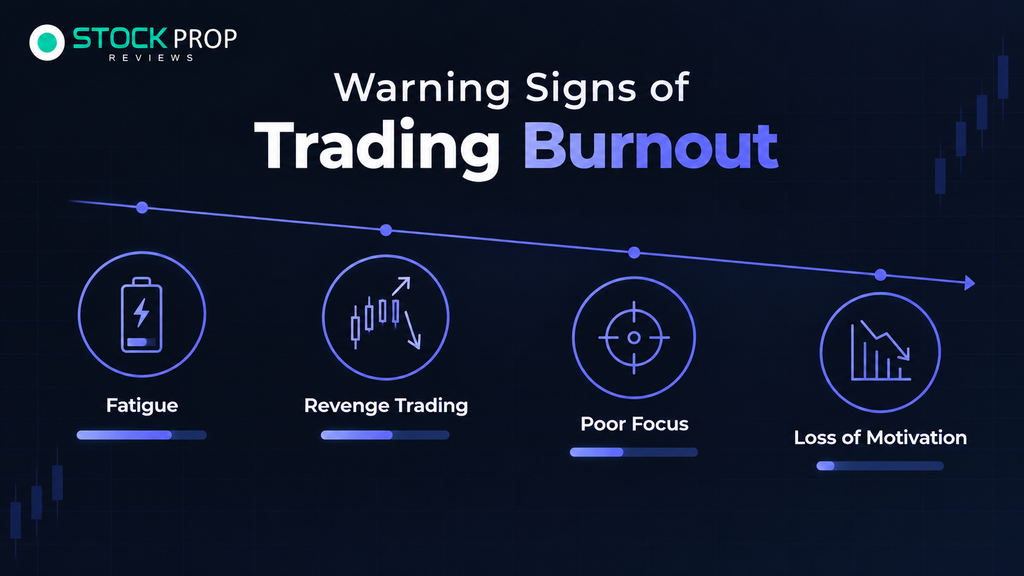
Burnout often develops gradually. Traders may dismiss early symptoms as temporary frustration or a lack of discipline.
The most useful warning signs are changes from normal behaviour that persist across multiple sessions.
| Warning sign | How it affects trading |
| Persistent fatigue | Difficulty concentrating on familiar setups |
| Revenge trading | Entering trades to recover losses |
| Compulsive chart checking | Monitoring markets outside planned sessions |
| Emotional volatility | Disproportionate anger or anxiety after small losses |
| Loss of motivation | Trading feels like an obligation |
| Decision paralysis | Hesitating on valid setups or constantly changing analysis |
| Neglecting personal life | Sleep, relationships, or daily responsibilities suffer |
These symptoms do not automatically prove burnout. Poor sleep, financial difficulties, unsuitable strategies, and other life pressures can produce similar experiences. Their persistence and combined effect matter more than any single symptom.
A losing streak is also not the same as being burned out. A disciplined trader can go through a string of trades without blowing up from a proven approach. A burned-out trader may break their rules after a couple of losses because their emotional capacity is already used up.
Similarly, while a trader may be exhausted and less motivated, they may still be profitable. Profit and loss can’t be used as a measure of a trading routine’s sustainability.
How Burnout Causes Prop Traders to Fail
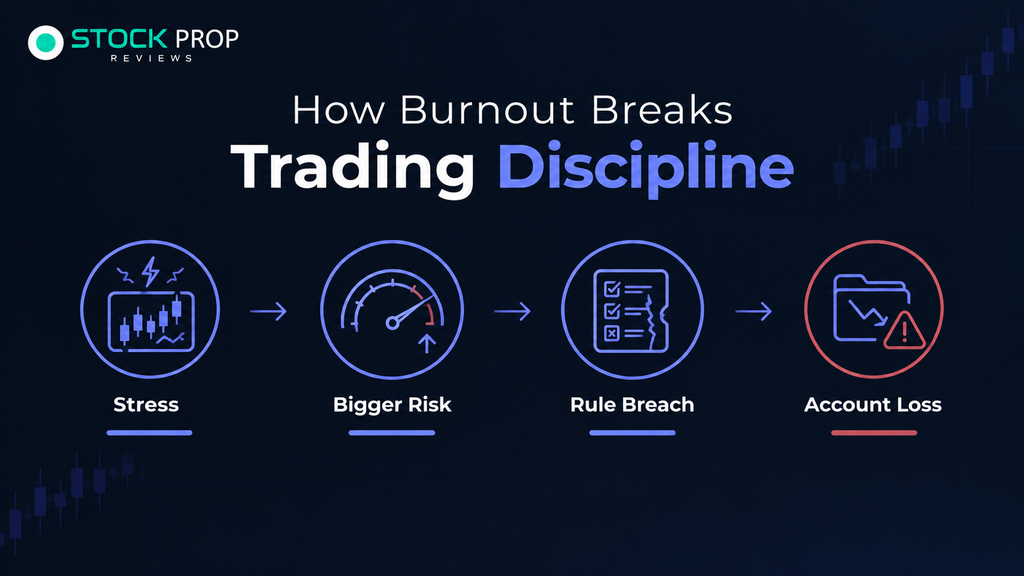
Burnout can turn manageable trading problems into account failures by weakening the decision-making process that normally controls risk.
Overtrading to recover losses
A trader who has spent weeks working towards a profit target may feel that stopping means wasting that effort. After a losing session, they take additional trades to recover the day’s losses.
These trades may not meet their normal entry criteria. Even if one produces a profit, the trader reinforces the habit of responding to emotional discomfort by taking more risk.
Trading becomes a way to relieve frustration rather than a process of executing a defined strategy.
Increasing risk near the drawdown limit
Say a trader has blown 3% of an account, with a 5% max loss limit. The remaining buffer may be manageable depending on the firm’s precise calculation and other applicable limits.
If the trader doubles the position size to recover faster, normal market fluctuations can also push the account closer to its limit much faster.
This increases the chance that the decision is exhaustion, where immediate relief takes precedence over long-term risk control. It also helps to set your own risk limits prior to a trading session to prevent emotional changes.
Abandoning a working strategy
After repeated disappointing sessions, traders may change indicators, entry criteria, timeframes, and position sizing simultaneously.
This makes it difficult to identify the actual problem. The strategy may be experiencing normal variance, market conditions may have changed, or execution quality may have deteriorated.
A structured review should separate three questions: Was the setup valid? Was the trade executed according to plan? Does the strategy’s broader sample of results still support its use?
Changing everything while mentally exhausted makes these questions harder to answer.
Spending more money on challenges
The evaluation purchase becomes a way to try to get back paid fees. The trader buys another challenge instead of looking into why an account failed, as passing seems the quickest way to justify the prior expense.
This forms a financial feedback loop. You put in more money . You expect more . Every trade decision you make is more emotional .
Challenge fees are to be viewed as money that can be lost, not an investment with a guaranty funded account. If another purchase will jeopardize essential spending then the responsible thing to do is stop.
How to Recover From Prop Trading Burnout
How much recovery will be will depend on what the problem is and how bad. A quick break can ease momentary fatigue but longer-term exhaustion may require major changes in trading, financial targets, or workload.
Pause trading when execution becomes unreliable
If you continually break your rules, revenge trade or are unable to focus, stop trading until you can assess the situation clearly.
You don’t have to wait for a hard account breach to take a break. A personal stop rule can stop your account from reaching the firm’s max loss limit.
The break is not an opportunity to trade actively for hours staring at charts or checking the account. If you get emotionally invested in market analysis, get out of that too.
A few days might be a good place to start, but readiness to return is a decision, not days away.
Review your trading process
When you’re feeling calmer, review a limited number of recent trades. Look for patterns of behavior, not trying to explain each loss individually.
Did you trade in the position sizes you intended to, did you trade at times you wouldn’t normally, did you change your strategy after a few losses? Ask yourself if you stuck to your entry criteria. Also think about if lack of sleep or personal stress affected your focus.
Split execution errors from rule-based trades. A losing trade may be a good trade if it is taken with a proven method. A lucky winner can justify bad habits .
If most of the losses were in fact valid setups executed properly, then look at the performance of the strategy rather than instantly assume burnout is the culprit.
Return with a controlled routine
As tempting as it may be to trade with full risk again, don’t do it. Create a routine where mistakes are more visible and cheaper.
You might want to reduce the length of your sessions, concentrate on your best trading time, trade fewer instruments or reduce position sizes where possible. If live trading still feels a little overwhelming, simulated practice can help.
Set out explicit standards for resuming normal activity. The intent is to show that the execution is consistent, not to recover missed profits or to show the break worked.
Establish boundaries and address financial pressure
Decide when your trading session will start and stop. Do not waste time checking your accounts and the markets outside of those hours.
Scalpers may prefer shorter, more focused sessions, while swing traders may benefit from scheduled chart reviews and rules for overnight risk. Create a routine for your strategy, not just any random block of time in front of a screen.
Defend sleep, exercise, meals, and time away from the markets. These habits won’t make you a profitable trader, but they will help you to stay focused and calm enough to make good decisions.
Direct attention also deserves financial pressure. If you can’t justify the fees and losses you incur in trades, suspend new purchases and reconsider your budget. Think about whether trading should be a limited sideline rather than a necessary source of income.
If tiredness, anxiety, low mood or sleep disturbance persist and affect everyday life, consult a qualified healthcare or mental
What Other Trading Burnout Guides Often Miss
Many trading psychology guides recommend breaks, exercise, and journaling. These habits can help, but they do not address every cause of prop trading burnout.
The trading model may be unsuitable.If a strategy is high risk to reach a profit target or has to be continually monitored, this can create pressure that rest won’t cure. Traders should ask themselves if their strategy and account rules are compatible with the time they can devote to trading.
Repeated challenge fees can intensify pressure. It can be difficult to accept the normal streaks of losing for past times of recoupment. This blow can be cushioned by having a set budget and the ability to stop purchasing assessments.
A break does not automatically fix the problem. Going somewhere else is not a panacea. But if that fatigue returns on that schedule with that risk, the trader can consider new workload, new strategy, new expectations, or new accounts.
See our FTMO review, FundingPips review, prop firm comparison, and funded trader lifestyle analysis for more information. These links help the readers relate to how the firm can pressure given its conditions and expectations.
Choosing a Prop Firm Without Adding Unnecessary Pressure
Selecting a firm won’t help you avoid burnout, but unclear conditions or weak account rules can add even more unwanted stress to an already challenging endeavor.
Ensure you know the daily loss limit, max drawdown calculation, payout and time limit rules, and even any pay-out rules or time limits that could affect your strategy before you buy an evaluation. Study the formal description of the account type you select.
Stock traders may also wish to research TradeThePool, a stock-focused prop trading firm. Before describing any firm as regulated, verify its current legal status and the precise scope of any applicable authorisation. A company’s published terms, simulated trading model, and regulatory status should not be treated as interchangeable.
Evaluate TradeThePool’s current rules, risk parameters, eligibility requirements, and payout conditions before purchasing an evaluation. Readers can get up to 10% discount when purchasing through our TradeThePool link. A discount does not remove evaluation risk or guarantee funding.
FAQs
Do successful traders suffer from prop trading burnout?
Indeed. Traders can profit even when they are tired, anxious, sleep-deprived, or unmotivated. Success in trading doesn’t always come down to short-term profitability.
How long to recover from prop-trading burnout?
There is no defined recovery period. You may feel fatigued and refreshed in spurts, or you may always be drained and therefore need to reduce your workload, risk, financial expectation, or professional help. Instead of a calendar, wait until you can consistently make decisions and follow rules best.
Should I quit trading after losing streak?
Not necessarily. Check to see if you traded according to your strategy and if the losses are within the expected performance of that strategy. If you’re chasing losses, breaking your own rules, or unable to focus, get out of the market and rethink your approach before risking more cash.
Would taking smaller positions help reduce burnout?
Reducing position size may help reduce the emotional impact of loss and your risk tolerance. However, it won’t address all sources of burnout (financial pressure, excessive screen time, unrealistic expectations, incorrect strategy).
Should I quit prop trading because I am burned out?
Not really. Perhaps just a break or more sustainable schedule. However, if you’re trading at the expense of your finances, sleep, relationships, or functioning in your daily life, even with reasonable changes, then it might be worth taking a longer break or rethinking trading.
Final Perspective
Prop trading burnout is more than lack of motivation alone. It can gnaw at concentration, risk management, emotional discipline, and consistency of strategy execution.
The practical answer is to acknowledge the pressures and control risk with less decision making, have limits on your trading, and measure your performance on disciplined execution and not on daily profit.
There is no account worth trading away your financial stability or wellbeing. Good entries are not enough for sustainable trading. It requires a routine you can live with, not fighting fatigue or fear or the urge to recoup lost capital.
Quick burnout self-testDetermine your medical needs