
Alpha Capital Group has a number of models to evaluate rather than a single universal challenge. The main question in this Alpha Capital Group review is not only whether the profit targets seem feasible. It is if the drawdown, daily loss, holding and payout rules fit the way you actually trade.
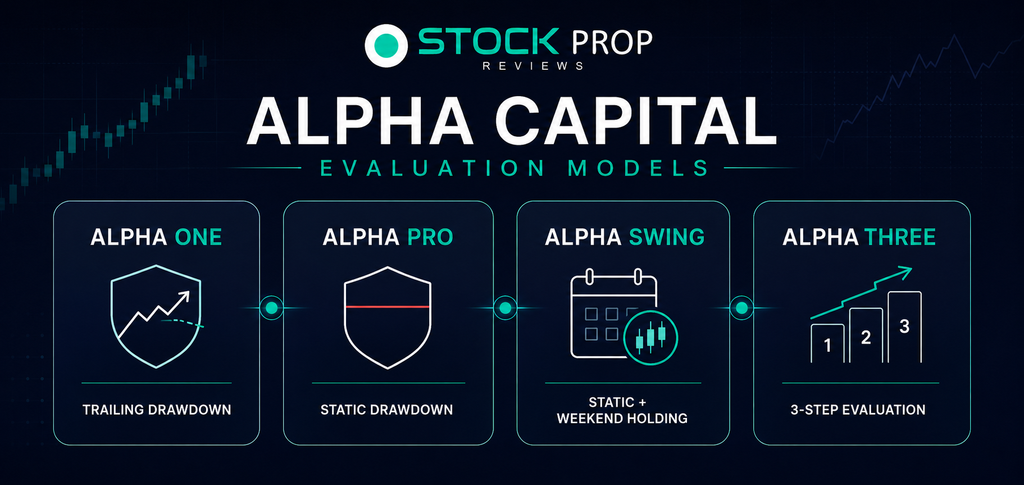
Currently, the lineup for evaluation is Alpha One, Alpha Pro, Alpha Swing and Alpha Three, but the most recent comparison published by Alpha Capital suggests that Alpha Three is no longer available for new purchases. Alpha Direct is an instant qualified, separate product.
This structure is ideal for traders who have a tested strategy and can manage position size. It is not for beginners still working out their strategies, traders who trade with revenge or anyone who needs big drawdown room to recover from losing streaks.
Quick verdict
Alpha Capital Group has a relatively detailed evaluation structure, and the biggest advantage is choice. Traders can select between one-step, two-step and swing-oriented models instead of forcing every strategy into the same risk framework.
The downside is that the choice can make the rules harder to compare. A trader who sees a 10% drawdown on one account may assume another 10% target or drawdown figure works the same way. It does not.
Alpha One uses trailing drawdown. Alpha Pro uses static drawdown. Alpha Swing also uses static drawdown but is designed around longer holding periods. The daily loss calculation also varies by program.
My main concern is therefore not that the evaluation rules are unusually complicated. It is that traders can buy the wrong model for their strategy.
Alpha Capital Group evaluation rules
Here is the current high-level structure based on Alpha Capital Group’s published rules.
| Program | Steps | Profit target | Max drawdown | Daily loss | Minimum trading days |
| Alpha One 6% | 1 | 6% | 4% trailing | 3% evaluation | 1 |
| Alpha One 10% | 1 | 10% | 6% trailing | 4% | 1 |
| Alpha One 12% | 1 | 12% | 8% trailing | 5% | 1 |
| Alpha Pro 6% | 2 | 6% / 6% | 6% static | 3% | 3 per phase |
| Alpha Pro 8% | 2 | 8% / 5% | 8% static | 4% | 3 per phase |
| Alpha Pro 10% | 2 | 10% / 5% | 10% static | 5% | 3 per phase |
| Alpha Swing | 2 | 10% / 5% | 10% static | 5% | 3 per phase |
| Alpha Three | 3 | 8% / 4% / 4% | 6% static | 4% | 3 per phase |
Alpha Capital says there is no maximum number of trading days during the assessment, although a 30-day inactivity rule applies.
The differences matter more than they initially appear.
A trader using Alpha One 10%, for example, is dealing with a 6% trailing drawdown. A trader using Alpha Pro 10% gets a 10% static maximum drawdown. Those accounts can have very different psychological and strategic characteristics despite both carrying a 10% first-phase profit target.
Trailing versus static drawdown
This is probably the most important part of the Alpha Capital evaluation system.
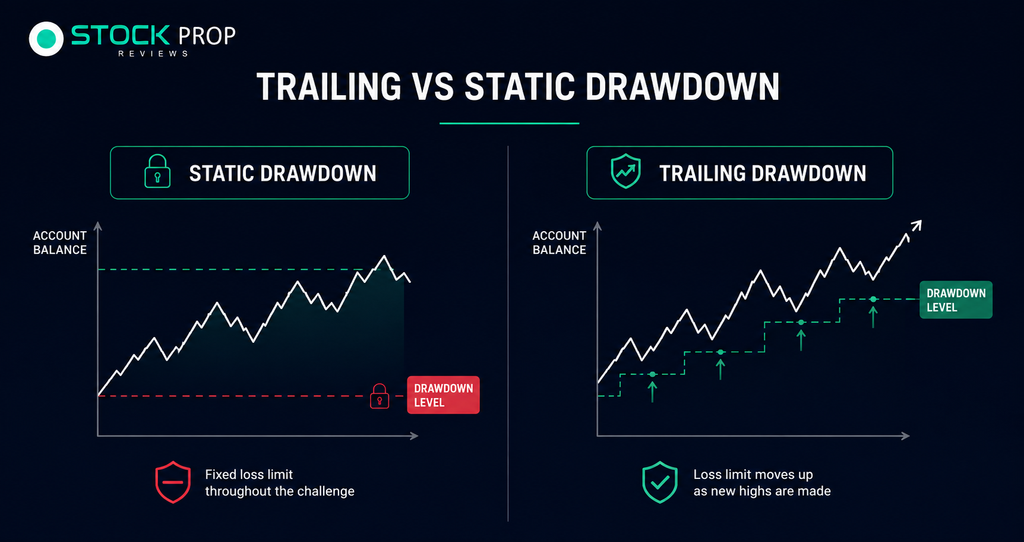
A static drawdown gives the trader a fixed loss floor. If the account starts at $100,000 with a 10% static drawdown, the maximum loss level is generally $90,000.
A trailing drawdown moves as the account reaches new highs. This means making money can actually reduce the amount of room available for a later losing trade.
Alpha Capital’s current Alpha One 10% example illustrates this clearly. A $100,000 account starts with a $94,000 floor. If the balance reaches $102,000, the floor moves to $96,000. Once the account reaches $106,000, the floor locks at the initial $100,000 level.
This creates an unusual situation.
Imagine a trader makes $6,000 fairly quickly. The account looks much healthier on the dashboard, but the trailing floor has now reached the starting balance. The trader cannot treat the $6,000 profit as a completely separate cushion.
That is why trailing drawdown is often harder for aggressive traders than the headline percentage suggests.
Our analysis of low drawdown prop firms explains the same issue across several firms: two accounts with the same headline drawdown can feel completely different depending on whether the limit is static or trailing.
Daily loss limits are where many traders actually fail
The overall drawdown gets most of the attention, but the daily loss limit is usually the more immediate threat.
Alpha Capital currently calculates the daily limit from the relevant starting balance and/or equity at the beginning of the trading day, with the daily candle beginning at 00:00 GMT+3. The exact calculation differs between plans.
Consider a trader on an Alpha Pro 10% account with a 5% daily loss limit.
If the trader normally risks 1% per trade, five full losses could theoretically consume the daily allowance. But the trader does not need five losing trades to create a problem.
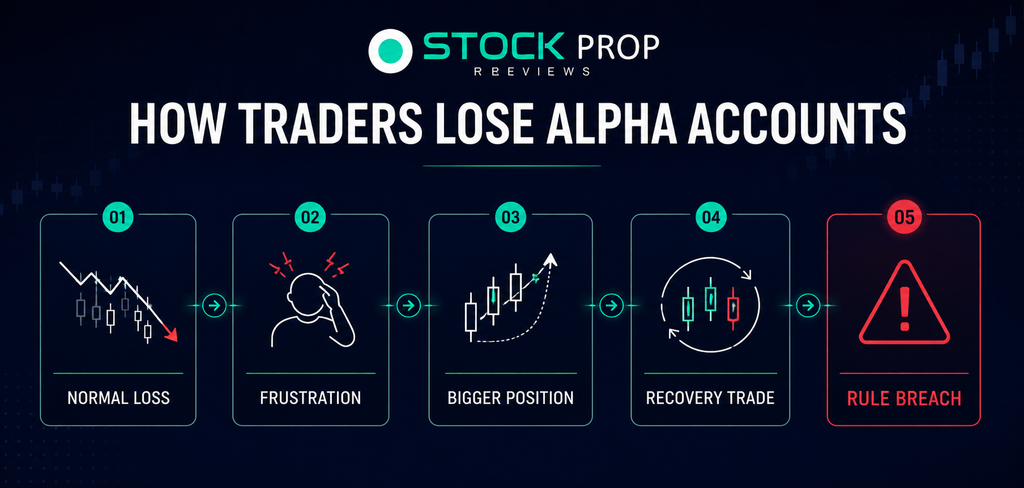
Three trades at -1%, followed by a larger position taken to recover the loss, can produce the same outcome much faster.
This is how evaluation accounts are often lost in practice:
Normal loss → frustration → larger position → another loss → daily limit breach.
The strategy itself may not be terrible. The risk escalation is the problem.
Alpha Pro: attractive risk structure with an important catch
Alpha Pro is probably the most interesting model for traders who prefer static drawdown.
The current versions offer 6%, 8% and 10% maximum drawdown levels. FX leverage can reach 1:100, with lower leverage for metals, indices and oil.
For a trader who dislikes trailing drawdown, this is a meaningful advantage.
But leverage should not be confused with usable risk capacity.
A 1:100 leverage setting does not mean a trader should increase position size fivefold. Leverage only changes how much exposure can be controlled relative to available margin. It does not increase the amount you can safely lose before violating the account rules.
Alpha Pro also has a rule distinction that swing traders need to understand. Weekend holding is allowed during the evaluation phases, but it is not allowed on the Qualified Account.
That creates a possible strategy mismatch.
A trader might pass using a multi-day setup, only to discover that the same holding style cannot be used after qualification.
Alpha Swing makes more sense for longer-term traders
Alpha Swing is more suitable for traders who actually hold positions for several days.
It has 10% static max drawdown, 5% daily loss limit on balance, 10% and 5% phase targets, 3 min trading days per phase. You can hold positions overnight during evaluation and Qualified Account stages.
The trade-off is leverage.
FX leverage is 1:30 rather than Alpha Pro’s 1:100. That is not necessarily a disadvantage. For a swing trader, lower leverage can actually discourage the kind of position sizing that creates unnecessary account volatility.
The important question is whether your strategy needs high leverage or simply needs enough exposure to express the trade.
News trading and holding restrictions
News trading is another area where traders should read the exact plan rather than assume all Alpha Capital accounts work the same way.
Alpha One and Alpha Pro have a five-minute restriction around relevant news releases. Alpha Swing has a different rule, where trades opened within two minutes before or after a release must remain open for more than two minutes.
This matters for scalpers.
A trader who normally enters immediately before a CPI, NFP or central-bank announcement could find that a strategy that works on a normal retail account does not translate cleanly to the evaluation.
The same applies to weekend holding. The product name matters less than the actual Qualified Account restrictions.
What competitors don’t explain well
Most Alpha Capital reviews concentrate on profit targets, account sizes and profit splits. Those figures are useful, but they do not answer the question that matters after you buy the challenge:
How much freedom does your strategy actually have?
There are at least four things traders should calculate before purchasing.
First, determine the maximum amount you normally lose during a bad trading day.
Second, compare that number with the account’s daily loss limit.
Third, calculate the expected drawdown during a normal losing streak.
Finally, check whether the strategy requires overnight, weekend or news exposure.
A trader with a 45% win rate and 1:2 risk-to-reward ratio may have a positive expectancy. That does not automatically make the strategy suitable for Alpha Capital.
If five losses can occur naturally in a sample of trades, risking 1% per trade may still be too aggressive for a 4% daily or 6% trailing environment.
This is why our truth about prop firm consistency rules is relevant here. The rules do not merely determine whether a trader is technically compliant. They can change the way the trader should manage risk.
How traders actually fail Alpha Capital evaluations
The most common failure pattern is not a mysterious rule violation. It is usually an ordinary losing period combined with excessive risk.
1. Trying to hit the target quickly
A trader makes 2% in the first few days and decides that the remaining target should be easy.
Position size increases.
The next trade loses.
Instead of returning to normal risk, the trader attempts to recover the loss immediately.
This is where an evaluation can deteriorate very quickly.
2. Treating the drawdown as a trading budget
A 10% maximum drawdown does not mean you should plan to lose 10%.
A trader who risks 2% per trade effectively gives themselves very little room for a normal losing sequence.
In professional risk management the starting point is usually the expected variance of the strategy, not the maximum allowable loss of the firm.
3. Ignoring floating losses
Equity may be part of the daily loss calculations depending on the plan.
A trader may look at the balance and believe they are safe while open positions are creating a much larger floating loss.
This becomes particularly dangerous during volatile news sessions.
4. Increasing size after winning
This mistake is less obvious.
Some traders think losing streaks causes account failures. In reality, a large position after a winning streak can be just as damaging.
A trader makes 5% and then decides to risk 2% on the next setup because there is now “room.”
One bad trade can erase a large part of the progress.
5. Choosing the wrong Alpha model
This may be the biggest avoidable mistake.
A trader who needs weekend positions should not automatically choose Alpha Pro simply because the static drawdown and leverage look attractive.
A trader who wants a one-step evaluation should understand that Alpha One uses trailing drawdown.
The best account is therefore not necessarily the one with the highest drawdown or leverage. It is the one whose restrictions interfere least with your existing strategy.
Who should avoid Alpha Capital Group?
Alpha Capital is probably a poor fit if you regularly:
- Increase risk after losses
- Use martingale or recovery systems
- Depend on unrestricted news scalping
- Need weekend holding on an Alpha Pro Qualified Account
- Change strategies every few weeks
- Trade positions large enough to approach the daily loss limit regularly
Beginners should also be careful.
The fact that an evaluation has a clear rulebook does not make it a suitable learning environment. If you are still discovering whether your strategy works, paying repeatedly for evaluations can become an expensive way to collect trading experience.
Our FTMO review makes a similar point about beginners: strict evaluation rules tend to expose weaknesses that already exist in a trader’s risk management.
Alpha Capital versus alternatives
The better alternative depends on what you trade.
| Firm/model | Main market | Drawdown approach | Best fit |
| Alpha One | Forex/CFDs | Trailing | Traders wanting one-step evaluation |
| Alpha Pro | Forex/CFDs | Static | Traders wanting higher FX leverage |
| Alpha Swing | Forex/CFDs | Static | Multi-day and weekend traders |
| FTMO | Forex/indices/commodities and other markets | Model dependent | Structured traders prioritizing established infrastructure |
| The5ers | Forex | Program dependent | Traders focused on longer-term scaling |
| TradeThePool | Stocks | Stock-focused risk model | Equity traders |
Our The5ers scaling analysis is worth reading if your priority is gradual account growth rather than simply passing an evaluation.
For futures traders, neither Alpha Capital’s CFD-oriented evaluation structure nor a stock-focused model is necessarily the right comparison. Futures-specific firms should be evaluated using futures drawdown, contract limits and session rules instead.
A note on TradeThePool
Stock traders looking for a different model may also want to research TradeThePool because it focuses on equities rather than forex and CFD evaluation accounts.
However, one correction is important. TradeThePool’s own published material does not support describing it as a regulated stock prop firm. Its current disclosures describe the online proprietary trading industry as unregulated and distinguish the company from regulated financial institutions.
The more defensible reason to consider it is its stock-focused environment and published risk framework, not regulatory status.
Readers can get up to 10% discount when purchasing through our TradeThePool link.
The real question is strategy fit
Alpha Capital Group is not automatically good or bad because one model offers a 10% target or another offers 10% drawdown.
The evaluation system becomes much easier to judge when you reverse the process.
Start with your trading strategy.
How many trades do you take?
How much do you normally risk?
How large is your worst historical losing streak?
Do you hold overnight?
Do you trade during major news?
Do you need weekend exposure?
Once you have those answers, compare them with the account’s actual restrictions.
That approach is more useful than choosing the challenge with the largest advertised account.
A trader who normally risks 0.25% to 0.5% per trade and takes a small number of high-quality setups may find Alpha Capital’s rules manageable. A trader who relies on rapid recovery trades, large leverage or news volatility may find the same rules extremely restrictive.
That difference is why passing the evaluation and making sustainable withdrawals are two separate problems.
Final trader perspective
Alpha Capital Group’s evaluation system has genuine flexibility because traders can choose between different drawdown structures and trading styles. Alpha One offers a one-step route, Alpha Pro provides static drawdown and higher FX leverage, while Alpha Swing is better aligned with longer holding periods.
The main risk is choosing a model based on its headline numbers rather than its restrictions.
For most traders, the practical rule is simple: do not risk close to the firm’s maximum just because the firm allows it.
Treat the drawdown as a survival boundary, not as a trading budget.
If your normal strategy can operate comfortably inside the daily loss limit, maximum drawdown and holding restrictions, Alpha Capital can be a reasonable evaluation structure to consider. If your strategy repeatedly needs the full risk allowance, the problem is likely the account fit rather than the entry setup.
For traders that focus on stocks, another model might make more sense. TradeThePool is worth checking out for its equity focus and published risk framework, but traders should independently assess its current terms rather than rely on claims about regulation.
FAQs
Is Alpha Capital Group good for beginners?
It can be difficult for beginners because the different evaluation models have materially different drawdown and holding rules. New traders should first prove that they can follow fixed risk limits consistently before paying for evaluations.
Which Alpha Capital account has the easiest drawdown?
There is no universally easiest option. Alpha Swing and Alpha Pro use static drawdown, which many traders find easier to manage than trailing drawdown. Alpha One uses trailing drawdown, so profits can cause the loss floor to move upward.
Does Alpha Capital allow weekend holding?
It depends on the program. Alpha One allows weekend holding on the Qualified Account, Alpha Swing allows it throughout the stages, while Alpha Pro does not allow weekend holding on the Qualified Account.
How many trading days are required?
Alpha One requires one minimum trading day during evaluation. Alpha Pro, Alpha Swing and Alpha Three require three trading days per phase. There is no maximum number of trading days, although Alpha Capital has a 30-day inactivity rule.
What is the biggest risk with Alpha Capital’s evaluation system?
The biggest risk is usually not the headline profit target. It is combining the daily loss limit and maximum drawdown with oversized positions. Traders who increase risk after losses can breach the account before their underlying strategy has enough trades to play out.