Getting funded changes the pressure, but it shouldn’t automatically change your strategy. A funded trader strategy should usually react more slowly after funding than most traders expect. The emphasis is on protecting the account, determining whether market conditions have truly changed, and adjusting based on evidence, not on the euphoria or despair that comes with a funded account.
This article is for traders who have just been funded or are about to make that transition. Not for traders who want a new strategy every time they have a losing week. If you don’t test your system properly, adaptation can quickly turn into another word for random experimentation.
What is a funded trader strategy?
A funded trader strategy is the repeatable way a trader finds setups, manages risk, enters trades, manages trades, and exits following the rules of a firm.
When the strategy is funded it has two functions.
The first is simply to establish positive expectancy.
The second is to operate within the risk architecture of the account.
That makes a difference. A strategy can be profitable in a personal account but it may not be suitable for a funded account because the firm’s drawdown, daily loss, position size, news, overnight or consistency rules change the way the strategy behaves.
This is a similar point made by Earn2Trade in their recent work on adaptive funded traders. Market conditions can switch from directional to range bound, liquidity can change and a previously effective setup can lose its edge. The secret is to adapt without turning the funded account into a testing account.
Why traders change their strategy after funding
The strange part is that many traders do not need a new strategy after passing.
They need to trade the same strategy with better discipline.
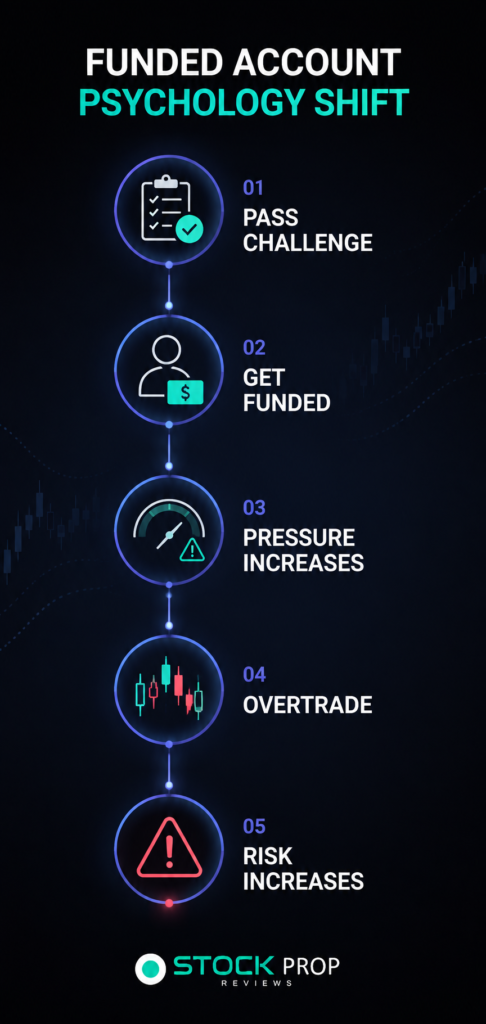
Passing an evaluation creates a psychological transition. During the challenge, the objective is relatively simple: follow the rules and reach the required target. Once funded, the trader starts thinking about withdrawals, monthly income, account longevity and what happens if the account is lost.
That changes behaviour.
A trader who normally risks 0.5% may start risking 1% because the account now feels like an opportunity that must be maximised. Another trader may take more setups because they believe they need to generate regular income. A third may stop taking valid trades because every losing position suddenly feels more important.
This is why strategy adaptation should begin with behaviour, not technical indicators.
Our article on Why You Trade Worse After Passing a Challenge covers this transition in more detail.
The first rule: do not change what already works
The safest starting point after funding is boring.
Trade the process that got you funded.
If you passed using one setup, one position size and one trading window, there is little reason to immediately introduce three new setups and double your trade frequency.
This is where many funded traders make their first mistake. They interpret funding as permission to become more aggressive.
It is not.
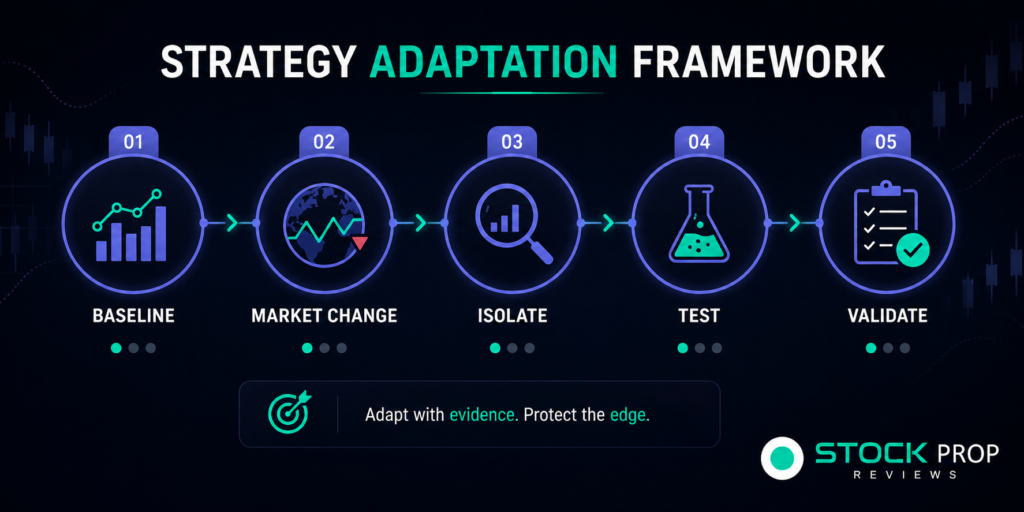
A better approach is to establish a baseline. Record your normal win rate, average winner, average loser, maximum consecutive losses, average holding time and typical drawdown. Then compare future performance against that baseline.
If performance deteriorates, you have something measurable to investigate.
Without a baseline, every losing trade feels like evidence that the strategy needs changing.
When should a funded trader adapt?
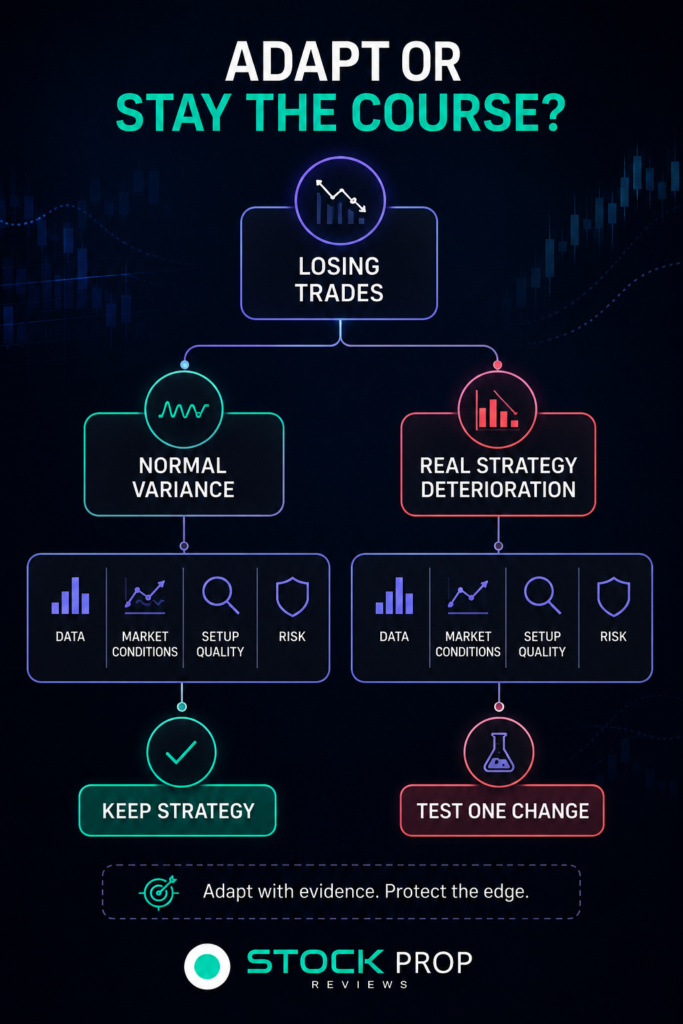
Not every losing streak means the market has changed.
A five-trade losing streak can happen inside a perfectly valid system. Even a strategy with a 50% win rate can experience uncomfortable sequences of losses.
Adaptation becomes more reasonable when several pieces of evidence appear together.
For example, suppose a breakout trader normally sees strong continuation after a defined consolidation. Over 100 trades, the setup has historically produced a positive expectancy.
Then the market changes.
Breakouts begin failing quickly. Volume no longer expands after the trigger. Price repeatedly returns inside the range. The same pattern appears across several sessions.
That is different from simply losing three trades.
The trader may have evidence that market structure has changed.
The mistake would be responding by immediately replacing the entire strategy.
Instead, isolate the problem.
Is the entry failing?
Is the confirmation too weak?
Is the time of day different?
Has volatility compressed?
Are stops being placed at levels that worked in the previous environment?
This component-by-component approach is one of the more useful ideas in Earn2Trade’s guidance on adapting a strategy inside a funded program.
Strategy adaptation should be smaller than strategy replacement
Imagine a scalper who normally trades momentum during the first hour of the New York session.
For several weeks, the market becomes slower. Breakouts still happen, but they need more time to develop. The trader begins getting stopped out before the move eventually occurs.
There are several possible responses.
The worst is increasing position size.
The second worst is taking more trades.
A more sensible response could be testing a slightly wider structural stop with smaller position size, waiting for stronger confirmation, or reducing the number of trades until volatility returns.
The important principle is that the risk should not increase simply because the strategy is underperforming.
If the stop becomes wider, position size should generally decrease so that the dollar risk remains controlled.
This is where adaptation becomes a risk-management exercise rather than a search for a perfect entry.
A practical framework for adapting a funded account
| Stage | What to examine | Safer response |
| Performance changes | Win rate, expectancy, drawdown | Collect more data |
| Market changes | Volatility, liquidity, trend or range | Adjust expectations |
| Setup deterioration | Entries failing more often | Isolate the weak component |
| Risk pressure | Larger losses or emotional trading | Reduce size |
| Strategy adjustment | New filter or timing rule | Test one change at a time |
| Validation | Results after adjustment | Compare against baseline |
This process prevents a common psychological mistake: changing five variables at once and then having no idea which change helped or hurt.
The psychology of adapting after getting funded
The hardest part is often not market analysis.
It is accepting that a funded account should feel smaller psychologically than it looks financially.
A trader may receive a $100,000 account and immediately think about the amount of capital available. But the usable risk budget may be a small fraction of that figure.
That difference matters.
Thinking about the headline account size encourages aggressive behaviour. Thinking about the actual loss limit encourages risk management.
A funded trader should therefore measure success by process metrics rather than the account’s advertised size.
For example:
- Did I meet my entry criteria?”
- Did I take a risk on my plan?
- Did I stop according to my session rule?
- Did I stay away from revenge trades?
- Did I only trade the market conditions my system is built for?
These questions are more useful than asking whether today’s P&L was large enough.
Our The Psychology Trap of Funded Accounts makes the same broader point: funding does not automatically create discipline. It often exposes whether the trader already has it.
What competitors often miss about adaptation
Many articles correctly say that traders should adapt to changing market conditions.
The missing part is the cost of adapting.
Every strategy change introduces uncertainty.
Suppose a trader normally takes 100 trades using a tested setup. They suddenly add a new indicator, change their stop placement and start trading a different session.
Now the trader no longer knows whether the original edge is still present.
This can create a dangerous cycle:
Losses → strategy change → unfamiliar results → uncertainty → more changes
Eventually, the trader is no longer trading a system. They are reacting to recent outcomes.
That is not an adaptation. It is strategy drift.
A good adaptation should have a specific reason, a defined test period and a clear risk limit.
How a funded trader should test a new idea
If you can, try not to use the full funded account as a laboratory.
Start with historical data, replay, simulation or a low-risk environment where the rules of the firm allow.
Then define what would be evidence.
For example:
“I think this setup works better when the opening range breaks with above average volume.
That’s falsifiable.
Compare the original setup with the modified setup.
If the new filter gives better results consistently on a reasonable sample it warrants further consideration.
If it generates two good trades and ten missed opportunities, that’s not enough evidence.
This is obvious but traders often do the opposite. They do a little change, get one big winner, and immediately they think they have found an improvement.
One trade is one thing.
That is no proof.
Do not confuse market adaptation with emotional adaptation
There are two different things happening after funding.
The market may change.
Your psychology may also change.
These should not be treated as the same problem.
If your strategy produces normal results but you suddenly feel uncomfortable taking trades, the market may not be the issue.
If you begin skipping setups because you are afraid of losing your funded account, changing your indicators will not solve the problem.
Likewise, if your strategy genuinely stops performing while your execution remains disciplined, telling yourself to “trust the system” will not restore its edge.
The trader has to identify which problem actually exists.
This distinction is especially important because funded programs create financial and psychological constraints that do not exist in exactly the same form in a personal account.
What to do after a losing week
Losing week ? Time to review . Not necessarily change strategy .
First, separate losses from execution from losses from strategy.
An execution loss might involve:
- entering late
- moving a stop
- taking an unplanned trade
- using excessive size
- trading outside the normal session
A strategy loss follows the rules but simply does not work.
These are completely different problems.
If most losses came from execution errors, changing the strategy may actually make things worse.
If trades followed the plan and the setup itself has deteriorated across a meaningful sample, then adaptation deserves consideration.
This is one reason our Why Profitable Traders Still Fail Prop Firms is useful alongside strategy analysis. A profitable strategy can still fail when risk, timing and account rules interact badly.
Strategy fit matters when choosing a prop firm
It’s not just a matter of changing your strategy to fit the market.
Sometimes the better option is to choose an account structure aligned with the strategy you’re already trading.
A swing trader with wide stops might do poorly in one drawdown model but do fine in another. A stock momentum trader might need different limits than a high-frequency futures trader. A news trader might be subject to restrictions that are inconsistent with his or her style of trading and make the firm’s rules incompatible with his or her style of trading.
Our Best Prop Firms in 2026 comparison shows why profit split alone is a poor way to compare firms. Drawdown structure, markets and trading restrictions can materially change strategy fit.
The same principle applies to individual firm reviews. Our FTMO Review and TradeThe Pool Review are useful examples of why the rules around an account can matter as much as the headline funding amount.
Where TradeThePool fits
If you are a trader who enjoys trading equities, then TradeThePool is worth considering. Their model is focused on stock trading and their program documentation details risk and scaling rules. The present terms also state that trading activity on the platform is executed in simulated environments and not in real-time, so traders should not confuse the account’s buying power with personal capital .
One important correction is necessary for accuracy. TradeThePool’s own website says that the online prop trading arena is not yet regulated and states that the company is not a financial institution or entity under the purview of financial regulatory authorities. For that reason, I would not describe TradeThePool as a regulated stock prop firm.
What can reasonably be said is that it publishes its rules, risk framework and compliance policies, which gives traders more information to assess before making a decision.
Readers can get up to 10% discount when purchasing through our TradeThePool link. The discount should be treated as a cost reduction, not a reason to choose the firm.
Common funded trader strategy mistakes
The most common mistake is to change too much too fast.
A trader passes with a low frequency strategy and then starts scalping because the funded account looks more like an opportunity.
Another increases position size after the first payout.
Another sees two losing trades and adds a new indicator.
Another changes markets because the original market has become quiet.
None of these actions are automatically wrong. The problem is that they are often driven by emotion rather than evidence.
The better question is always:
What specific evidence tells me my current process needs to change?
If you cannot answer that clearly, staying with the existing process is often the more professional decision.
The funded trader strategy should evolve carefully
Getting funded is not the point where you finally need a perfect strategy.
It is the point where protecting a working process becomes more important.
Markets change. Volatility changes. Liquidity changes. Strategies go through periods of strength and weakness. Adaptation is therefore necessary for traders who want to stay active over the long term.
But adaptation does not mean chasing every market move.
The strongest approach is usually gradual. Establish a baseline, identify what has actually changed, isolate the weak part of the strategy, test one adjustment and keep risk controlled while gathering evidence.
Most importantly, do not let the excitement of getting funded convince you that the strategy that passed the evaluation is suddenly inadequate.
Sometimes the market changes.
Sometimes your psychology changes.
And sometimes nothing changed at all. You simply had a normal losing sequence.
Knowing which one you are dealing with is the real skill.
FAQs
Should I change my strategy after getting funded?
Usually not immediately. Start by trading the process that helped you pass. Only make meaningful changes when performance data or market conditions provide a clear reason.
How much should I risk after getting funded?
There is no universal percentage because firms use different risk structures. A sensible approach is to risk substantially less than the maximum the account allows, especially while adapting to a new funded environment.
How do I know if my trading strategy has stopped working?
Look for decay over a meaningful sample not a couple of losses. Compare current expectancy, win rate, drawdown and setup quality to your historical baseline .
Is changing position size a form of strategy adaptation?
Yes, but it should usually be treated as risk adaptation rather than an improvement to the strategy itself. If you increase size because you are losing, you are increasing financial pressure rather than fixing the underlying problem.
What is the biggest mistake after getting funded?
For many traders, it is abandoning the disciplined process that got them funded. Larger positions, more trades and unnecessary strategy changes can turn a normal drawdown into an account-ending problem.