Low volatility trading can help some prop firm traders pass challenges faster as smaller price swings make it easier to manage position sizing, stop placement and drawdown control. But low volatility doesn’t necessarily mean easier trading. When markets get too quiet, setups can disappear, breakouts can fail and traders often trade that aren’t really there.
This book is for beginners, funded traders and day traders who are able to adapt their strategies to smaller ranges of price. This is not for traders who require big momentum moves, news spikes or aggressive scalping to hit their profit targets quickly.
And this is where the main difference lies: although low volatility may make risk easier to deal with, it may also make it harder to achieve profit targets. Most articles on low volatility trading don’t discuss this trade-off.
What is low volatility trading?
Low volatility trading means adapting a strategy to a market where price is moving within relatively small ranges and large directional moves are less frequent.
Volatility measures how much an asset’s price moves over a given period. Traders commonly use measures such as Average True Range, historical volatility, or implied volatility to assess whether current price movement is relatively high or low.
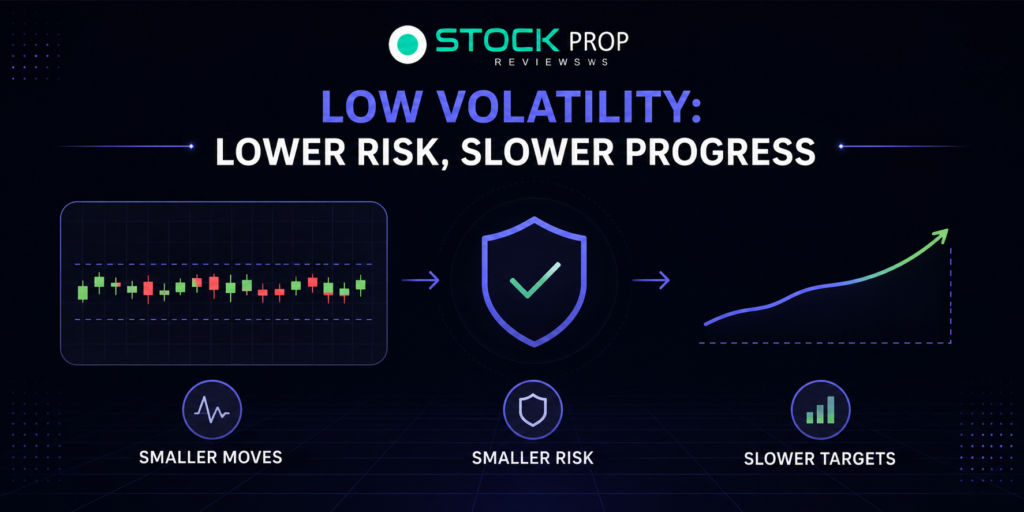
For a prop challenge, the difference matters because the trader is usually operating under a fixed loss limit. A strategy that produces smaller but more controlled losses can have an advantage over one that regularly exposes the account to large swings.
But there is an important caveat. A low volatility market does not equate to lower trading risk. Sharp moves can still happen with thin liquidity, wider spreads around market transitions and unexpected news. FTMO points out that less liquidity can lead to both less action and sudden volatility, especially around rollovers and major events.
Why low volatility can help pass a prop challenge
The main advantage is not that low volatility creates more winning trades. It is that it can make risk easier to control when the strategy is properly matched to the conditions.
Imagine a trader with a $100,000 evaluation account and a maximum permitted drawdown of $10,000.
Trader A trades a highly volatile index. One normal stop may cost $1,500 because the instrument needs a wide stop to avoid being taken out by ordinary fluctuations.
Trader B trades a slower major currency pair and risks $500 per trade.
After five consecutive losses, Trader A has lost $7,500. Trader B has lost $2,500.
Neither trader necessarily has a better strategy. The difference is how much volatility their strategy has to absorb.
That is particularly important in challenge environments. A trader does not need to be spectacular. The trader needs to make progress without allowing normal losing periods to become rule violations.
FTMO, for example, describes its Maximum Daily Loss and Maximum Loss as core risk limits, showing why position sizing matters as much as entry quality in an evaluation.
Low volatility versus high volatility for challenge traders
| Factor | Low volatility | High volatility |
| Typical price range | Smaller | Larger |
| Stop distance | Often smaller | Often wider |
| Position sizing | Easier to control | Requires more adjustment |
| Number of setups | Can decrease | Often increases |
| False breakouts | Common | Can be less frequent during strong trends |
| Drawdown pressure | Potentially lower per trade | Potentially higher |
| Profit target speed | Usually slower | Potentially faster |
| Overtrading risk | High from boredom | High from too many opportunities |
| Best suited to | Patient, selective traders | Momentum and experienced intraday traders |
This table shows why the statement “low volatility passes challenges faster” needs some qualification.
It can reduce the speed at which an account loses money. It does not necessarily increase the speed at which an account makes money.
That distinction is critical.
The real prop challenge advantage
A challenge is not simply a competition to make the highest return.
It is a constrained trading environment where the trader has to balance profit objectives against drawdown limits.
That changes how volatility should be evaluated.
Suppose a strategy normally produces:
- 1% average risk per trade
- 2% average winning trade
- 1% average losing trade
- occasional 3% to 4% adverse movement
That strategy may work perfectly well in a personal account.
Inside a challenge, however, the occasional large adverse movement can become the problem. If several trades overlap or the market moves rapidly, the trader may reach the daily or overall drawdown threshold before the strategy has time to recover.
A lower-volatility version of the same strategy might produce smaller targets and smaller losses.
That can make the equity curve easier to manage.
This is one reason professional risk guidance frequently focuses on limiting the amount risked per trade rather than simply searching for the highest-return setup. FTMO, for example, has stated that it generally recommends no more than 1% risk per trade idea for its traders.
The lesson is broader than any one firm: challenge survival depends heavily on how much each normal losing trade costs.
Why low volatility does not always mean easier trading
This is where the popular narrative becomes misleading.
Low volatility can remove the very price movement a trader needs to make money.
StoneX recently highlighted that subdued markets can weaken directional signals, reduce momentum, and create an opportunity cost when capital remains tied up in stagnant positions.
Consider a breakout trader.
The trader identifies resistance at 100 and enters when price breaks above it.
In a high-volatility environment, price might move from 100 to 103 quickly.
In a low-volatility environment, price might move from 100 to 100.30, return to 99.90, break 100 again, and repeat the process.
The trader can experience several small losses without the market ever producing the directional move needed for the strategy to work.
That creates a different type of challenge.
The account is not being destroyed by one massive trade. It is being slowly damaged by repeated marginal trades.
How traders actually fail in low volatility markets
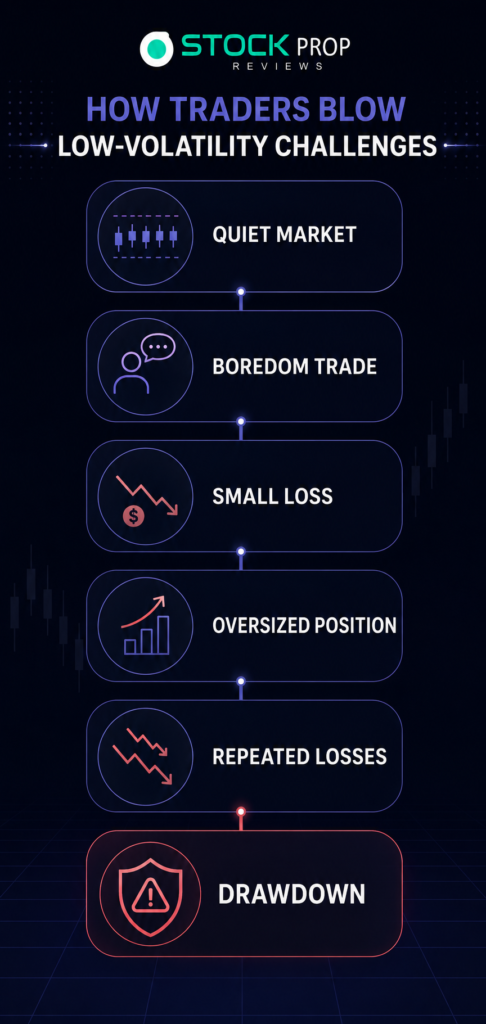
The most common failure is not usually poor market analysis. It is forcing activity when there is no meaningful opportunity.
The boredom trade
A trader watches the market for three hours.
Nothing happens.
Eventually, a small candle breaks a minor intraday level.
The trader enters because there has been no trade for several hours.
The breakout fails.
The trader loses 0.3%.
The next setup looks similar, so another trade is taken.
Another loss follows.
After six trades, the account may be down 1.5% even though the market never offered a genuine directional opportunity.
This is particularly dangerous in a challenge because the trader can start thinking about the profit target rather than the quality of the setup.
The oversized position
Low volatility can also create another mental trap.
Sometimes traders will increase the size of their position to make the trade “worth taking” because the market is moving slowly.
That defeats the point of trading in a low vol environment.
If the trader is used to risking $500 and then doubling up on the position because the expected move seems small, a sudden volatility expansion can turn a routine setup into a major loss.
The market was not dangerous because volatility was low. The trader was caught because position sizing was based on the expected reward, not the risk budget of the account.
The forced breakout
Low-volatility markets often develop narrow ranges.
That makes breakout levels visually attractive.
But a narrow range can produce repeated false breaks.
A trader who buys every move above resistance can accumulate several small losses before one genuine breakout occurs.
FTMO similarly warns that traders need to adapt to market conditions and that lower liquidity periods can produce unusual price behaviour and false breaks.
The better approach: trade less, not bigger
The practical response to low volatility is usually not to increase leverage.
It is to become more selective.
A trader can use a simple process:
Identify the range → wait for price to reach a meaningful level → confirm the setup → size the position according to the stop → accept smaller targets when conditions demand it.
The final step is often ignored.
If the market’s average daily movement has contracted, expecting the same profit target used during a high-volatility period may be unrealistic.
StoneX has also recently emphasized that lower volatility can require smaller targets and greater patience rather than expecting large directional moves without a fresh catalyst.
How to adjust position size during low volatility
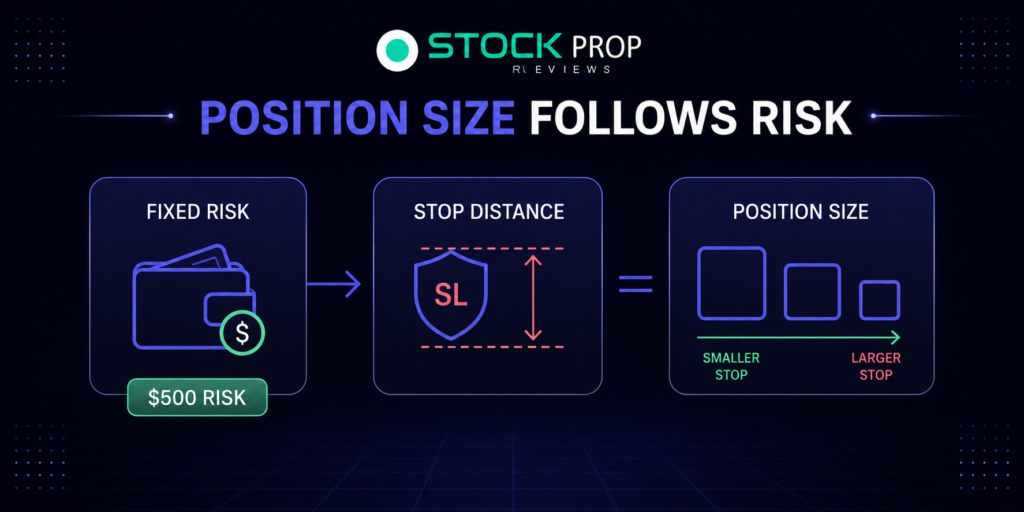
Position size should be determined by the distance to the stop and the amount of account capital the trader is willing to lose.
For example:
Account size: $100,000
Maximum risk: 0.5%
Dollar risk: $500
If the stop is $1 away from the entry, the trader can theoretically take 500 units.
If the stop is $2 away, the position falls to 250 units.
The important point is that volatility should influence the stop and the position size together.
A tighter market does not automatically justify a larger position.
Likewise, a wider market does not necessarily mean the strategy should be abandoned. It may simply require a smaller position.
This is one of the biggest differences between disciplined low volatility trading and gambling on small price movements.
Which strategies fit low volatility markets?
Low volatility favors strategies that do not require explosive price expansion.
Range trading works when support and resistance are well defined and the range is wide enough to cover costs.
Mean reversion can also work when price repeatedly returns to a well-defined average or mid-point of a range.
Short term scalping might work in liquid instruments but the costs of execution become important. A strategy that very small moves are focused on might get hurt by spread and slippage.
It’s more difficult to follow trends when the market isn’t going anywhere. That doesn’t make trend following a bad strategy. It just means the trader has to wait for the volatility and structure to return.
FTMO reminds that traders should take into account liquidity, consistency of volatility, market structure and trading costs when selecting instruments.
Who should use low volatility trading for prop challenges?
Low volatility trading is generally better suited to traders who:
- already have a proven strategy
- are happy to take fewer trades
- are happy to take smaller targets
- use controlled position sizing
- know when not to trade
- can avoid revenge trading after several small losses
It is less suitable for traders whose entire edge depends on large momentum moves.
A news trader waiting for a 2% index move should not suddenly become a range trader because the market is quiet.
The strategy should fit the trader’s edge first. Volatility should determine when and how aggressively that strategy is deployed.
What competitors often miss
Many discussions of low volatility focus on opportunity versus risk.
The bigger issue for prop traders is the interaction between volatility and challenge rules.
A market can be statistically calm while still being difficult to trade.
The trader may experience:
- less legal setups
- smaller average winners
- more temptation to trade
- repeated small losses
- pressure to increase position size
- frustration when profit target seems far away
That sequence can produce a drawdown without any dramatic market crash.
This is why low volatility should not be treated as a shortcut to passing.
The real advantage comes when a trader uses quiet conditions to preserve capital while waiting for high-quality opportunities.
That mindset is very different from trying to manufacture profits from every candle.
For a broader discussion of how risk rules interact with trader behaviour, our truth about prop firm risk management is useful. Traders comparing providers can also review our FTMO vs FundedNext comparison.
Low volatility and prop firm selection
The firm’s rules still matter.
A low-volatility strategy may be comfortable under one drawdown model and frustrating under another.
For example, a trader who needs several days for a position to develop should pay attention to holding restrictions, overnight rules, daily loss calculations, and payout conditions.
A trader who closes everything intraday should focus more heavily on daily loss limits, execution, spreads, and the relationship between the profit target and maximum drawdown.
Our FTMO review covers the firm’s current risk framework in more detail, while our TradeThePool review is relevant for traders who prefer equities.
TradeThePool deserves a separate caveat here. Its own website states that the online prop trading arena is not yet regulated and describes Five Percent Online Ltd. as a proprietary trading firm rather than a financial institution. Its evaluation environment is also simulated.
So I wouldn’t say TradeThePool is a regulated stock prop firm without caveats. It does publish its rules, risk controls, KYC/AML policies and program terms, which can make its framework easier to examine, but that’s not the same as being regulated like a securities broker or financial institution.
Readers can get up to 10% discount when purchasing through our TradeThePool link.
A practical low-volatility challenge plan
Before trading a challenge in a quiet market, answer five questions.
What is my average range?
Know whether today’s movement is actually below your strategy’s normal operating range.
Where are the meaningful levels?
Avoid treating every tiny intraday high or low as a trading signal.
How much am I risking?
Calculate dollar risk before entering rather than adjusting size emotionally.
What is my realistic target?
A quiet market may not support the same target used during a momentum session.
When will I stop trading?
Define the threshold where bad conditions are a reason to wait, and not a reason to push through another setup.
That last question can solve more challenges than any other indicator can.
The biggest misconception about passing faster
Low volatility does not make traders pass challenges faster by itself.
It can make the risk-management side of the challenge easier, provided the trader does not compensate for slow movement by increasing risk.
That distinction matters.
A trader risking 0.25% to 0.50% per trade in a controlled environment may have considerably more room for normal losing streaks than someone risking 1% to 2% while chasing volatile moves.
But if the first trader takes 15 low-quality trades because nothing is happening, the advantage disappears.
The objective is not to trade during low volatility.
The objective is to recognize when low volatility creates a favourable environment for your particular strategy and stay out when it does not.
FAQs
Low volatility good for prop firm challenges?
It can. Lower volatility allows traders to use smaller stops and controlled position sizes, which can help mitigate the impact of single losses. But there are fewer opportunities and price moves tend to be smaller, making it harder to hit profit targets.
Does low volatility decrease drawdown?
Unless you want to. Low price movement reduces risk in individual trades but repeated low quality trades can lead to a slow drawdown. Volatility is not as important as position sizing and trade selection.
What is the best way to trade low volatility?
When market structure is obvious, range trading and carefully chosen mean-reversion trades can do well. Scalping can also work in liquid instruments, but spreads and execution costs become especially important here.
Do I increase position size when volatility is low?
No, generally. Position size should be based on how much you are prepared to lose and how far away your stop is. The market is slow, that doesn’t mean increase size. This can turn a quiet market into a big account risk.
Does low volatility help me through a prop challenge faster?
It can help mitigate risk but does not ensure a quicker pass. If there’s not enough movement in the market to hit the target, forcing trades can result in more losses than profits. The better approach is to protect drawdown and wait for conditions that match your tested strategy.