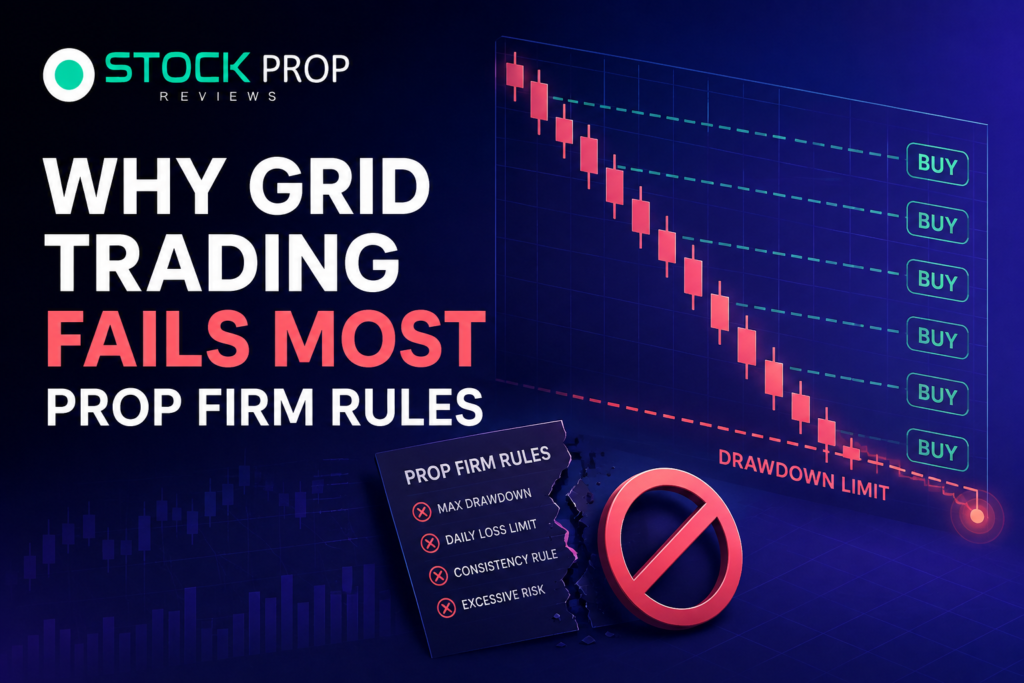
Proprietary firms that offer grid trading can be attractive for traders that make a living from multiple entries, frequent small wins and systematic position management. The challenge is that a typical grid may not align with how many prop firms quantify drawdown, position exposure, consistency, trade duration and risk concentration.
This article is for traders who are considering using a grid strategy in a prop firm evaluation – forex traders, futures traders, stock traders, manual entries, or automated entries. It’s not for traders seeking a strategy they can just copy to a prop account without checking the specific trading rules of the firm.
The important distinction here is this: grid trading is not automatically banned by every prop firm. The problem can be the way a grid creates exposure.
What Is Grid Trading?
A strategy that entails placing a number of buy and sell orders at fixed price levels. As the price moves through the grid it will open additional positions or close existing ones.
For instance, suppose EUR/USD is trading around 1.1000. A trader can place buy orders every 20 pips below the present price and sell orders at the same levels above.
The strategy is meant to capture repeated price moves, not to predict one particular entry.
That can work out pretty well in a range. The trouble is when prices are trending strongly in one direction.
A normal grid can magnify the exposure as the market moves against the trader. What appears to be a few small trades can thus become one large directional position.
That’s where prop firm rules come into play.
Why Grid Trading and Prop Firm Rules Often Conflict
Most prop firms are not evaluating whether a strategy looks clever on a chart. They are evaluating whether the resulting trading behaviour fits their risk model.
A grid can create several problems at the same time.
| Prop firm constraint | What a grid can do | Why it matters |
| Daily drawdown | Accumulate several losing positions | Losses can compound quickly |
| Maximum drawdown | Keep adding exposure during a trend | Floating losses can consume the risk buffer |
| Position limits | Create many simultaneous positions | Total exposure becomes difficult to control |
| Consistency rules | Produce clustered profits or losses | Results may not fit profit-distribution requirements |
| Trade-duration rules | Keep positions open while waiting for a reversal | Some firms restrict minimum or maximum holding behaviour |
| Automation restrictions | Place large numbers of orders automatically | Certain firms restrict EAs, bots, or automated execution |
| Risk concentration | Build exposure in one direction | A single market move can affect the whole grid |
The key point is that a grid is not just a collection of independent trades.
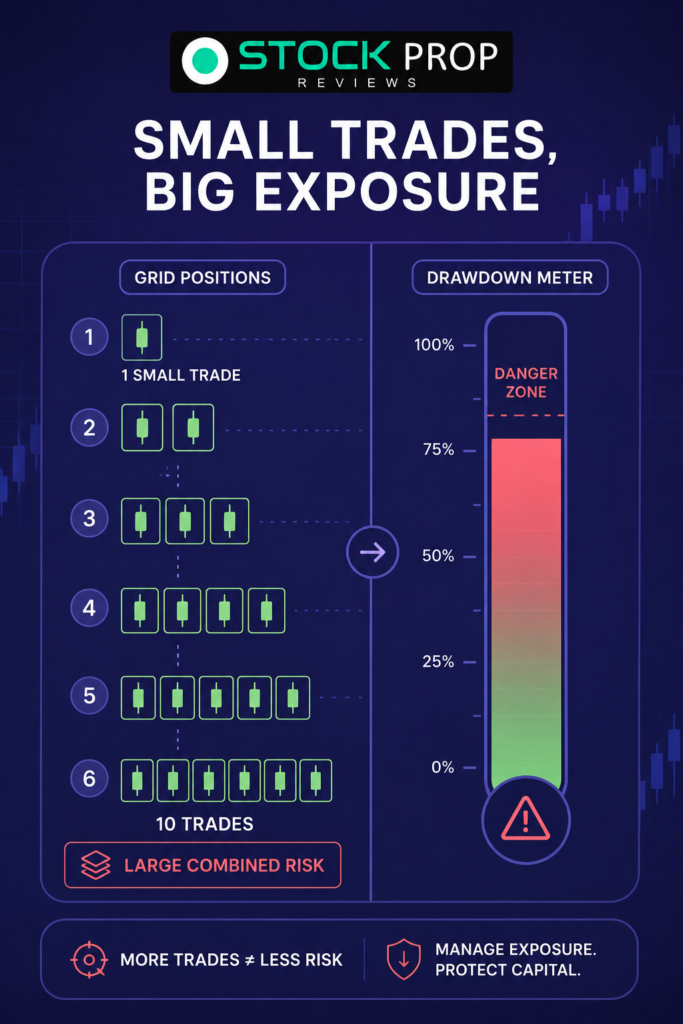
If ten positions are all based on the same market movement, the risk should be considered collectively.
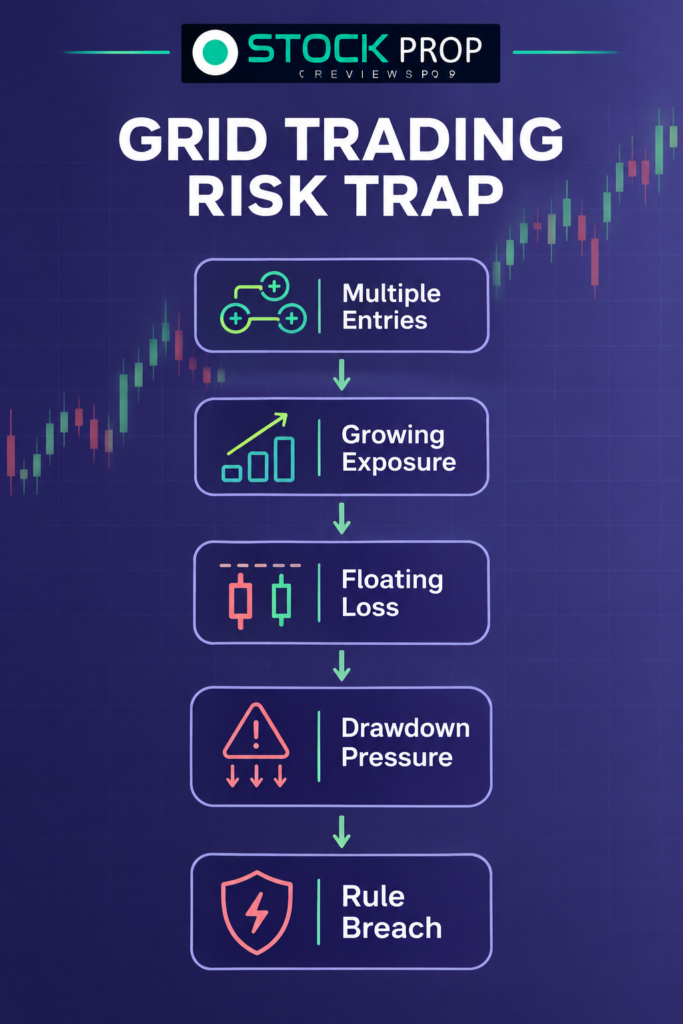
The Drawdown Problem Most Grid Traders Underestimate
This is probably the biggest issue.
Imagine a trader has a $100,000 evaluation account with a $10,000 maximum drawdown.
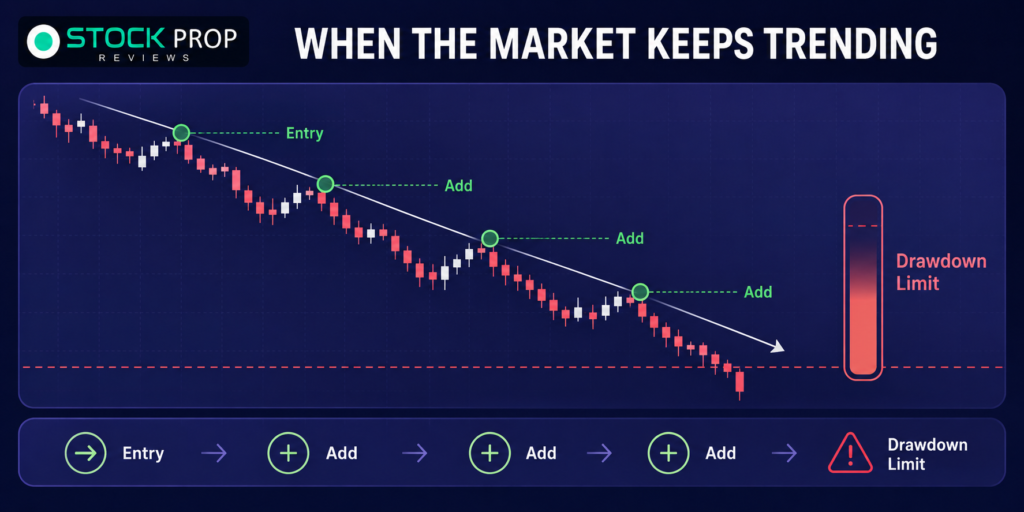
The trader opens a small long position. Price falls, so another position is added. Price falls again, and another position is added.
Each individual trade might appear small.
The combined position is not.
Suppose the trader eventually has 10 positions open, each carrying a $500 floating loss. The account is now down approximately $5,000 before commissions and other trading costs.
The trader has used half of the available drawdown without any single trade looking catastrophic.
If the market continues moving against the grid, the remaining risk buffer can disappear surprisingly quickly.
This is why simply saying “I only risk 0.5 percent per trade” can be misleading.
If ten trades are correlated and open simultaneously, the trader may not really be risking 0.5 percent in practical terms.
They may be risking several times that amount.
Grid Trading Can Turn a Small Loss Into a Rule Violation
A personal trading account and a prop account behave differently.
With your own account, you can decide to tolerate a larger temporary drawdown while waiting for price to return.
A prop firm may not give you that opportunity.
Consider a trader running a mean-reversion grid on gold.
The market spends several hours moving sideways, so the strategy generates a series of small profitable closes. The trader becomes confident that the range will continue.
Then gold breaks through the range after an unexpected economic release.
The grid continues adding positions.
The trader now has a problem that cannot be solved simply by being “right eventually.”
If the account reaches its daily or maximum loss threshold before the market reverses, the evaluation is over.
The eventual reversal does not matter.
This is one of the most important differences between grid trading in a personal account and grid trading under a fixed-risk prop model.
What Competitors Often Miss About Grid Trading
Several articles discussing grid trading focus on whether the strategy works in ranging markets.
That is useful, but incomplete.
MarketMaster explains that grid and Martingale-style strategies may be prohibited by some prop firms because they can involve multiple trades and increasing exposure as price moves against the trader.
The broader issue is not simply that grids use multiple orders.
The real question is how the grid behaves when the market stops ranging.
A1 Trading makes a similar point from the strategy side. Its explanation of grid systems highlights their suitability for sideways markets while noting the larger drawdown risk that can appear during strong trends.
Finextra’s discussion of grid bots also identifies trending markets, poor grid settings, inadequate testing, and weak risk controls as major failure points.
What these discussions do not always explain to a prop trader is the interaction between those risks and a fixed account-level loss limit.
A personal strategy can survive a temporary adverse move that a prop account cannot.
That difference matters more than the theoretical win rate.
Grid Trading vs Prop Firm Risk Models
The strategy works from one basic assumption: price will continue to fluctuate around a range.
The prop firm works from a different assumption: the account must remain within predefined risk limits regardless of what the market does.
Those two objectives can collide.
A grid trader might think:
“If price comes back, the positions will recover.”
The prop firm’s risk system effectively asks:
“Can the account survive long enough for that recovery to happen?”
If the answer is no, the strategy has failed from a prop trading perspective even if it would eventually have recovered in a personal account.
This is why strategy fit should be assessed before buying an evaluation.
A Practical Grid Failure Example
Consider a simplified $50,000 account with a $2,500 daily loss limit.
A trader opens five long positions as price falls.
Each position eventually reaches a $300 floating loss.
The total floating loss is $1,500.
The trader still has $1,000 of daily loss capacity.
Instead of cutting exposure, the trader adds five more positions because the market is now “oversold.”
The next move creates another $1,500 of combined losses.
The account has now crossed the daily limit.
Nothing unusual happened from a charting perspective.
The market simply continued trending.
The trader did not necessarily make a terrible entry. The problem was that the strategy kept increasing exposure while the available risk budget was decreasing.
This is one of the most common ways a grid becomes incompatible with a prop account.
The Martingale Problem Is Even More Serious
Grid trading and Martingale are not identical.
A standard grid can use equal position sizes.
A Martingale system increases position size after losses.
That distinction matters.
Suppose a trader uses:
- 1 lot
- 1 lot
- 2 lots
- 4 lots
- 8 lots
The strategy becomes increasingly dependent on a reversal.
The problem is obvious when the market trends.
Losses become larger exactly when the trader has less remaining risk capacity.
Some prop firms specifically prohibit Martingale or similar practices because the exposure profile can become inconsistent with their risk controls. MarketMaster identifies increasing lot sizes after adverse moves as one reason some firms restrict these strategies.
A trader should therefore never assume that a grid and a Martingale system will be treated as the same thing by every firm. Read the firm’s actual prohibited-strategy language.
Profit Consistency Can Also Cause Problems
Drawdown is not the only concern.
Some prop firms impose consistency rules that restrict how much of the account’s profit can come from one trade or one day.
That creates another possible conflict with grid systems.
A grid may generate many small profits and then one large profitable exit after a major market reversal.
Depending on the firm’s calculation method, that large position could represent too much of the trader’s total profit.
TradeThePool, for example, currently applies position-profit consistency requirements to certain programs. Its program terms state that the maximum position profit ratio can be 30 percent unless a different ratio applies.
This is an important reminder that a trader can be profitable and still fail a firm’s requirements.
The strategy needs to fit the profit rules, not just the loss rules.
Trade Duration Can Matter Too
Automated grids often open and close positions quickly.
Some firms restrict high-frequency activity, minimum trade duration, or automated execution.
TradeThePool’s current terms, for example, prohibit high-frequency trading where the majority of trades last only a few seconds or less. Its program terms also specify minimum trade-duration requirements for certain positions.
That does not mean every grid is prohibited.
It means a trader needs to examine the exact execution pattern produced by the grid.
A strategy that appears acceptable manually could create a very different rule profile when automated.
The Biggest Mistakes Grid Traders Make
The first mistake is treating every grid order as an independent risk.
They are usually correlated positions.
The second is using the same grid spacing in every market condition.
A 20-pip grid can behave completely differently during a quiet Asian session and a major US economic release.
The third is adding positions because the trader believes the market is “due” for a reversal.
Markets do not owe a grid trader a mean reversion.
The fourth is testing the strategy based on win rate alone.
A grid can produce a very high percentage of winning trades while still having a poor risk profile. Ten small winners do not necessarily compensate for one uncontrolled trend.
The fifth is checking the firm’s rules after purchasing the account.
That is backwards.
The strategy should be checked against the rules before paying for an evaluation.
What a Grid Trader Should Check Before Joining a Prop Firm
Before using a grid trading strategy with a prop firm, check at least these areas:
| Rule area | Question to ask |
| Drawdown | Is it static, trailing, equity-based, or balance-based? |
| Daily loss | Does floating loss count toward the limit? |
| Position size | Are there limits on total or individual exposure? |
| Multiple entries | Are layered positions allowed? |
| Hedging | Are opposing positions permitted? |
| Automation | Are EAs, bots, or automated execution allowed? |
| Trade duration | Is there a minimum holding period? |
| Consistency | Can one position or day produce too much of the total profit? |
| News trading | Are entries around major releases restricted? |
| Overnight | Can the grid remain open outside regular market hours? |
| Scaling | Do position limits change as the account grows? |
This checklist is more useful than simply asking whether a firm “allows grid trading.”
A firm may not mention the word grid at all while having several rules that make a conventional grid impractical.
Best and Worst Prop Firm Fit for Grid Traders
A grid trader should generally look for a firm whose risk rules are easy to understand and compatible with the strategy’s actual exposure.
The best fit is usually a program where the trader can clearly calculate maximum exposure, understand how floating losses affect drawdown, and operate without prohibited automation or trade-duration patterns.
The worst fit is a program where the trader needs a large floating drawdown buffer to allow the grid to recover.
That is especially dangerous when the account has a tight trailing drawdown.
A trailing limit can move closer to the strategy as the account gains value, reducing the amount of room available for a later grid cycle.
For a broader view of how drawdown structures affect strategy selection, see our analysis of low drawdown prop firms.
What About Stock Prop Firms?
Stock prop firms can be a different environment because the instruments, trading hours, liquidity, and position rules are different from those of many forex or CFD programs.
TradeThePool currently offers stock and ETF trading and publishes detailed rules covering position volume, daily loss, consistency, trade duration, and overnight trading. Its program terms state that opening or adding to a position cannot exceed 5 percent of the previous one-minute trading volume for the instrument.
That type of volume restriction is particularly relevant to grid traders.
Multiple small orders are not automatically harmless if they collectively create excessive exposure or exceed a firm’s volume requirements.
TradeThePool is also presented by StockPropReviews as a regulated stock prop firm with clear risk rules and transparency. Traders considering that model should still read the current program terms rather than relying on any third-party summary. Readers can get up to 10% discount when purchasing through our TradeThePool link.
Alternatives to Traditional Grid Trading
If your main attraction to grid trading is systematic execution rather than the averaging-down component, there are safer ways to adapt the concept.
One option is a limited-entry mean reversion strategy.
Instead of allowing unlimited additions, define a maximum number of entries before the strategy stops.
Another approach is a range breakout strategy.
Rather than assuming price will return to the middle of the range, the system accepts that the range may fail and exits when the market proves the original thesis wrong.
A third approach is to use fixed-risk scaling.
Each additional entry should be calculated from the remaining account risk rather than simply following a predetermined grid.
None of these removes trading risk. They simply make the risk easier to measure.
How This Fits With Prop Firm Selection
When choosing a prop firm, the first consideration should be strategy compatibility, not the promised profit split.
Our extended comparison of the best prop firms makes the same point: drawdown models, consistency rules, trading restrictions and the practical effect of those rules are more important than a headline percentage.
A grid trader should take that one step further.
Do not ask:
“Which prop firm allows grid trading?”
Ask:
“Which firm’s risk model can my grid survive?”
Those are very different questions.
For traders who want a deeper look at how prop firm rules can interfere with otherwise profitable strategies, our prop firm risk management myth article covers the wider difference between personal-account risk management and rule-based funded trading.
Who Should Avoid Grid Trading With Prop Firms?
Grid trading is probably a poor choice if you depend on large floating drawdowns, frequently add to losing positions, use Martingale sizing, or cannot define a hard maximum exposure.
It is also unsuitable for traders who have not tested how their strategy behaves during strong one-directional markets.
Beginners should be particularly careful.
The attractive part of grid trading is easy to understand: lots of small trades can create a high win rate.
The difficult part is understanding what happens when the market does the opposite of what the system expects.
That is where most of the damage occurs.
FAQs
Are prop firms allowed to do grid trading?
Not all the time. Some firms explicitly prohibit Grid or Martingale style systems and others do not use the term “grid” but have position, drawdown, automation or trade-duration rules that can make certain grid systems unacceptable.
Why do grid traders lose prop firm challenges?
Cumulative exposure is the number-one reason. Many losing positions can add up to a large combined floating loss, even if each position is small in itself. Then a strong trend can push the account through its daily or max drawdown limit.
Is Martingale and Grid Trading the Same?
Nope. A grid is usually multiple orders spaced at price intervals. Specifically, Martingale means increasing position size after losses. Grids can use fixed position sizes, but some grid systems combine grid logic with Martingale sizing.
Are automated grid bots a good option for prop firms?
It is contingent upon the firm’s policy. Some allow automation and some do not – EAs, bots, high-frequency execution, copying through third parties or certain types of automated trading may be prohibited. Traders should check current terms before running a bot.
Is it profitable to do grid trading at a prop firm?
It may be profitable when market conditions are right, but profitability is not necessarily consistent with the rules. A strategy can make money over a long backtest and still fail a prop evaluation because the drawdowns, position concentration, trade duration or profit distribution do not fit the firm’s rules.
Final Take
The biggest problem with grid trading prop firms is not that every grid strategy is inherently bad.
It is that traditional grid logic often assumes the trader has enough capital and time to wait for mean reversion.
A prop firm gives you neither unlimited capital nor unlimited drawdown.
Once that is understood, the problem becomes much clearer.
A grid that risks small amounts per order can still carry substantial account-level risk when those orders accumulate. A high win rate can still hide one large losing cycle. And a strategy that works perfectly in a personal account can fail a prop evaluation because the account reaches its risk limit before the market reverses.
The practical lesson is simple: measure the grid as one combined risk position, not as a collection of small trades.
If the strategy cannot survive the firm’s worst realistic market scenario without approaching the account’s drawdown limit, the issue is not the prop firm.
The strategy and the rule set simply do not fit.