This is a high risk to reward strategy. It can be profitable in normal trading and still struggle under consistency rules trading environments. The problem is usually not the expected value of the strategy. It’s the form of the equity curve and the amount of profit coming in on any given day.
This article is for the funded, futures, forex and stock trader who is a beginner and who is using prop firm evaluations or funded accounts where profit concentration, drawdown or daily limits affect eligibility. This is not for the trader looking for a shortcut to pass a challenge with one oversized trade.
A strategy that sometimes spits out +5R or +6R winners might look very good in a personal account. That same winner however can be a problem under a prop firm’s consistency rule. One trading day can be too much of the total profit of the account.
What Is a Prop Firm Consistency Rule?
A consistency rule limits how much of a trader’s total profit can come from one trading day or, in some programs, a small number of trading days.
A common calculation is:
Best trading day ÷ Total net profit × 100 = Consistency percentage
For example, suppose a trader has made $10,000 in total profit and the firm’s rule allows a maximum of 30% from the best day.
The largest acceptable day would be:
$10,000 × 30% = $3,000
So if the trader made $ 5,000 on one day, then that day makes up 50 % of total profit. The trader might have hit the profit target, stayed within the drawdown limit, and followed all the other rules, but could still fail the consistency requirement, or have a payout delayed until further profits push the percentage down.
The exact computation differs among firms. Some apply the rule at time of an evaluation, some at payout, and some have no consistency requirement at all. Current examples typically use thresholds between 30% and 50%, but there are stricter and more flexible models.
That distinction matters because “consistency rule” is not one universal industry rule. Traders need to read the firm’s actual terms rather than assuming every company calculates it the same way.
Why High RR Strategies Create a Problem
High RR trading is not automatically bad.
A strategy risking 1R to make 4R can have positive expectancy even with a relatively low win rate. For example, a trader might lose four trades at -1R each and then make +4R on the fifth trade.
The problem is that the winning distribution is uneven.
A simplified sequence could look like this:
| Trade | Result |
| 1 | -1R |
| 2 | -1R |
| 3 | -1R |
| 4 | -1R |
| 5 | +4R |
| Total | 0R |
Now imagine the trader eventually gets several smaller wins and one unusually large winner. The strategy may remain profitable, but the firm’s consistency calculation can treat the large day as evidence of uneven performance.
This is where traders confuse strategy profitability with rule compatibility.
A strategy can have positive expectancy and still be poorly suited to a specific prop firm’s rules.
That is one of the most important points competitors often miss.
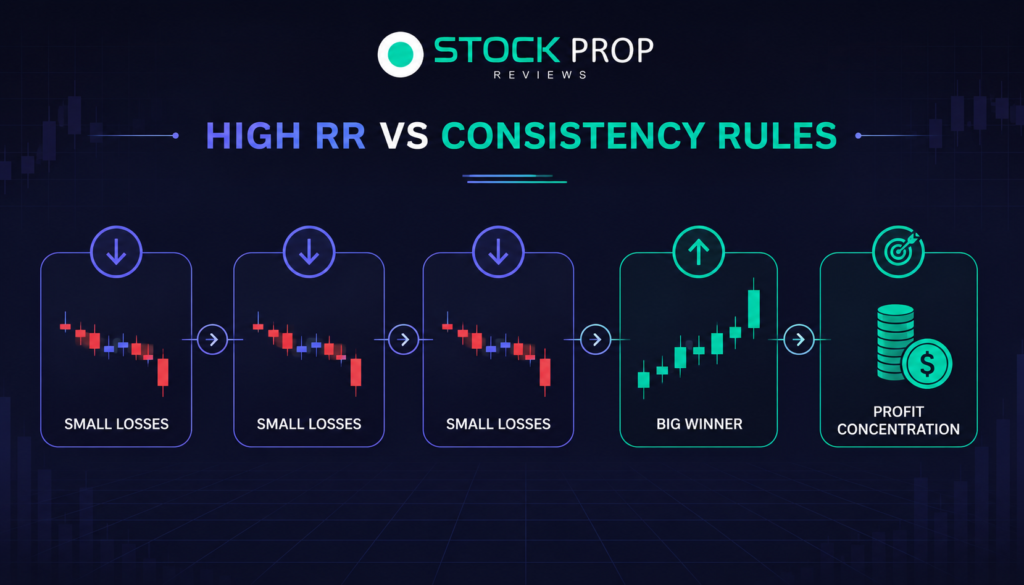
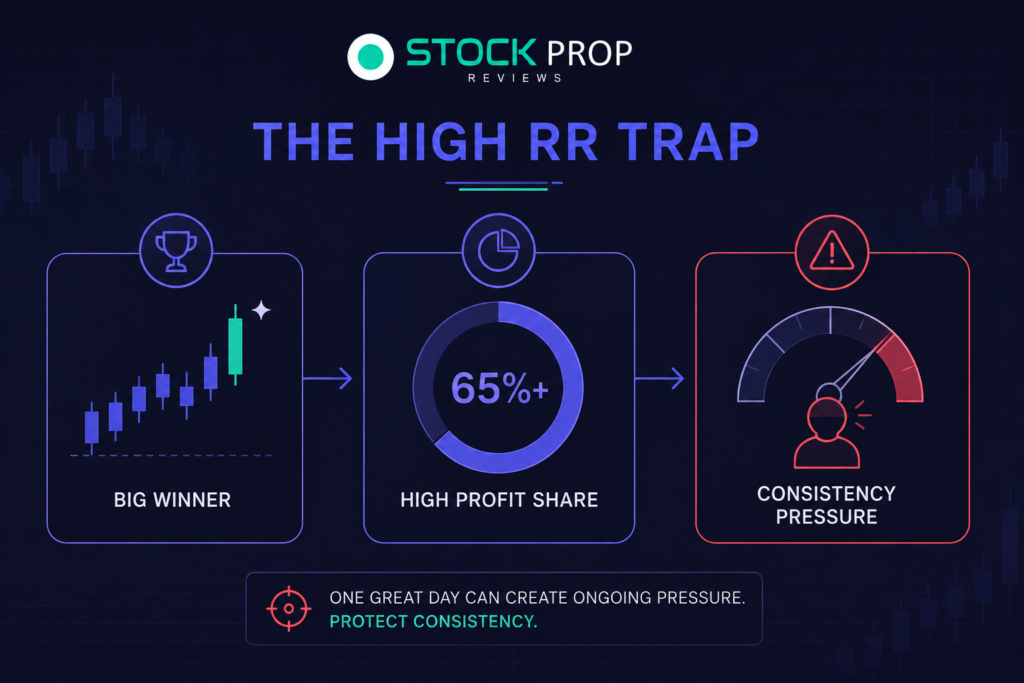
The High RR Trap: One Great Day Can Become a Liability
Consider a futures trader using a breakout strategy.
The trader normally risks $500 per setup and looks for $2,000 or more on a strong breakout. Most sessions produce small losses, scratches, or modest winners. Then an important economic release creates a large market move.
The trader catches it perfectly and makes $4,500.
The next day, the trader checks the account and sees that the $4,500 session represents a large percentage of total profits.
Nothing was necessarily wrong with the trade.
The entry followed the strategy. The stop was respected. The position size was planned.
But the trader has created a new problem: the account now needs more profitable trading to dilute the oversized winning day.
This can create a dangerous psychological cycle.
The trader starts thinking:
“I already hit the target, so why can’t I withdraw?”
Then:
“I need another $2,000 to make my best day less significant.”
Then:
“I might as well take another setup.”
The consistency rule has now changed the trader’s decision-making.
The original high RR strategy is no longer being traded purely on its edge.
High Win Rate Does Not Automatically Solve the Problem
It is easy to assume consistency rules mainly punish low-win-rate traders.
That is not necessarily true.
A trader with a 70% win rate can still violate a consistency requirement if one day produces an unusually large percentage of total profit.
For example:
| Day | Profit |
| Monday | +$400 |
| Tuesday | +$350 |
| Wednesday | +$450 |
| Thursday | +$500 |
| Friday | +$3,000 |
| Total | +$4,700 |
The trader was profitable every day, but Friday produced roughly 64% of total profit.
The issue is not poor discipline in the traditional sense. It is profit concentration.
That is why traders should track their distribution of returns rather than looking only at win rate.
Traders similarly emphasize reviewing metrics such as win rate, profit/loss ratio, drawdown, and time-based performance instead of judging a strategy from a single result.
What Competitors Often Don’t Explain
Many explanations of consistency focus on the formula.
The formula is easy.
The difficult part is understanding how the rule changes trader behaviour.
A trader using a 1:5 RR model may naturally have a lumpy equity curve. That is not necessarily a weakness. Some breakout and trend-following systems depend on occasional large winners to offset multiple small losses.
Forcing that trader to produce a smoother daily distribution can therefore create a strategy mismatch.
The trader may start doing things that actually damage the original edge:
- Taking profits earlier just to create more winning days
- Reducing winners because they are becoming “too large”
- Taking mediocre setups after a big winning day
- Increasing size to compensate for small losing sessions
- Avoiding valid setups because the account is already close to a consistency threshold
The worst outcome is changing a profitable strategy into a less profitable one simply to satisfy an administrative rule.
The answer is not always to abandon high RR trading. It is to determine whether the firm’s rules and the strategy’s return distribution are compatible before paying for an evaluation.
High RR vs Low RR Under Consistency Rules
There is no universal winner.
| Strategy characteristic | High RR approach | Lower RR approach |
| Typical target | 3R to 6R+ | 1R to 2R |
| Win rate | Often lower | Often higher |
| Profit distribution | More uneven | Usually smoother |
| Large winning days | More likely | Less likely |
| Consistency-rule pressure | Higher | Usually lower |
| Main psychological risk | Giving back open profit | Overtrading for small gains |
| Best environment | Flexible rules | Strict consistency structures |
A high RR strategy can actually be safer from a drawdown perspective if the trader controls position size properly.
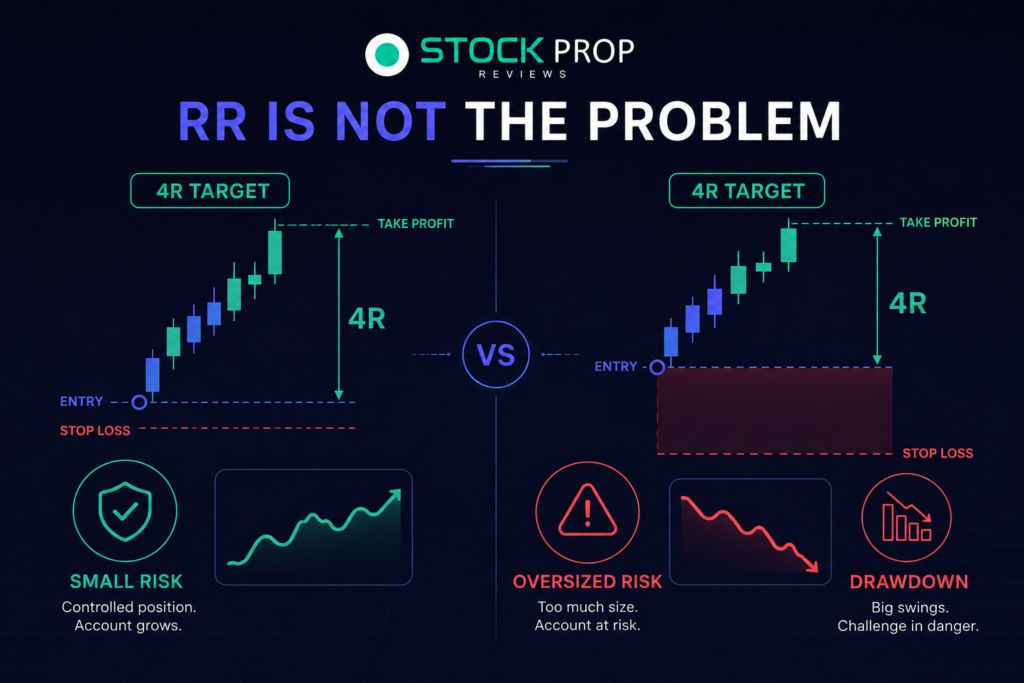
The problem appears when a trader combines high RR with oversized risk.
For example, risking 2% to make 8% can look attractive on paper. But several losing trades can bring the account close to its drawdown limit before the large winner appears.
Prop firms care about the path, not just the final mathematical expectancy.
The Real Failure: Position Size, Not RR
This distinction is critical.
A trader does not necessarily need to lower the reward-to-risk ratio.
They may need to lower the risk per trade.
Suppose a trader’s personal strategy risks 1% per trade for a potential 4R winner.
If the trader reduces risk to 0.25%, the same 4R setup produces a 1% account gain instead of 4%.
The strategy still has the same structural RR.
What changes is the impact of each outcome on the prop account.
That can make the equity curve easier to manage while preserving the underlying setup.
This is why position sizing deserves more attention than simply asking whether a firm “allows” high RR trading.
Common Trader Mistakes
Treating the Profit Target as the Finish Line
One of the biggest mistakes is assuming that reaching the profit target means the challenge is effectively complete.
A trader can reach the target through one unusually large day and then discover that the consistency requirement has not been satisfied.
The target and the consistency requirement are separate constraints.
Changing the Strategy After a Big Winner
A trader makes +5R and then deliberately takes smaller, lower-quality trades to create additional profitable days.
That is backwards.
The strategy should determine whether a trade is valid. The consistency rule should influence risk planning before the trade, not force random trades afterward.
Increasing Size After Losing Days
This is especially dangerous with high RR systems.
If a trader has three losses and decides to increase size because “the next winner will cover everything,” the strategy’s original expectancy no longer matters.
The trader has changed the risk model.
Prop trading rules explained by TradeFundrr also emphasize planned risk limits, position sizing, and avoiding overtrading rather than trying to recover losses aggressively.
Ignoring the Calculation Until Payout
A consistency requirement should be monitored throughout the account.
Waiting until the payout request to calculate the ratio is unnecessary.
A simple spreadsheet tracking total profit and best day can show whether the account is becoming increasingly concentrated.
How to Make a High RR Strategy More Prop-Firm Friendly
The first step is to calculate your historical distribution.
Look at at least 30 to 50 trades, preferably more.
Record:
- Risk per trade
- R multiple
- Daily profit
- Largest winning day
- Largest losing day
- Maximum drawdown
- Number of trades per day
Then calculate how often your strategy produces unusually large days.
If your backtest shows that 40% of total profits typically come from a few exceptional sessions, a strict consistency rule may be a poor fit.
You can then test lower position sizing.
For example, instead of risking 1% per trade, test 0.5% or 0.25%. Do not change the entry and exit rules initially. The purpose is to see whether the same edge can survive inside the firm’s risk framework.
This is much better than changing the strategy after buying a challenge.
Drawdown Matters More Than the RR Number
High RR gets a lot of attention because it looks attractive.
But prop firm survival usually comes down to three things working together:
Risk per trade + drawdown structure + return distribution
Risking 0.25% on a 1:5 setup is more manageable than risking 2% on a 1:2 setup.
The RR ratio alone tells you very little about whether a strategy will survive a prop account.
The other one is the drawdown model.
A trailing drawdown can be a very uncomfortable thing for an aggressive strategy as winning trades can raise the risk threshold of the account. And it can still be profitable if there is a pullback after and it breaches.
This is what our truth about prop firm risk management is all about and why a firm’s risk structure can change the way a strategy plays out in real life. .
Which Prop Firm Structure Fits High RR Traders?
There is no single best firm for every high RR strategy.
The better question is whether the firm’s rules allow the strategy’s natural return distribution.
| Firm structure | High RR fit | Main concern |
| No consistency rule | Stronger | Drawdown still matters |
| Loose consistency rule | Moderate to strong | Large days may still need monitoring |
| Strict consistency rule | Weak to moderate | Profit concentration |
| Trailing drawdown | Often difficult | Large pullbacks after winners |
| Static drawdown | Usually easier | Still requires controlled sizing |
| Flexible trading period | Better | Can reduce pressure to force trades |
Our broader 2026 prop firm comparison makes the same point from a different angle: the firm’s rule structure often matters more than the headline account size or profit split.
TradeThePool as an Alternative Structure
For traders who primarily trade equities, TradeThePool is worth examining because its structure is different from many forex and futures evaluation models.
TradeThePool operates as a regulated stock prop firm with clearly defined risk controls and a focus on stocks rather than forex or futures. Its model can therefore make sense for traders who want to evaluate their strategy against a stock-focused risk framework rather than a traditional CFD-style prop environment.
Readers can get up to 10% discount when purchasing through our TradeThePool link.
That does not make it suitable for every trader. A trader who depends on futures contracts, forex leverage, or a specific intraday execution model should compare the actual instruments and restrictions before switching.
You can also see our TradeThePool review for a closer look at its account structures and trading conditions.
Who Should Avoid High RR Strategies Under Strict Rules?
A high RR approach is probably a poor fit if:
- Most of your annual or monthly profits normally come from a handful of trades.
- You need large position sizes to make the strategy worthwhile.
- Your average losing streak regularly approaches the firm’s drawdown limit.
- You tend to take revenge after several losses.
- You change your exits whenever the account gets close to a payout.
- You cannot explain your historical return distribution.
The biggest warning sign is not a low win rate.
It is dependent on one or two exceptional trades to recover everything else.
That can work in a personal account with sufficient capital and no external rules. It becomes much harder when another party determines your maximum loss and payout conditions.
Best Alternatives for High RR Traders
If your strategy conflicts with a strict consistency rule, you can use three practical alternatives.
Lower the Risk, Keep the RR
This is the first thing to do.
If the strategy is truly edge, reducing position size allows the setup to remain intact while minimizing the impact of individual occurrences.
Choose a Different Rule Structure
Find programs where the consistency calculation is missing, less restrictive, or applies only to a particular stage.
Always check the current terms. The rules of prop firms can change and third party articles can get outdated very quickly.
Trade a Different Strategy During Evaluation
This option needs caution.
Do not completely abandon your core strategy just to pass an evaluation. If the strategy is incompatible with the funded environment, passing the challenge does not solve the underlying problem.
The better solution is to use a variation that has already been tested under the same risk constraints.
FAQs
Can a high RR strategy pass a consistency rule for prop firms?
Yes. High RR does not necessarily violate a consistency rule. The problem is usually the proportion of total profit that comes from the trader’s biggest winning day. A high RR strategy can work if the position sizing and daily profit distribution still work with the threshold of the firm.
Can you sustain a high win rate?
No. Many trades can be successful for a trader and still have one extraordinary large day that is too much of total profit. Consistency is a measure of profit concentration, not the percentage of winning trades.
Do you have to lower your RR to pass a prop firm?
Not quite. Lowering the RR may alter the strategy’s expectancy. Often a better first test is to reduce the risk per trade as it leaves the strategy structure intact but reduces the size of the individual wins and losses.
Drawdown or RR which is better?
Neither should stand alone for prop trading. The interaction between risk per trade, drawdown mechanics, return distribution, and consistency requirements. Even a strategy with a great RR can fail if the path of its drawdown is not in line with the firm’s rules.
Can Consistency Rules Be Bad For Traders?
Not necessarily. One oversized position can be enough to discourage traders from passing an evaluation. But they can also produce a mismatch for legitimate strategies that naturally generate uneven returns. It’s not a good rule or a bad rule. It’s just a rule. Traders should evaluate its value based on how it matches their strategy.
Final Takeaway
High RR strategies don’t fail because high RR is a bad thing.
They don’t work when the return distribution of the strategy is not compatible with the risk framework of the prop firm.
A trader who takes a series of small losses and has the occasional big winner can still have a perfectly legitimate edge in his trading. But when one of those winners gets too big relative to the total profit, a consistency rule can turn a profitable strategy into an administrative headache.
The practical answer is to test the strategy against the rules before you pay for the challenge.
Calculate Your Best Day Ever. Measure your drawdown . Track risk on each trade. Then, compare those numbers to the actual consistency threshold of the firm.
The strategy is only effective when you take oversized positions and rely on one exceptional day, so the problem is bigger than the consistency rule.
If the strategy still works after reducing risk and smoothing the distribution, the rule may just need better account level risk management.
That difference can stop a trader from changing a good strategy for the wrong reason.