Swing trading can have a higher chance of surviving prop firm rules than aggressive scalping for some traders, but that does not mean swing trading is automatically more profitable. The advantage comes from lower trade frequency, less execution noise, and more time to manage risk. The catch is that a swing trader needs a prop firm whose rules allow overnight and weekend positions without creating excessive pressure from floating drawdown.
This article is for beginners and funded traders who hold positions for several days and want to understand how prop firm rules affect that approach. It is not aimed at scalpers, high-frequency traders, or traders whose strategy depends on closing every position within the same session.
The important distinction is simple: swing trading can fit a prop firm well, but only when the firm’s risk model fits the strategy.
Why swing trading can work better with prop firm rules
A good swing trader may only have two or three quality setups per week. A scalper might take dozens of trades in the same span of time.
That makes a difference.
Every trade is yet another opportunity for costs of the spread, slippage, emotional errors and rule breaking. If a trader makes 50 decisions a day, they have many more chances to hit a daily loss limit than someone who waits for one high quality setup.
Swing trading also gives traders the ability to plan entries and stops. Rather than reacting to a one minute candle, the trader can create a thesis based on a four hour or daily structure.
But there is a significant counter-argument.
The swing trading system usually requires wider stops and allows for temporary losses. That could conflict with rules based on equity or trailing drawdown. A position can be technically correct and still go against the trader before reaching its target.
This is why the statement “swing trading has a higher success rate” needs to be qualified. It is true that some prop firm environments may be better suited structurally for swing trading, but that does not mean that swing trading will guaranty a higher win rate.
Our own comparison of swing-friendly firms comes to the same basic conclusion: overnight permission is not enough. The drawdown model and the management of open positions are equally important.
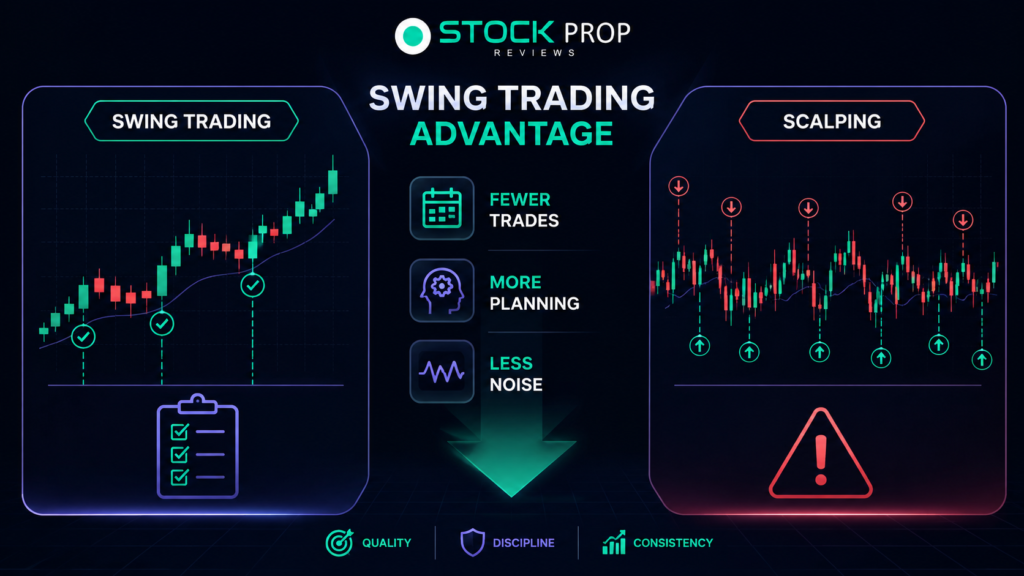
The real advantage is fewer decisions, not bigger profits
One of the biggest misconceptions about swing trading is that its advantage comes from capturing larger price moves.
That can happen, but it is not the main reason the approach can work well under prop firm restrictions.
The bigger advantage is reduced decision frequency.
Consider two traders with the same 1% risk per trade.
Trader A scalps ten times a day. Trader B takes three swing trades per week.
Even if both have the same theoretical edge, Trader A faces more opportunities for:
- revenge trading after a loss
- entering during poor liquidity
- moving stops
- increasing size impulsively
- violating daily drawdown
- overtrading after reaching a profit target
Trader B still has risk, but there are fewer decisions that can go wrong.
This matters psychologically as well. Prop firm accounts create a different environment from personal accounts because the trader is operating inside predefined loss limits. A profitable strategy can fail when the trader starts changing it simply to avoid violating those limits.
We have seen this issue repeatedly across prop firm evaluations. Traders often do not fail because their entry system suddenly stops working. They fail because they start trading differently once the account balance approaches a critical rule threshold.
Swing trading prop firms need different rules
A prop firm can advertise itself as suitable for swing traders while still being a poor choice for a genuine multi-day strategy.
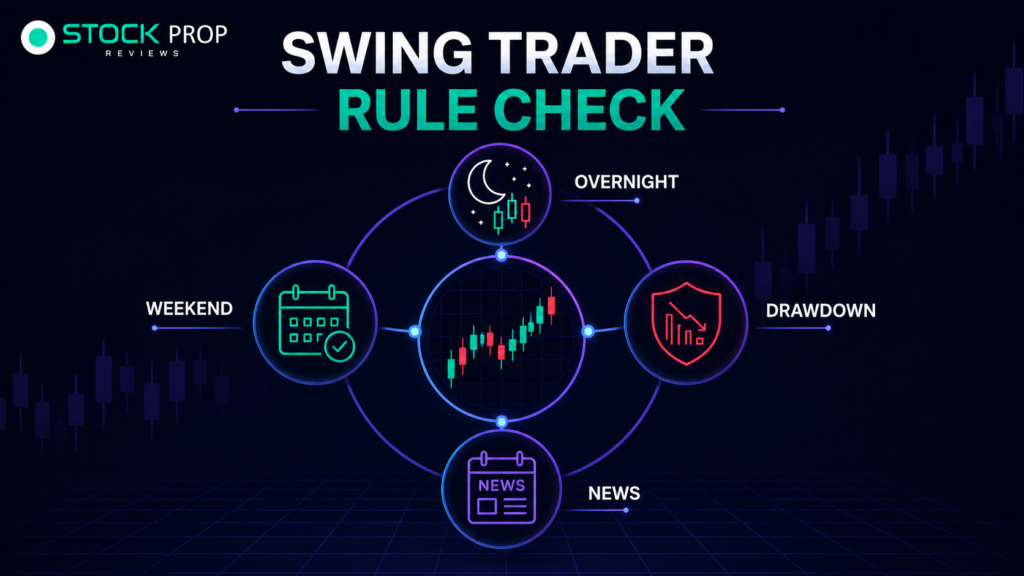
The first thing to check is whether positions can remain open overnight.
The second is whether weekend holding is allowed.
The third, and arguably most important, is how drawdown is calculated.
A trader holding a position that is temporarily down 2% needs very different conditions from a scalper who closes every trade within minutes.
The drawdown problem
Suppose a $100,000 account has a $10,000 maximum drawdown.
A swing trader enters a position risking $1,000. The trade initially moves against the position by $700 before recovering and eventually producing a $2,000 profit.
On a personal account, that temporary fluctuation may be irrelevant if the original trade plan remains valid.
Under an equity-based drawdown model, however, the floating loss immediately affects account equity.
This is where many swing traders misunderstand prop firm rules.
Your stop loss is not necessarily the same thing as the firm’s risk limit.
A trader may believe that a $1,000 stop means the account has only $1,000 of risk. But if several positions are open simultaneously, floating losses, commissions, spreads, and correlated positions can create much greater exposure.
That is why position sizing should be based on the firm’s actual drawdown mechanics rather than simply copying the risk model used in a personal account.
A practical comparison for swing traders
The table below focuses on the characteristics that matter most to a swing trader rather than headline funding amounts.
| Factor | Swing trader preference | Why it matters |
| Overnight holding | Allowed | Positions may need several sessions to develop |
| Weekend holding | Allowed where strategy requires it | Prevents forced exits before the trade reaches target |
| Drawdown | Static or trader-friendly | Gives trades room to experience normal volatility |
| Daily loss | Clearly defined | Prevents accidental rule breaches |
| Trailing drawdown | Preferably avoided for wide-stop strategies | Can punish normal floating losses |
| Consistency rule | Minimal or clearly defined | Swing returns can be uneven |
| Time limit | Flexible | Good setups do not appear every day |
| News restrictions | Clearly documented | Multi-day positions can cross economic releases |
Several current competitor guides make the same observation. Velotrade highlights weekend holding, end-of-day drawdown and the absence of forced overnight closures as important swing-trading requirements. JPTradingCapital similarly emphasizes overnight policies, weekend rules and drawdown calculations when evaluating firms.
The difference is that traders should not stop their research at a “best firms” list. The actual rulebook is what matters.
Why traders fail even when the firm allows swing trading
The most common mistake is taking the same position size they would use in a personal account.
Imagine a trader normally risks 2% on a swing trade because their personal account can tolerate a long sequence of losing trades.
That does not automatically translate to a prop account.
If the account has a 5% daily limit and a 10% maximum loss, three poorly timed positions can put the trader dangerously close to failure.
The second mistake is opening several correlated trades.
A trader might buy EUR/USD, GBP/USD and an equity index because each setup looks independent. In reality, all three positions can be exposed to the same dollar or risk-on move.
The trader thinks there are three separate trades.
The account experiences one large macro position.
The third mistake is moving the stop because the trader believes the original thesis remains valid.
This is especially dangerous for swing traders. Wider stops are acceptable only when the position size is reduced accordingly.
A wide stop combined with a normal position size is not swing trading discipline. It is simply larger account risk.
The consistency rule problem
Consistency rules deserve special attention because they can change how a swing trader manages winning positions.
Suppose a trader reaches $10,000 in total profit, but one position generates $5,000 of that amount.
A 40% consistency rule could create a problem because the single position represents 50% of total profit.
That does not mean the trade was bad.
It means the trader’s natural return distribution does not match the firm’s rule.
This distinction is often missed in generic prop firm comparisons.
Swing trading naturally produces uneven returns. You may have several small losses followed by one large winner. A firm that expects profits to be distributed evenly across trading days or positions can unintentionally encourage the trader to take mediocre setups just to make the account statistics look more consistent.
That is not necessarily good trading.
StockPropReviews’ analysis of consistency rules makes this point directly: the rule may encourage traders to manage the account around the restriction rather than manage trades according to their actual edge.
What competitors often miss
Most articles about the best swing trading prop firms focus on three questions:
Can you hold overnight?
Can you hold it over the weekend?
What is the profit split?
Those are useful questions, but they are not enough.
The more important question is:
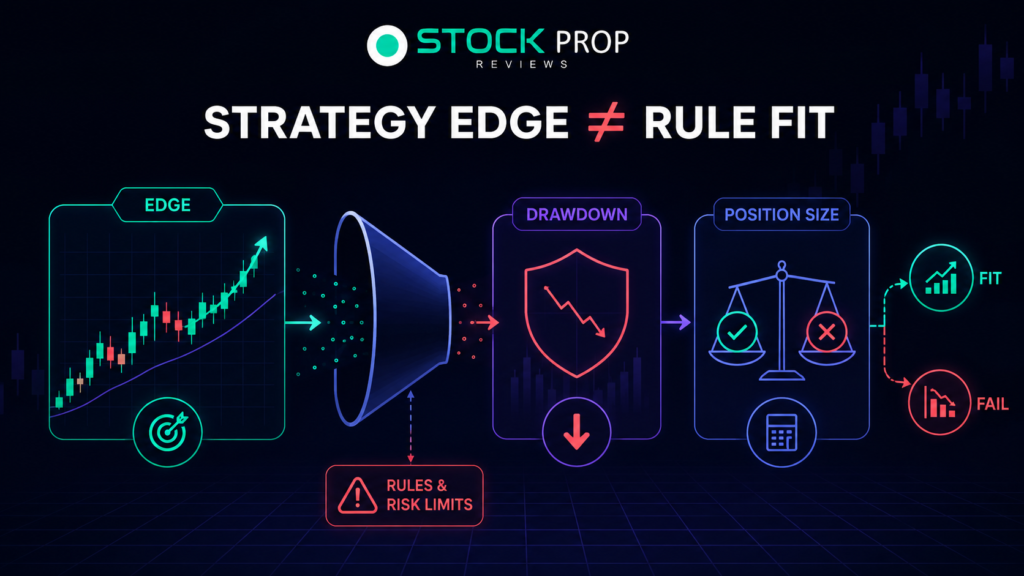
Can your actual strategy survive the firm’s drawdown calculation?
Consider a trader who wins 45% of the time but targets 2.5R winners and accepts 1R losses.
That strategy may be profitable over a large sample.
But if the trader needs five or six losing trades before a major winner appears, a tight trailing drawdown can make the strategy difficult to execute.
Another trader might have a 65% win rate but take small profits and occasionally suffer a large loss. That strategy could look impressive on a performance chart but be extremely vulnerable to a prop firm’s maximum-loss rule.
The rule structure changes the practical value of the strategy.
That is the part many comparison articles overlook.
A real-world swing trading scenario
Consider a trader using the daily chart on an index.
The trader identifies a bullish trend and waits for a pullback toward previous support. The planned entry is 5,000, the stop is 4,900 and the target is 5,300.
The trader is risking 100 points to make 300.
The position initially moved to 4,940.
The trader is down 60 points, but the original setup remains intact.
A swing-friendly account may allow the trader to remain in the position.
A restrictive trailing-drawdown model could make the same trade much harder to manage, particularly if the account has already built profits and the drawdown level has moved upward.
Eventually, the market reached 5,300.
The trade was correct.
But the trader still could have lost the account before the market reached the target.
That is why strategy fit comes before profit split.
Which type of prop firm suits swing traders?
FTMO remains a relevant benchmark for forex traders because it offers a specific Swing Account structure. One of the trade-offs is that it has lower leverage but its Swing Account, according to third-party comparisons, currently allows for holding overnight and on weekends.
Another name to look out for in longer term strategies is The5ers. The long-term perspective and scaling structure could be suitable for traders who prefer to go slow rather than hit targets faster. Current swing trading comparisons continue to show it as a multi-day traders’ candidate
TradeThePool is a different case because it focuses on stocks rather than forex or futures. Its current program terms include dedicated swing trading provisions, including overnight exposure requirements and specific position-volume rules.
One important correction is necessary here: TradeThePool should not be described as a regulated stock prop firm. Its own website says the online prop trading arena is not yet regulated and its program terms state that the company is not a financial institution or entity operating under financial regulatory authorities.
What it does offer is a stock-focused model with clearly documented trading and risk rules. That distinction is more useful to a trader than calling a firm “regulated” when the firm’s own disclosures say otherwise.
Readers can get up to 10% discount when purchasing through our TradeThePool link.
Best alternatives for different swing traders
There is no universal winner.
FTMO is worth considering for traders who want an established forex-focused environment and are comfortable adapting position size to its drawdown and leverage structure. Our FTMO review provides a deeper look at its rules and limitations.
The5ers may be more suited for traders looking for a longer term development model and who do not want to rush an evaluation. The negative is that a slower progression could frustrate traders hoping for rapid account growth.
FundingPips can also be considered by traders looking for overnight and weekend flexibility, although its specific restrictions and account model still need to be checked before purchase. Our FundingPips review looks more closely at how its rules affect different strategies.
For a broader view, our [prop firm comparison] looks beyond headline profit splits and focuses on drawdown, payout structures and strategy compatibility.
When swing trading is actually a bad idea
Swing trading is not automatically safer.
It becomes a poor choice when the trader uses oversized positions simply because they take fewer trades.
A trader who risks 3% per swing is not necessarily safer than a scalper risking 0.25% per trade.
Swing trading can also be problematic for traders who cannot tolerate watching a position move against them. The strategy requires accepting that a good trade may spend hours or days in negative territory.
It is also a poor fit for traders who constantly check their account balance.
If every temporary loss causes the trader to close a valid position, the strategy loses its statistical advantage.
This is why patience is not just a personality trait in swing trading. It is part of the execution model.
How to improve your odds with swing trading prop firms
The practical way is easy.
First, determine what is the most you can lose on one trade (based on the actual drawdown of the firm, not the nominal account size).
Second, assume losses. Don’t think that the next trade you make is going to be a winner. Build the strategy around that.
Third Review overnight, weekend and news rules before paying for an evaluation.
Fourth, determine whether drawdown is calculated on balance, equity, end of day equity or with a trailing mechanism.
Fifth, determine if consistency rules are inhibiting your natural profit distribution.
Finally, be sure to test the strategy using the exact rules of the firm before attempting to pass an evaluation.
A backtest with a 55% win rate is not enough. You want to learn what happens when the same strategy has to work with a 5% daily loss limit, a 10% max drawdown and the need to keep positions open for several days.
That is the true test.
FAQs
Does swing trading have a higher success rate in prop firms?
Not automatically. Swing trading can have a better structural fit for some prop firm rules because it involves fewer trades and less intraday decision-making. However, wide stops, floating drawdown and overnight risk can create serious problems if the firm’s rules do not match the strategy.
Are swing trading prop firms better than firms for scalpers?
Neither is universally better. A swing trader generally needs overnight flexibility, wider risk tolerance and clear drawdown rules. A scalper usually cares more about execution speed, spreads, commissions and intraday loss limits.
Can you hold swing trades overnight in a prop firm?
Some firms allow it, while others restrict or prohibit it. Traders should check the current program terms rather than relying on the firm’s general marketing page.
Is trailing drawdown bad for swing trading?
This can be a problem for strategies that depend on floating losses being temporary. A trailing stop can tighten the loss point, bringing it closer to the current account equity, thus reducing the room a position has to fluctuate.
What is the biggest mistake swing traders make with prop firms?
Using personal-account position sizing is one of the biggest mistakes. Prop firm risk limits are based on the firm’s rules, not on what a trader normally considers a comfortable stop.
The bottom line for swing traders
Swing trading can work well in a prop firm environment because it reduces trade frequency, gives traders more time to plan, and can reduce the psychological pressure associated with constant entries and exits.
But the strategy only works when the firm’s rules allow it.
The biggest mistake is choosing a prop firm because it advertises high profit splits or says “overnight trading allowed.” A genuine swing trader needs to examine the entire risk structure.
If the strategy needs wide stops, temporary floating losses and multi-day holding periods, a restrictive drawdown model can destroy the edge before the trade has time to work.
That is the real reason some swing traders appear to perform better in prop firms than aggressive short-term traders. It is not because swing trading is inherently easier. It is because a lower-frequency strategy can reduce decision errors, provided the firm’s rules give the trade enough room to develop.
The best swing trading prop firms are therefore not necessarily the firms with the highest funding or biggest profit split. They are the firms whose rules allow your existing trading edge to survive.
For stock traders specifically, TradeThePool can be worth researching because its program is built around stocks and provides explicit swing-trading rules and risk parameters. Just remember that it is a proprietary trading program operating in a simulated environment, not a regulated brokerage or regulated financial institution.