
Quick verdict
This The 5%ers review is a simple one at its core. We are built on patience and risk management, not speed. If you’re a trader who likes to grow slowly and can be disciplined over longer periods of time, the structure can work well. If you are used to getting results quickly or moving aggressively, it is likely to feel limiting.
Good for swing traders and controlled intraday traders. Not for the scalpers. Not for the high risk trader. Not for someone trying to get through an eval fast.
What The 5%ers actually offers
The 5%ers positions itself differently from most challenge-based prop firms. Instead of pushing traders to hit targets within strict deadlines, it removes time pressure and focuses on consistency.
On paper, this sounds like an advantage. In practice, it shifts the challenge from speed to discipline.
You are not racing against a clock, but you are trading within tight risk boundaries. That changes how you approach the market. You cannot rely on recovery trades or aggressive position sizing. You have to be selective.
Rules and trading conditions
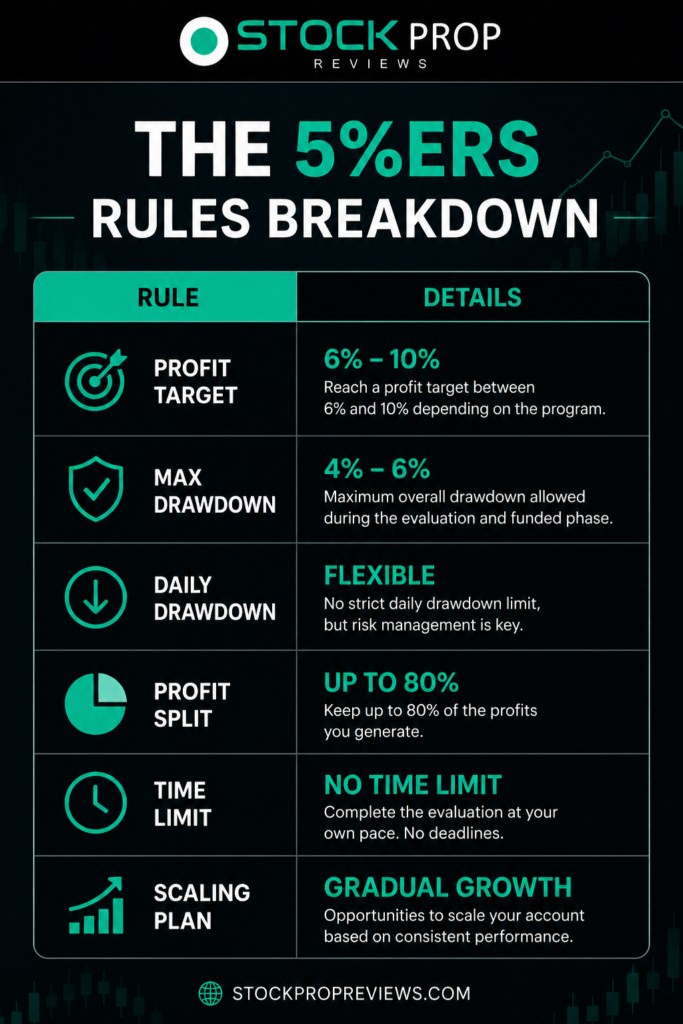
Below is a simplified view of the structure most traders deal with.
| Rule | Typical Range |
| Profit Target | Around 6% to 10% |
| Max Drawdown | Around 4% to 6% |
| Daily Drawdown | Less emphasized but still relevant |
| Profit Split | Up to 80% |
| Time Limit | No strict deadline |
| Scaling | Gradual increases |
The absence of a time limit is what attracts most traders. But the tighter drawdown is what defines the experience.
A 5% drawdown leaves very little margin for error. That is where many traders underestimate the difficulty.
How it feels in real trading
Once you start trading the difference is obvious.
No deadline means no pressure to force trades. That’s nice. You wait for cleaner setups and do not overtrade.
But there is also another thing. Many traders lose structure from absence of urgency. They second-guess decisions more, they hesitate more, and sometimes they take lower-quality trades just because they feel like they should be doing something.
This is not a matter of rules. “It’s a behavioural problem.”
What most reviews don’t explain properly
Many competitor reviews focus on the obvious advantages. The lack of time pressure is usually presented as a major benefit. It is, but only if you already have discipline.
What gets missed is how the drawdown interacts with that freedom.
A tight drawdown means you cannot afford inconsistency. Even a few poorly timed trades can end the account. There is no room to “figure things out” during the evaluation.
Another point that is often overlooked is scaling. Growth exists, but it is slow. Traders expecting fast capital increases usually get frustrated and start forcing trades. That typically leads to failure.
Why traders fail here
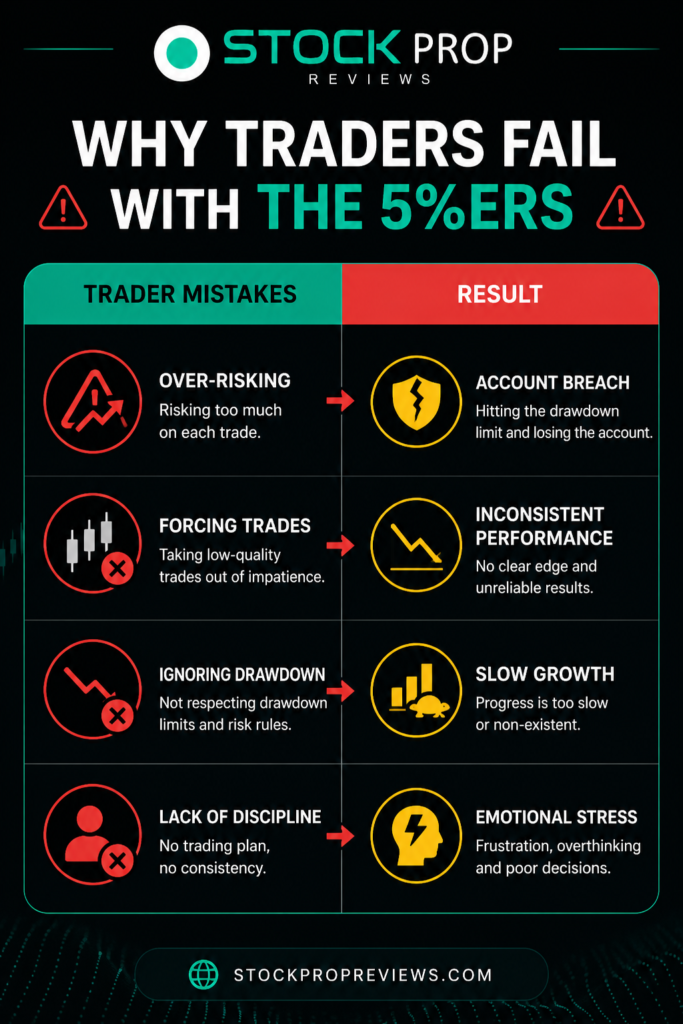
The failure is not that the rules are unfair too often. It comes from mismatched expectations.
The usual pattern is as follows:
A trader has a good plan but takes slightly more risk than they should. A few misses. They try to recover instead of slowing down. This brings them closer to drawdown limit. One more loss and it’s all over.
That isn’t possible with the structure.
This is in line with what we discussed in our article on why funded traders fail without consistency rules where discipline is more important than strategy.
Strategy fit
The 5%ers favors a specific type of trader.
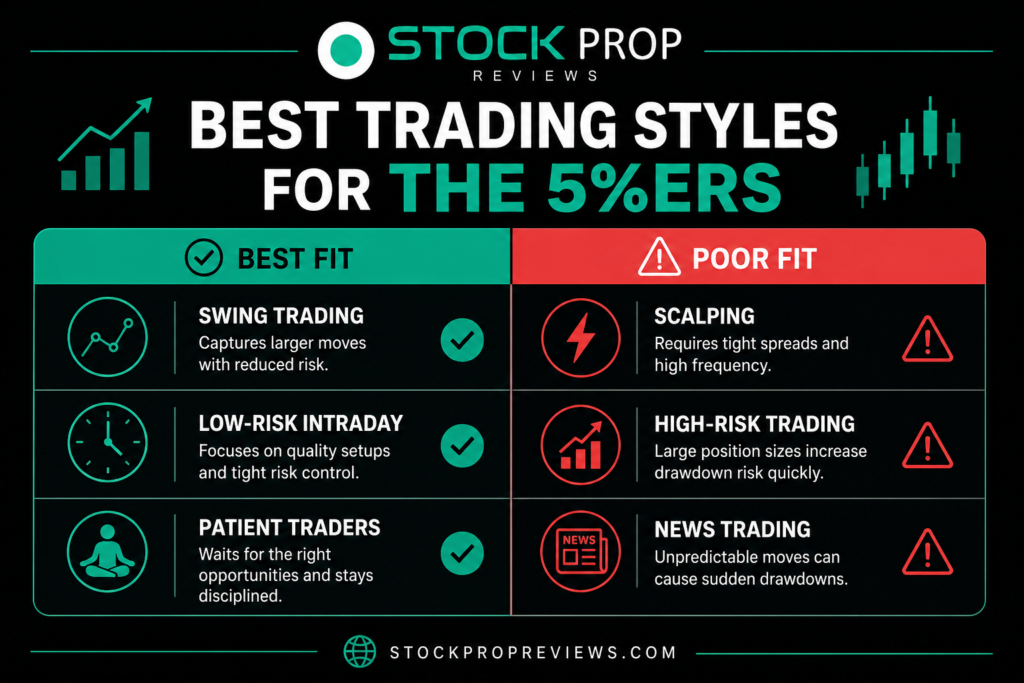
It works best for those who are already comfortable trading with low risk per position and are willing to wait for high-probability setups. Swing traders fit naturally into this model because they take fewer trades and focus on broader market moves.
It is less suitable for traders who depend on fast execution. Scalpers, for example, deal with spreads and small price movements. A few small losses can quickly add up under a tight drawdown limit.
Compared to firms discussed in our FTMO review, the difference is clear. FTMO rewards performance within a defined period. The 5%ers rewards survival and consistency over time.
Comparison with typical prop firm models
| Feature | The 5%ers | Standard Challenge Firms |
| Time Pressure | None | Strict |
| Drawdown | Tight | Moderate |
| Growth Speed | Slow | Faster |
| Trading Style Fit | Selective | Broad |
There is no universally better option here. It depends on how you trade.
If you perform well under pressure, a time-based model may actually improve your focus. If you prefer a calmer environment, The 5%ers makes more sense.
Common mistakes traders make
The biggest mistake is to think that a time limit makes the evaluation easier. It doesn’t. It only changes the difficulty.
The second common problem is risk sizing. Traders often try to speed up progress by increasing the lot size. It works for a while but usually ends up hitting the drawdown cap.
There’s also a psychological trap. Traders say they feel they have time to recover and no deadlines. That leads to lack of discipline which eventually shows in performance.
Who should avoid this firm
This firm is not built for every trading style.
If you rely on fast entries and exits, or if your strategy depends on taking many trades per day, you will struggle to stay within the risk limits.
It is also not ideal for traders who need quick feedback or fast progression. The slow scaling can feel restrictive, especially in the early stages.
In those cases, options covered in our best prop firms comparison may offer a better fit.
Alternatives to consider
FTMO remains a good option for traders who thrive on pressure and like to work towards milestones.
FundedNext is more flexible with account types, which can be a good thing for traders who are trying different things.
There is another reason why TradeThePool deserves attention. It is more stock than forex, and more clearly regulated and transparent in its risk rules. It gives a more stable framework for traders wanting to get out of forex. TradeThePool link and get up to 10% discount when you buy.
A practical perspective
Consider two traders using the same strategy.
One risks 0.5% per trade. The other risks 2%.
The first trader can handle a series of losses without hitting the drawdown limit. The second trader cannot. Even if both have the same win rate, their outcomes will be very different.
The structure rewards the first trader and filters out the second.
That is why many traders feel the firm is either very fair or very restrictive. It depends entirely on how they manage risk.
The real advantage of The 5%ers
The biggest strength is not the rules themselves. It is what those rules encourage.
They push traders toward:
- Lower risk per trade
- Better trade selection
- More consistency
For experienced traders, this can improve long-term performance.
For less experienced traders, it exposes weaknesses quickly.
TradeThePool mention in context
Some traders will learn that their strategy is better suited to another market. TradeThePool is a transparent risk parameters explicit rule stock focused option.
It’s not a direct replacement, but it may be a better fit for traders who prefer equities or a more regulated environment. Readers can get up to 10% off their purchase through our TradeThePool link.
Final thoughts
The 5%ers was not made to impress with speed. “It screens traders by discipline.
Hence the wide divergence of opinion on it. Traders who like structure, tend to like it. Flexibility is limited for traders who need it.
The firm is open about how it works. How traders can adapt to it is the question.
FAQs
Is The 5%ers good for beginners?
It can be, but only if the beginner already knows risk management. Without that the tight drawdown is hard to handle.
Can you make your account grow quickly?
Growth is possible but generally slower than other prop firms. The model prefers stability to quick wins.
No time limit, really?
Yes, but that doesn’t make the process any easier. It just takes away the pressure of time, while still keeping the risk strict.
What’s the best style of trading?
Swing trading and controlled intraday strategies usually do best in this structure.
What is the biggest problem?
Trading with low drawdown and being disciplined over time.