A rule for prop firms says that you can’t lose more than a certain amount of money in a single trading day. When that level is reached, the company either stops your trading for the day or cancels your account.
This rule is most important for traders who are being evaluated and people who have funded accounts. You don’t have to follow this rule if you only trade with your own money.
This is usually the first rule that beginners break that leads to failure. For experienced traders, this is a limit that affects how big their positions are and which trades they choose. This is not a small thing. It tells you how to trade.
Definition of daily loss limit in prop trading
A daily loss limit is the most you can lose in one trading day. It can be measured from your starting balance, your equity, or the highest equity point you reached that day.
If you break the rules, there is no negotiation. The system does it on its own.
Most traders don’t find the number itself confusing; they find it confusing how it is calculated in real time.
How prop firms calculate daily loss limits
There is no single standard. The same “5% daily loss” can behave very differently depending on the calculation method.
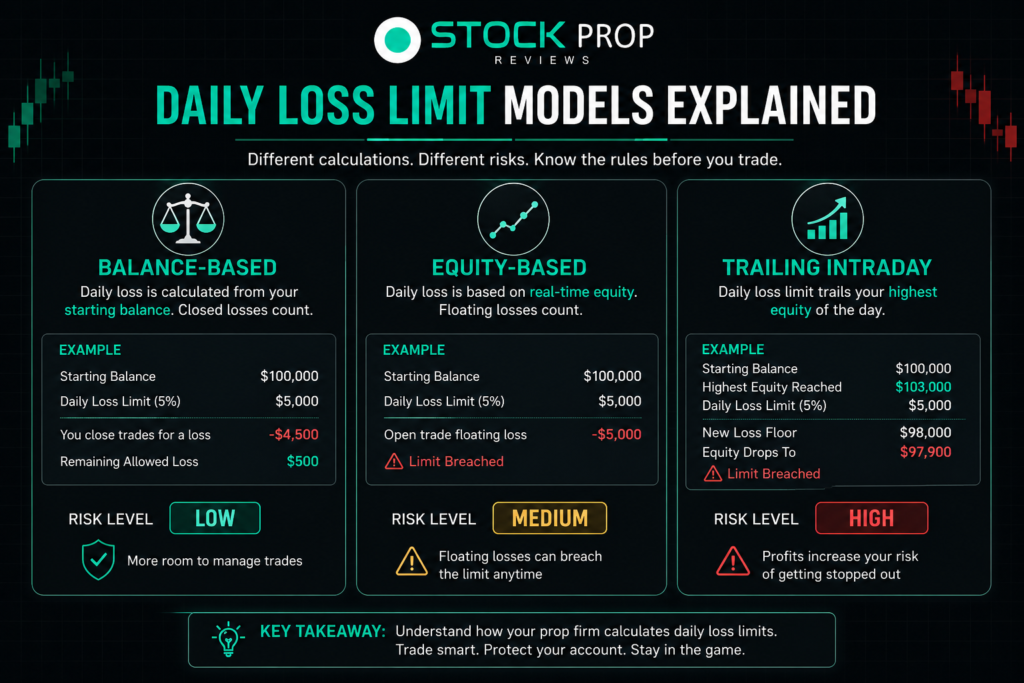
Balance-based model
This is the simplest version. The firm measures losses based on your account balance at the start of the day.
If you begin with $100,000 and your limit is $5,000, you can close trades up to -$5,000 that day. Floating losses usually do not count until you exit the trade.
This model gives traders more room to manage positions and is generally easier to handle.
Equity-based model
Here, the firm tracks your real-time equity, not just closed trades.
If your open position goes into a $5,000 loss, you have already breached the rule, even if you haven’t closed the trade yet.
This is where many traders get caught. They think they are “still in the trade,” but the system has already marked the account as failed.
Intraday trailing model
This is the most strict version, and people often get it wrong.
As your account grows during the day, the loss limit goes up. If you start with $100,000 and go up to $103,000, the allowed drawdown goes up.
Your new floor goes from $95,000 to $98,000 if the limit is $5,000. Even if you never went negative on the day, a drop from your peak can still cause a breach.
This model punishes giving back profits, which is something that happens a lot in active trading.
A real scenario most traders recognise
A trader starts the session with a $100,000 account and a $5,000 daily loss limit.
They take two clean trades and are up $2,000. Confidence builds. The next trade is larger, based on the idea that the trend will continue.
The market reverses sharply. The position goes into a $6,500 drawdown within minutes.
From the trader’s perspective, they were “still up earlier.” From the firm’s perspective, the account just violated risk limits.
This is not a rare situation. It is one of the most common ways traders lose accounts.
Why firms enforce this rule
The daily loss limit isn’t there to keep you from doing things for no reason. It fixes a very specific issue.
One bad day can ruin weeks of steady performance without it. That risk adds up quickly for a prop firm that has a lot of traders.
It also sorts out behaviour. Traders who chase losses, increase their size without thinking, or ignore risk controls tend to fail quickly. The rule quickly shows those habits.
What most articles don’t explain properly
You will find plenty of definitions online, but very few explain how this rule behaves under real conditions.
Profits don’t always give you safety
In trailing models, making money early in the day can actually tighten your margin for error. Your loss threshold moves closer than you expect.
This creates a false sense of security. Traders feel ahead, then lose control when the market shifts.
Floating losses matter more than traders think
The market doesn’t care if you closed the trade in systems that are based on equity. If your position goes against you, the loss has already been counted.
This is especially risky in fast markets, where the price can move past your level before you have a chance to react.
Strategy matters more than skill here
A good trader with the wrong approach will still fail.
For example, a scalping strategy that relies on frequent entries and variable sizing can run into the daily loss limit even with a decent win rate. The structure of the rule conflicts with how the strategy operates.
Common mistakes traders make
One pattern keeps coming back.
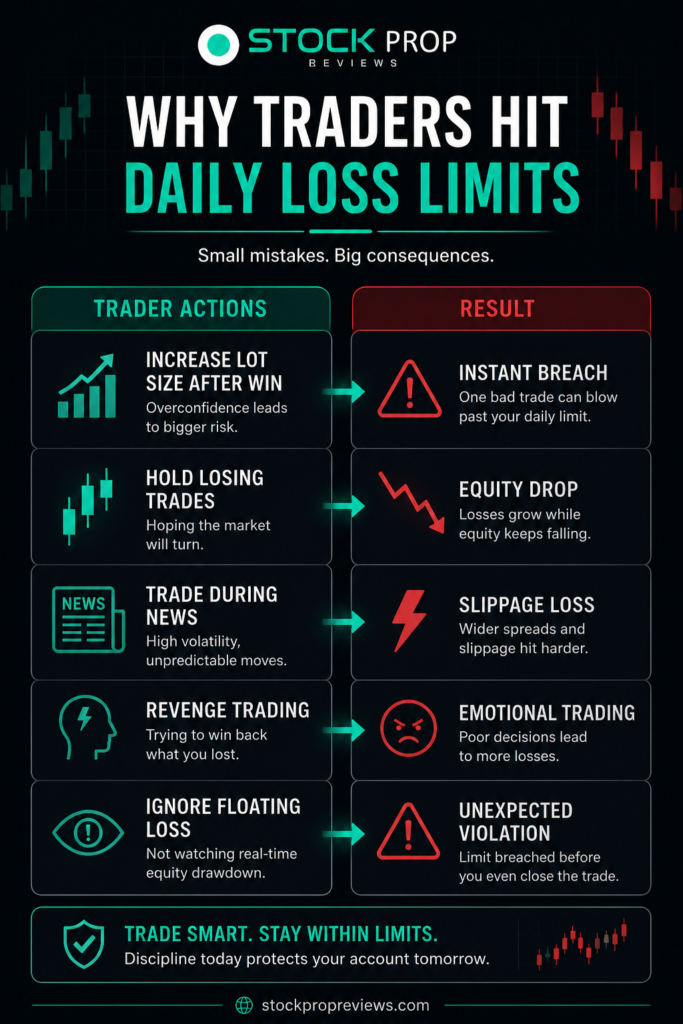
After a win, traders make their positions bigger. At the time, it seems right. There is a lot of confidence, the market is clear, and the momentum is strong.
Then a loss comes. Because the size went up, that one trade takes up a lot of the daily limit.
Another mistake is trying to make up for losses in the same session. When a trader is losing, the quality of their decisions usually goes down. They take trades they would normally avoid, even when the market is bad.
Timing is also a problem. Trading when there is a lot of news or not a lot of money in the market makes slippage more likely. A stop that is in the right place can still lead to a bigger loss than you thought.
Daily loss limit vs max drawdown
People often mix up these two rules, but they have different uses.
Every day, the daily loss limit starts over. It keeps short-term risk in check and stops one bad session from getting worse.
Max drawdown shows how much the account has lost over time. It doesn’t reset and serves as a final limit.
You can stay within your daily limit every day and still lose because of overall drawdown if your losses add up over time.
How experienced traders work around it
Traders who last in funded environments treat the daily loss limit as a hard boundary, not a guideline.
They usually keep risk per trade small enough that several losses are required to hit the limit. This gives them time to step back and reassess.
They also tend to stop trading earlier than expected. If they are down 2–3% on the day, they often walk away. Not because they cannot continue, but because the probability of making poor decisions increases.
Another adjustment is avoiding certain sessions altogether. High-impact news events and erratic market conditions are simply not worth the risk when strict limits are in place.
Who struggles the most with this rule
People who need to be flexible often find this rule to be too strict.
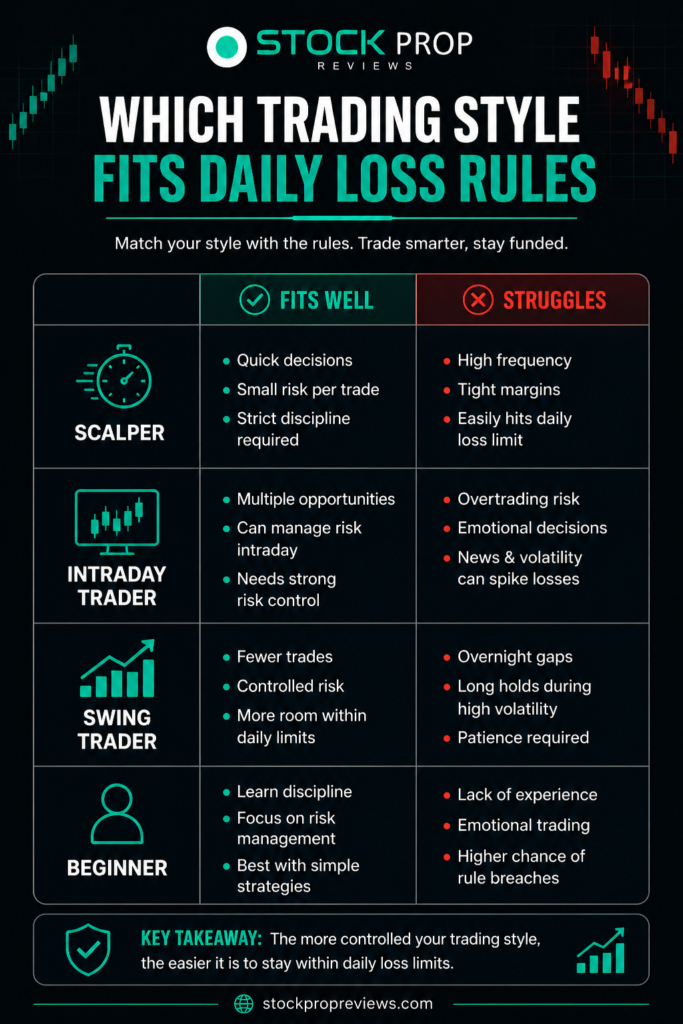
Scalpers often fit this description because they need to make trades often and make quick changes. If the execution isn’t perfect, losses add up quickly.
Traders who use recovery strategies also have a hard time. Any method that calls for increasing size after a loss goes against a fixed daily cap.
People who are new to something have a different problem. They are still learning how to be disciplined, so the rule feels more like pressure than structure. This often makes people make decisions based on their feelings.
Who it suits better
It is usually easier for swing traders and traders who trade less often to adjust.
They plan their trades with a clear risk in mind, which makes it less likely that they will trade too much in one session. The slower pace fits naturally with the limits.
Traders who already use fixed risk per trade also tend to stay within their limits without having to make big changes.
Comparing daily loss limit structures
| Model | How it behaves in practice | Typical trader reaction |
| Balance-based | Loss counted on closed trades | More confidence, sometimes too relaxed |
| Equity-based | Includes floating losses | Sudden breaches during active trades |
| Intraday trailing | Moves with profits | Frustration when giving back gains |
No model is inherently better. The issue is whether your strategy fits the structure.
Firm differences and alternatives
Some prop firms have rules that are easier to understand, while others have stricter risk frameworks.
Balance-based limits are usually easier for new traders to work with. The rules are clearer and less reactive to intraday fluctuations.
Firms that are stricter often use both equity-based limits and trailing drawdowns. These setups are meant to quickly weed out traders, not to support long adaptation periods.
When looking at different options, it can be helpful to read a full FTMO review to see how their limits work in real life. A Topstep review shows a different structure for futures traders, where trailing drawdown is more important.
A more detailed prop firm comparison guide can help you figure out which setups work best for different trading styles and how these rules differ from one company to the next.
It can also be helpful to read a more in-depth explanation of why prop firm rules are the way they are. It helps explain why so many traders have trouble with daily limits in particular.
Where TradeThePool fits in
TradeThePool approaches this differently by focusing on stock trading with clearer, more transparent risk rules.
The structure is easier to follow compared to many forex-based firms that rely on intraday trailing calculations. This reduces the chance of accidental breaches due to misunderstanding.
Readers can get up to 10% discount when purchasing through our TradeThePool link.
The main advantage here is not flexibility, but clarity. For many traders, that alone makes a difference.
The underlying reality traders face
Most traders don’t fail because they don’t know the rule. They fail because of how they act around it.
Profits early on lead to bigger trades. Losses make people feel like they have to act quickly. Both of these things bring the account closer to its limit.
The daily loss rule makes this cycle clear right away. It makes traders stick to a level of consistency that they haven’t reached yet.
FAQs
What happens when you reach your daily loss limit?
It is immediately enforced by the system. Your account may be locked for the rest of the day or permanently closed, depending on the company.
Do trades that are still open count toward the limit?
Yes, in a lot of companies. Floating losses are a part of equity-based models, which is why traders can go over limits without closing positions.
Is it possible to trade again the next day after hitting the limit?
Some companies will let you do it if the account is only locked for a day. Some people see it as a full breach and close the account.
Is a daily loss limit the same thing as a stop loss?
No. The trader sets a stop loss for each trade. The company enforces the daily loss limit at the account level.
What is the best risk per trade under this rule?
Most funded traders make between 0.5% and 1% on each trade. This stops multiple losses from reaching the daily limit too quickly.
Final perspective
The rule for daily loss limits for prop firms is easy to understand on paper but hard to follow in real life. It’s not so much about maths as it is about behaviour.
Traders who change their strategy because of it tend to stay in the game. People who think of it as a small problem usually learn the hard way.