Most traders who fail funded stage prop firm accounts do not fail because they suddenly forgot how to trade. They fail because their behavior changes the moment the account becomes “real.”
If you have already passed an evaluation or you are close to passing one, this is for you. If you are still struggling to hit a profit target consistently, this article will not help much yet. The funded stage exposes weaknesses that only show up after short term success.
The uncomfortable truth is simple: passing an evaluation proves you can hit a number. Surviving the funded stage proves you can protect capital over time.
Those are two different skills.
The Structural Difference Between Evaluation and Funded Stage
Most competitors focus on how to pass. Very few explain what changes after.
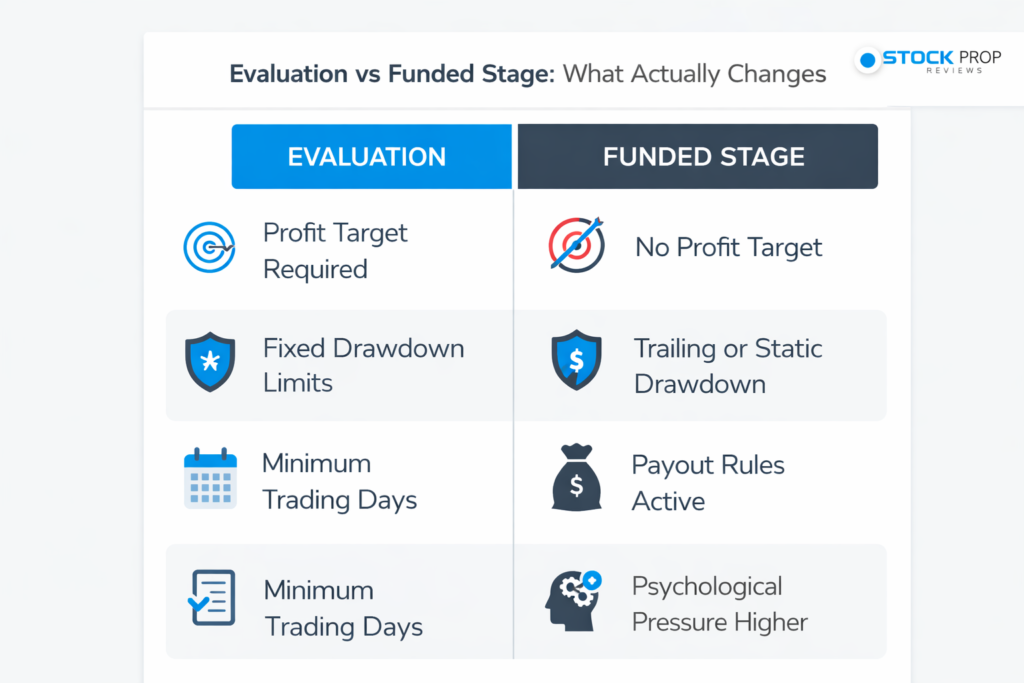
In an evaluation phase, you must:
- Hit a profit target
- Stay within daily and overall drawdown
- Trade a minimum number of days
It is a short performance test.
In the funded stage, the profit target is often removed. Instead, you deal with:
- Trailing or static drawdown
- Rules for payouts
- Requirements for consistency
- Stress on the mind
The rules might look the same on paper. In real life, the incentives are very different.
You have to be careful during the evaluation because if you fail, you have to start over. A lot of traders feel validated and work harder during the funded stage. Most accounts break at that point.
Quick Verdict
If you keep failing funded stage prop firm accounts, it’s usually because you took on more risk after passing.
- You didn’t get trailing drawdown right.
- You changed your plan
- You wanted a quick payout.
It’s not always just about the company. It’s usually about how people act when they’re under stress.
Typical Rule Comparison
Here is how evaluation and funded rules often differ across futures and CFD firms:
| Rule | Evaluation | Funded Stage |
| Profit Target | Required | Removed |
| Max Daily Loss | Fixed | Same |
| Max Overall Loss | Static or trailing | Often trailing |
| Profit Split | None | 70 to 90 percent |
| Payout Eligibility | Not applicable | After minimum days |
The trailing drawdown detail is critical. Many traders do not fully understand how it reacts to new equity highs.
The Real Reasons Traders Fail the Funded Stage
Risk Expansion After Passing
This is the pattern I see the most often.
During evaluation, a trader risks 0.5 percent of their money on each trade. They pass. They risk 1.5 or 2 percent once they get money because “now it matters.”
One bad day wipes out weeks of hard work.
The strategy didn’t change at all. Only the size of the position changed.
If you could pass with a 0.5 percent risk, you can live with a 0.5 percent risk. Most of the time, the desire to scale right away is emotional, not strategic.
Trailing Drawdown Confusion
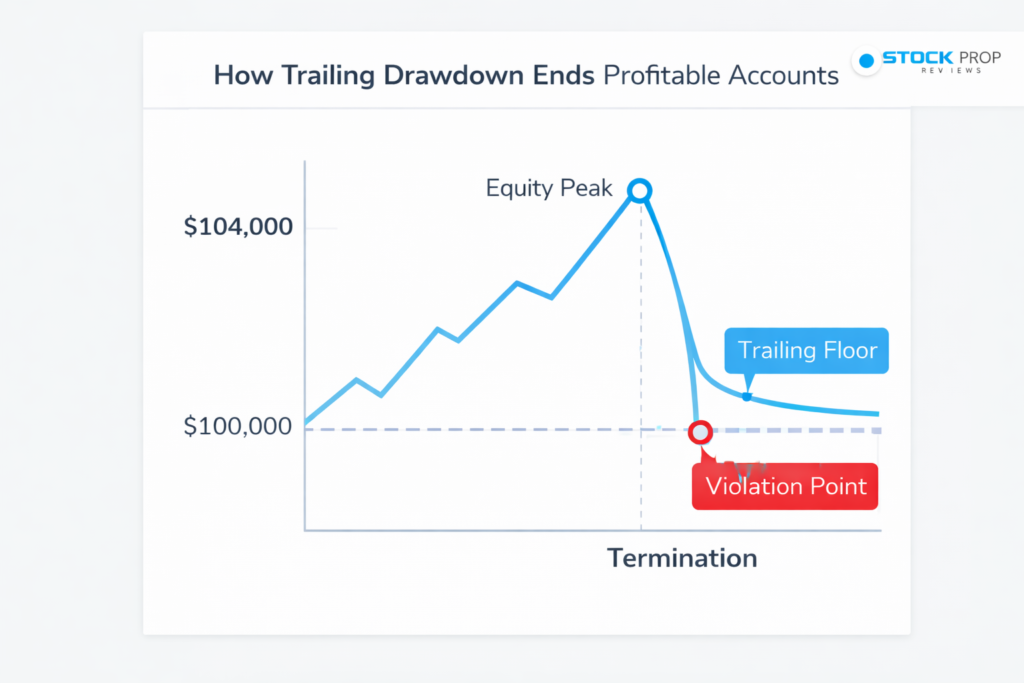
Let’s use a basic example.
You begin with 100,000.
Your trailing drawdown is $5,000.
You push the account up to 104,000.
Your effective floor could now go up to 99,000.
The account ends if you give back 5,000 from the peak, even if you are still above your starting balance.
A lot of traders fail at this point in the funded stage prop firm accounts. They go up quickly, feel good about themselves, and then lose too much during normal market fluctuations
Many traders underestimate how strict trailing drawdown rules can be. Our detailed TopStep review explains why many traders pass evaluations but fail once real funding pressure begins..
Because the target ended the phase, the evaluation did not punish that behaviour. The funded stage goes on forever.
Trailing drawdown is one of the biggest reasons traders lose funded accounts. Our analysis of FundingPips rules and drawdown breakdown shows how traders can violate risk limits even while their account is still profitable.
Payout Pressure
As soon as traders can split their profits, they feel the need to act.
They trade calendars instead of trading processes.
“I need one more strong week before I get paid.”
That way of thinking leads to:
- Too much trading
- Trading setups of lower quality
- Holding through news without an edge
Many funded accounts fail on their first attempt to make a payout.
It’s not because they don’t know how. It’s being impatient.
Strategy Drift
The strategy that passed evaluation was usually tight and selective.
After funding, traders:
- Add more pairs
- Trade more sessions
- Take marginal setups
- Increase frequency
They stop doing what worked.
In our FTMO review, we break down how static drawdown models reward consistency over frequency. The same applies here. Discipline, not aggression, survives longer.
What Most Articles Do Not Tell You
There is one pattern that stands out after reading the content of major competitors. They concentrate on how to evaluate. There isn’t much room for long-term survival.
People often don’t pay attention to three things.
First, short-term changes can help you do well on an evaluation. A good week in the market can help you get through. That doesn’t mean your edge will stay the same.
Second, most funded failures happen when the company is making money, not when it is losing a lot of money. Traders push equity up, trailing drawdown goes up, and a normal pullback breaks the rule.
Third, rules about consistency quietly punish equity curves that are spiky. Some companies limit how much profit they can make in a single day. In response, traders push harder and often hit drawdown.
You can see how structural differences in trailing models affect survival odds if you read our comparison of FTMO and MyFundedFutures.
Real Trading Scenarios
The News Spike Trap
A scalper buys and sells CPI. Makes 3,000 in a few minutes. Keeps trading even when things are unstable. Slippage and whipsaw take back 4,000.
The trailing floor has changed. The account is no longer open.
From the trader’s point of view, they still made money that week. From the point of view of the rules, they broke the peak drawdown.
The Slow Erosion
Another trader passes the test but only with strict limits: two trades a day and a set amount of risk.
Once they have money, they can make five trades a day. The win rate goes down a little. There isn’t anything big that happens. But small losses add up. A normal red day reaches its maximum daily loss.
Account is gone.
Not a big deal. It’s just a change in structure.
The Size Jump
A trader wants to get their money faster. Doubles in size after a week of making money.
Two losing trades now equal five losing days in the evaluation phase.
Stress on the mind goes up. Execution gets worse. Drawdown speeds up.
This kind of pattern happens all the time.
Data and Psychology Behind the Pattern
Statistically speaking, good market conditions and positive variance can help you reach short-term profit goals.
For long-term survival, you need to be able to expect things to stay the same and be able to control your risks across different market regimes.
Most retail traders don’t realise how much of their success in evaluating was based on market conditions.
After funding, three changes happen in the mind:
- Validation and too much confidence
- Fear of losing funding status
- Need to take out profits quickly
Even when traders think they are being rational, these forces push them toward higher risk.
Futures Models vs Regulated Stock Prop Firms
Not all prop firm structures create the same failure pressure.
| Factor | Futures/CFD Prop | Regulated Stock Prop |
| Trailing Drawdown | Common | Rare |
| Static Drawdown | Sometimes | Common |
| Leverage | High | Moderate |
| Rule Transparency | Varies | Typically clearer |
Regulated stock prop firms such as TradeThePool operate with clearer static drawdown frameworks. There is less ambiguity around how equity peaks affect termination levels.
Readers can get up to 10% discount when purchasing through our TradeThePool link.
This is not about guarantees. It is about understanding structure. Clearer rules reduce confusion, but they do not replace discipline.
Who Is Most Likely to Fail Funded Stage
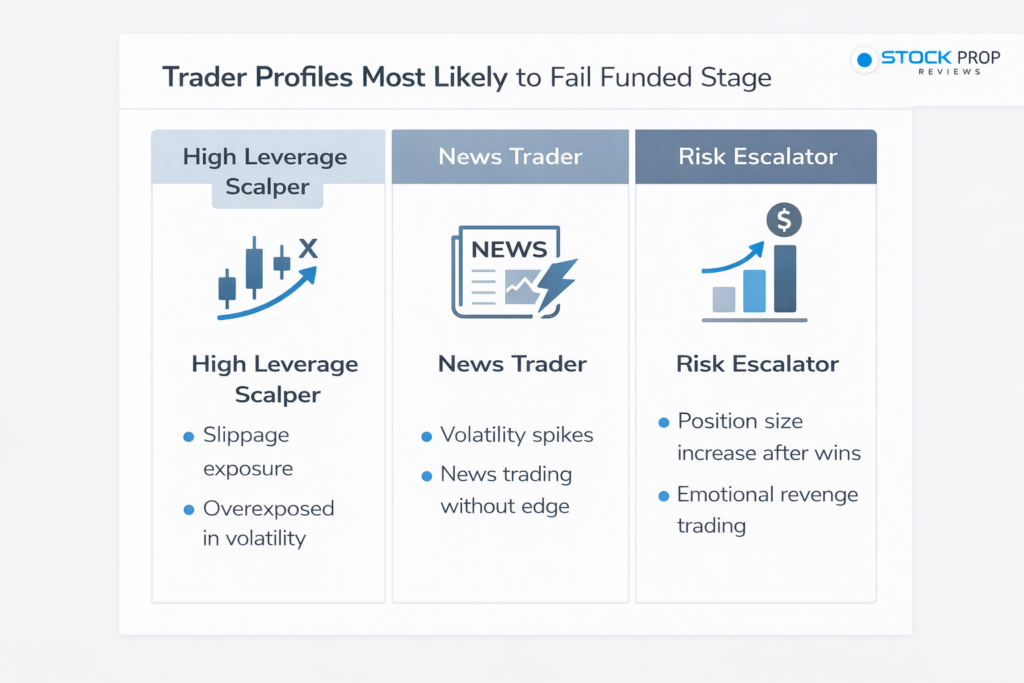
Scalpers with high leverage often have trouble because small mistakes can quickly add up.
News traders have to deal with a lot of volatility and slippage, which doesn’t work well with trailing models.
Traders who sometimes use large R multiples also have trouble with trailing equity floors.
You need to know how consistency rules affect payouts if your system doesn’t pay out evenly.
In our review of MyFundedFutures, we go into more detail about how trailing models increase exposure to volatility by breaking down the risk structure.
Balanced View: It Is Not Always the Trader
Some firms complicate the problem with:
- Poor rule clarity
- Inconsistent enforcement
- Hidden restrictions in payout policies
That is why reviewing transparency matters.
However, even transparent firms see high funded stage failure rates. Structure can reduce confusion, but it cannot prevent emotional overreach.
The Core Truth
Passing the evaluation shows that you can make money once.
The funded stage tests whether you can keep yourself from sabotaging yourself over and over again.
Most traders pay attention to entries and targets. Not many people focus on protecting their long-term capital within fixed risk limits.
Stop trying to pass faster if you keep failing funded stage prop firm accounts. Try to stay alive longer.
Make it smaller. Keep the same level of risk that you used to pass. Don’t trade right after big jumps in stock prices. Keep an eye on your drawdown floor every day.
The funded stage should feel like you have control over it and be a little boring.
If it feels like you have to do it right away, the risk is probably too high.
Alternatives If You Keep Failing
If trailing drawdown keeps hurting your strategy, you might want to make some changes to the structure.
TradeThePool is a regulated stock prop model that has a static drawdown and clearer risk metrics. That works for traders who would rather have stability than high leverage. When you buy through our TradeThePool link, you can save up to 10%.
You could also look into smaller account sizes. Lower nominal capital often lowers mental stress and the chance of things getting worse.
Or, before you commit again, carefully look over the structures of the firms, like we did in our FTMO review.
Changing the structure won’t fix discipline, but it might be more in line with your strategy.
FAQs
Why do traders fail funded stage prop firm accounts so quickly?
Because they raise the risk after passing and don’t realise how trailing drawdown reacts to big profits.
Is it harder to get funded than to evaluate?
Similar in structure, but harder on the mind. There is no goal, but there is always a chance of danger.
Does trailing drawdown cause most funded failures?
It plays a big role in futures and CFD firms, especially for traders whose equity curves change a lot.
Should I change my plan after I get money?
No. Most failures happen when traders stop using the risk model that helped them pass.
Are regulated stock prop firms safer?
They often have clearer static drawdown structures, but discipline and risk control are still what keeps them alive.