If you’re looking for high-profit split prop firms, you’re probably asking yourself a simple question: where can I keep most of what I make?
Yes, several companies do advertise profit splits of 90% to 95%. The longer answer is that the percentage by itself doesn’t tell you if you’ll really get paid. High splits usually mean stricter rules, scaling conditions, or consistency requirements that make it harder for traders to reach the payout stage.
This guide is for traders who are already funded or almost funded and know how drawdown works and how much risk there is per trade. It is not meant for complete beginners who are still having trouble being consistent. A 95 percent split won’t help you if you can’t control your daily loss limits yet.
We compare the best choices below and explain what most articles by competitors don’t.
What High Profit Split Prop Firms Actually Mean
A high profit split prop firm pays traders 90 percent or more of generated profits after passing evaluation or under an instant funding model.
In theory:
- 80 percent split on 10,000 profit = 8,000 payout
- 90 percent split on 10,000 profit = 9,000 payout
That 1,000 difference matters. But only if:
- You survive long enough to request payouts
- You do not breach daily or total drawdown
- You meet consistency rules
Many traders fail between passing and first payout. That gap is rarely discussed in marketing content.
Before reaching any profit split stage, traders must first pass the prop firm evaluation process, where they must prove consistent performance while respecting strict risk limits.
Comparison Table: High Profit Split Prop Firms
Below is a simplified comparison based on publicly advertised structures.
| Firm | Advertised Max Split | Drawdown Type | Scaling Needed for Max Split | Key Restrictions |
| FundedNext | Up to 90% | Static and trailing models | Yes | Consistency rule on some accounts |
| FundedElite | Up to 95% | Trailing drawdown | Yes | Strict daily profit balance rules |
| Atlas Funded | Up to 90% | Static | Yes | Minimum trading days |
| TradeThePool | Up to 80% base | Static | Yes | Stock-only, regulated structure |
Important: Many companies say they have 95 percent or more, but that number is often unlocked after certain milestones are reached. The first payout might not match the headline percentage.
Firm Breakdown and Practical View
FundedNext
FundedNext offers multiple models, including both static and trailing drawdown structures. The advertised split can reach 90 percent.
Quick verdict
Better suited for traders who understand consistency metrics and can distribute profits across multiple days.
What traders overlook
If a large portion of your monthly profit comes from one strong day, you may violate internal consistency parameters. This is common among breakout traders and news traders.
Who should avoid it
Traders who depend on one or two high-volatility sessions per month.
For a deeper structural look, see our detailed FundedNext review where we break down model differences and payout timing.
FundedElite
FundedElite offers profit splits of up to 95%, which draws in aggressive traders right away.
A quick decision
It looks good on paper, but the way drawdowns work means you have to be very careful with your money.
What competitors don’t say
Trailing drawdown moves with your high equity. Your maximum loss gets smaller if you make a lot of money quickly and then lose it. After a good start, many traders lose their jobs because they get too big too quickly.
Real life
A trader makes 6% in the first week and then raises the lot size. Even if the account is still up overall, two losing trades during a pullback can break trailing limits.
People who should stay away from it
Scalpers who take on more risk after winning streaks.
Atlas Funded
Atlas Funded promotes 90 percent splits under static drawdown models.
Quick verdict
Static drawdown is structurally easier for swing traders.
What matters
Minimum trading days and pacing rules can delay payouts if you hit target too quickly.
This model works better for traders who grow equity steadily rather than in bursts.
TradeThePool
BusinessThePool works in a different way than most companies that deal with CFDs. It focuses on trading stocks and stresses having clear rules and a regulated structure.
The base split is lower than what some aggressive 95 percent marketing companies offer, but the rules are clear and the risk parameters are clear.
This model can help traders who care more about structural clarity than headline percentages feel less stressed. When readers buy through our TradeThePool link, they can save up to 10%.
It isn’t meant for forex scalpers who want to use a lot of leverage. It works better for structured equity traders..
Profit Split Versus Drawdown Structure
This is where most comparison articles fall short.
Profit split is only one variable. Drawdown structure determines survival.
Static drawdown
Your maximum loss limit stays fixed. If total drawdown is 10,000, it remains 10,000.
Trailing drawdown
As your account reaches new highs, your maximum loss threshold goes up. If you make 8,000, your maximum loss often goes up. A sharp drop can wipe out your account even if you are making money overall.
Static models are often easier for swing traders who hold positions for several days to deal with. After making early gains, trailing models can become limiting for aggressive intraday traders.
In our article comparing static and trailing drawdowns, we go into more detail about this and show how profit spikes can backfire.
Many traders focus on profit split percentages but ignore how risk limits actually work. Understanding prop firm drawdown rules is critical because exceeding daily or overall limits immediately violates your account.
How Traders Actually Fail With High Splits
From a performance standpoint, the majority of failures are not technical in nature. They are mental.
Some common patterns are:
- Risk goes up after passing the test.
- Trying to get the most money possible from an early payout because of a high split
- Not paying attention to the daily loss limit when things are unstable
- Not knowing you are breaking consistency rules
It’s ironic that a 95% split can put more pressure on you than an 80% split. Traders think they have to “make it worth it,” which makes their positions bigger.
Many traders discover this problem after funding. Our detailed FundingPips review shows how trailing drawdown and aggressive trading during profitable weeks often eliminate otherwise profitable traders.
In our article about whether you can live off of prop firm trading, we talked about how unpredictable monthly performance makes it hard to plan your income. This is also true here. Stability is more important than percentages in the news.
Strategy Fit Analysis
Swing Traders
Generally better for firms with a 90 percent split, especially when the drawdown is static.
They tend to:
- Trade less often
- Don’t trade too much
- Spread out your profits over several sessions.
The main risk is gaps that happen overnight. Traders need to check their weekend holding policies..
Intraday Scalpers
High-split firms are in a higher risk category.
Scalpers often:
- make a lot of money in one strong session.
- After momentum builds, raise the lot size.
- Get used to quick changes
This combination goes against the rules for trailing drawdown and consistency.
Be careful if you depend a lot on CPI, NFP, or news volatility spikes. High splits don’t make up for structural weakness.
Futures Traders
In futures models, leverage is embedded in contract structure. A single oversized position can exceed daily loss limits quickly.
High splits only benefit futures traders who already use strict fixed-dollar risk per contract. Otherwise, the failure rate increases.
Data Versus Emotion
Let’s quantify it.
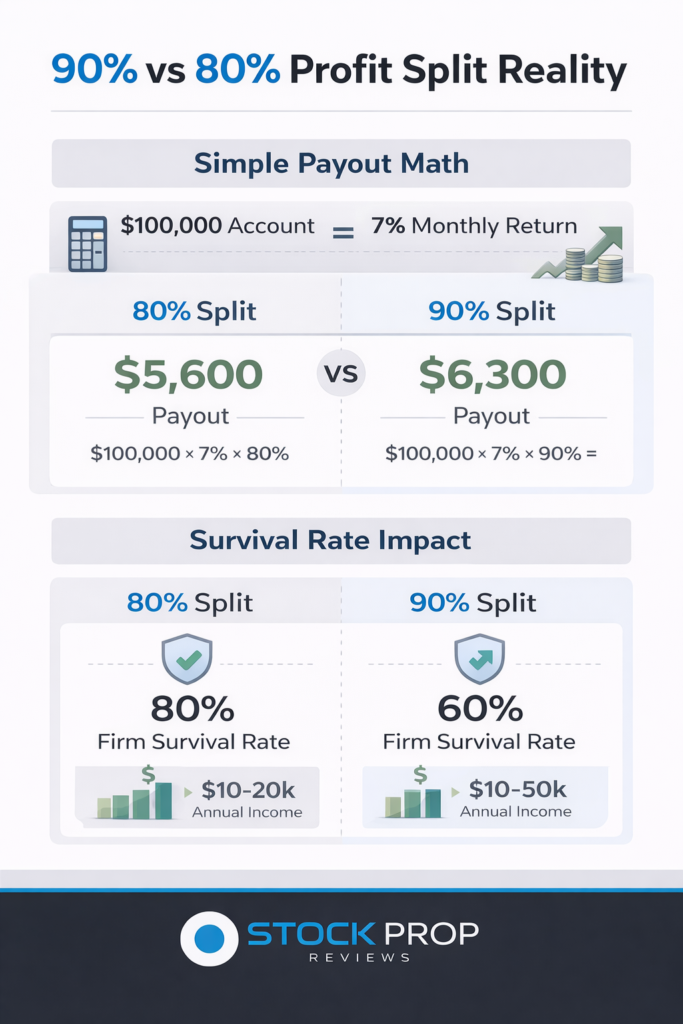
Account size: 100,000
Monthly return: 7 percent
Gross profit: 7,000
At 80 percent split
You receive 5,600
At 90 percent split
You receive 6,300
Difference: 700
Now consider probability of breach.
If stricter rules reduce your monthly survival rate from 80 percent to 60 percent, your annual expected value may actually drop despite higher split.
This is where disciplined traders think differently. They evaluate rule structure before percentage.
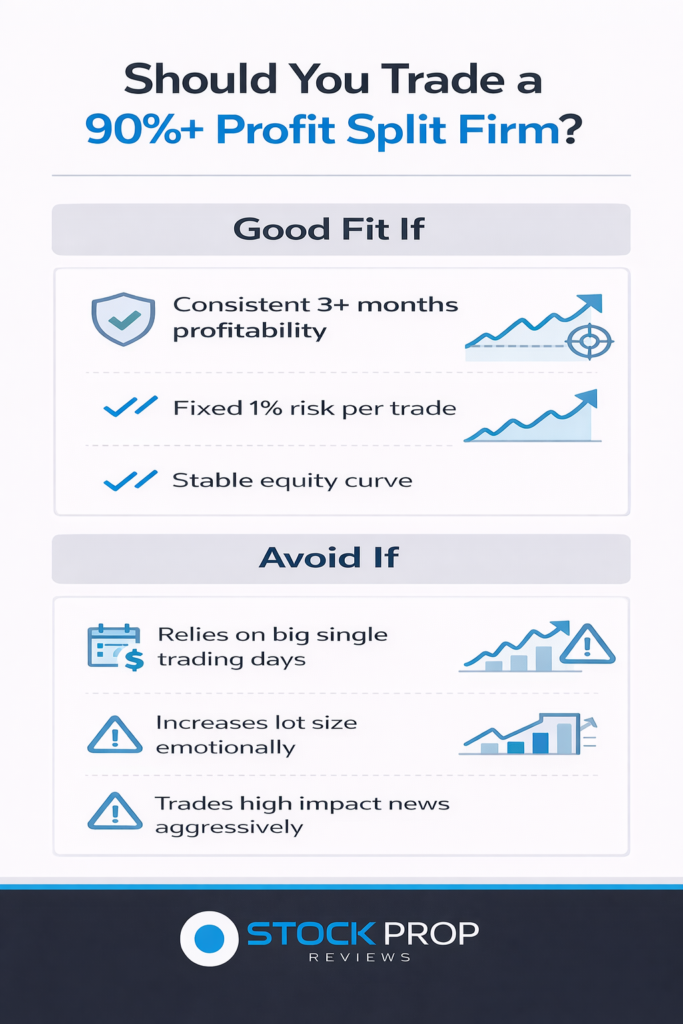
Who Should Avoid High Profit Split Prop Firms
If your equity curve depends on a few big days, you should think about 90 percent or more of the companies.
- You often change the lot size based on how you feel.
- You have a hard time stopping trading when you lose money every day.
- You haven’t had three months in a row of making money.
In those situations, a simpler structure with a moderate split can lead to more money over time.
Balanced Perspective
There is nothing wrong with prop firms that take a lot of money. They are business models that compete with each other to meet trader demand.
But the story that the marketing tells is about the highest possible payout. Professional traders are all about keeping risks under control.
A trader who can stay in the market for 12 months at 80% will do better than one who keeps losing at 95%.
When evaluating firms, prioritize:
- Drawdown structure
- Daily loss cap
- Consistency rules
- Payout frequency
- Your own trading psychology
Only then should you look at split percentage.
For traders who prefer structured equity trading within a transparent framework, TradeThePool provides a more regulated approach compared to many offshore CFD models. Readers can get up to 10 percent discount when purchasing through our TradeThePool link. It may not advertise extreme splits, but clarity and rule stability matter more over time.
Even experienced traders struggle once real payouts are involved. As explained in our Topstep review, most traders fail after funding not because of bad strategies but because their behaviour changes once real capital and payouts are on the line.
FAQs
Are prop firms that split profits 100% real?
Some companies offer promotional 100 percent splits for the first payout or after certain scaling milestones. Most of the time, these structures are not permanent and are only there for a short time.
Is it always better to have 90% than 80%?
You can only get paid if you reach the payout stage every time. More strict rules can lower your overall chance of survival.
Do higher splits mean stricter rules?
Yes, a lot of the time. A lot of companies balance higher splits with trailing drawdowns or requirements for consistency.
What matters more than the profit split?
Your own discipline, the drawdown model, the payout reliability, and the rule transparency.
Can 90 percent split firms help beginners succeed?
Possible, but not likely unless there is proof of consistency. First, beginners should focus on making the process stable.
Choosing among high profit split prop firms should not be about chasing the biggest percentage. It should be about matching your strategy and psychology to the rule structure.
Percentage multiplies performance. It does not create it.