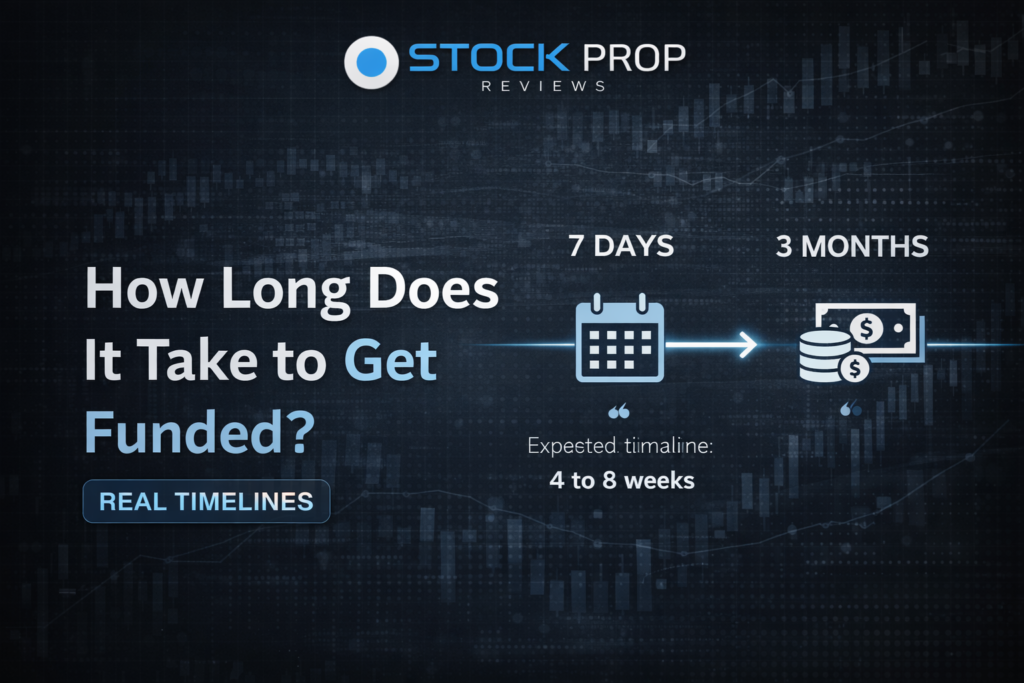
If you’re wondering how long it takes to get funded at a prop firm, the truth is that most disciplined traders take 4 to 8 weeks, while beginners often take several months, including failed attempts.
Yes, you can technically pass in a week. Not many traders do it without losing at least one account first.
This article is for new traders and traders who are still in the evaluation stage and want to know what to expect. It is not for traders who want quick money or easy ways to trade. The timeline has less to do with the company and more to do with how well you can control your risk, your mental state, and your ability to follow rules when you’re under pressure.
Let’s talk about what really happens when you trade.
What “Getting Funded” Really Means
When you trade prop, you usually need to get money in the following ways:
You buy a problem.
You reached your profit goal.
You follow the rules about drawdown limits.
You pass verification if you need to.
You get an account with money in it.
You make money and ask for a payout.
Most articles by competitors end with “pass the challenge.” That’s only part of the story. The real goal is to stay alive long enough to keep withdrawing.
If you pass in five days but lose the funded account in two weeks, the speed didn’t matter.
If you’re new to prop trading, it helps to understand the structure first. Our guide on how stock prop firms work explains how evaluations, funding, and profit splits actually operate in practice.
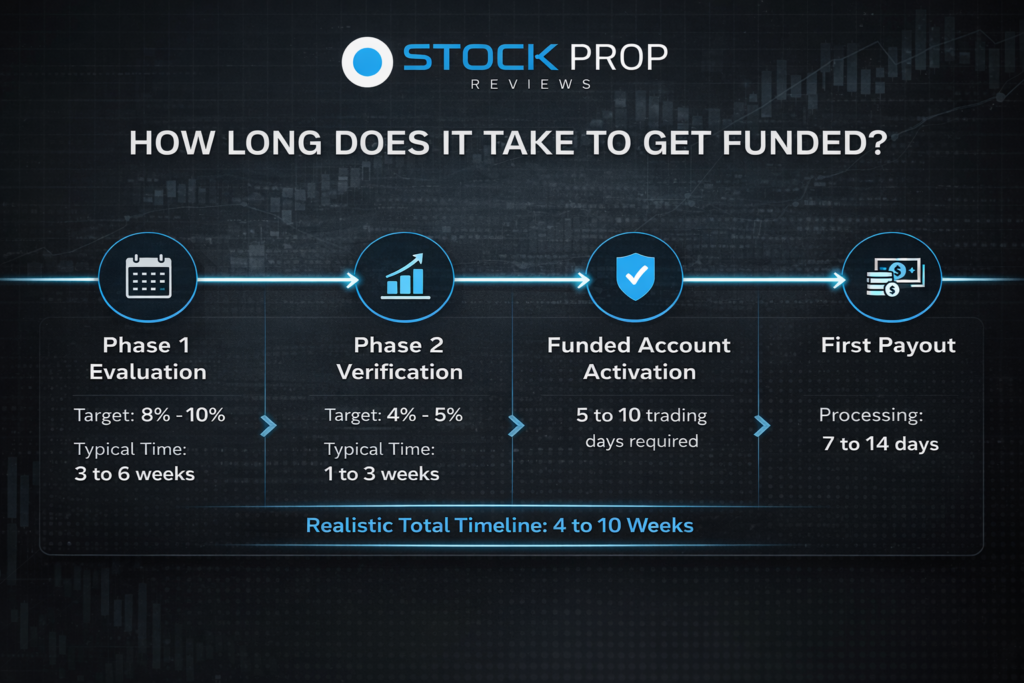
Typical Timeline From Purchase to First Payout
This is what most traders go through in a standard two-phase evaluation model.
The goal for Phase 1 is usually to make 8% to 10% more money.
A trader who is consistent and risks 0.5% to 1% of their money per trade usually needs 3 to 6 weeks.
The goal for Phase 2 is smaller, usually 4% to 5%.
This could take another week to three weeks.
You usually have to wait 5 to 10 trading days after getting money before you can ask for a payout. It takes another week or two to process.
That means the real timeline is between 4 and 10 weeks.
Beginners often have to try many times. That makes the time frame three months or longer.
Why Some Traders Pass in One Week
It happens. Usually only two things need to happen.
First, the market is moving in a strong direction.
Second, the trader takes on more risk than is reasonable.
If you risk 2% per trade and catch a strong move, you can hit 8% in a few sessions. The problem is sustainability. The same risk profile often breaks daily loss rules when the market is normal.
Speed and survival don’t often go hand in hand.
How Risk Management Changes the Timeline
Let’s look at a real-life example.
A trader takes a 0.5% risk on each trade.
The rate of winning is 50%.
The average reward is twice the risk.
That trader needs about 8 to 12 good trades to get to 8%. For someone who takes 3 to 4 setups a week, that usually means at least 3 to 4 weeks.
Now, think about a trader who puts 2% of their money at risk with each trade.
They only need a few trades that go their way to reach their goal.
But if they lose two times in a row, they could be close to a daily drawdown.
Most of the time, when a challenge fails, it’s not because of a bad strategy. They are failures in position sizing.
Our article on why traders lose accounts after payout makes this very clear. The most common reasons are being too sure of themselves and letting their accounts get too big.

One-Phase vs Two-Phase Timelines
One-phase models look better on paper. You only hit one goal. No stage for verification.
But profit targets are usually higher, and trailing drawdown is more aggressive. Traders who want to get through quickly often break the rules and push size.
Models with two phases slow you down. That can really help with discipline. A lot of traders stabilize during verification because the second target is smaller.
If you’re not sure which structure is best for your strategy, our prop firm comparison breakdown shows how different evaluation models affect speed and survival rate.
What Most Articles Don’t Explain
After reviewing several large industry posts, a few important realities are often skipped.
Reset Cycles
Many traders do not pass on their first attempt. One failed challenge plus one reset adds weeks or months. The timeline should include likely setbacks.
Trailing Drawdown Pressure
As your equity goes up, the trailing drawdown goes up too. If you make a lot of money quickly, your maximum loss goes up too. Even though you were making money before, a normal pullback can suddenly break limits.
One reason timelines stretch longer than expected is misunderstanding risk limits. Our breakdown of daily drawdown vs overall drawdown rules explains why these limits stop many traders before they ever reach payout.
This is especially risky for scalpers who quickly increase their bets after winning early.
Emotional Escalation
It feels different to trade with evaluation than to trade with a demo. When real money and the chance to win money are at stake, people act differently.
A lot of the time, traders:
After a winning streak, make the lot size bigger.
Make trades follow the rules for minimum trading days.
Trade news that changes quickly without changing risk
These actions make the timeline longer because they cause failures.
Beginner Timeline Reality
If you’re new to structured risk trading, here’s a more realistic expectation.
The first two to three months are usually spent getting used to the rules about how much you can lose each day. A lot of new traders are used to flexible retail accounts that don’t strictly enforce drawdown.
A beginner might:
Fail the first challenge because you traded too much
Pass the second try after lowering the risk
Lose funded account by making it bigger
It can take beginners three to six months to get their funded performance to a stable level.
Once risk becomes automatic and not emotional, the timeline gets a lot better.
Strategy Type and Funding Speed
Different strategies have different effects on the timeline.
Swing traders usually take longer to reach their goals because they trade fewer setups. But they usually last longer because they avoid noise and slippage during the day.
Scalpers can get through quickly during weeks when prices are moving a lot. But they are more likely to have problems with spreads widening, execution, and daily loss limits.
The news traders have the most unpredictable market. Just slippage can make risk calculations wrong.
If you trade futures instead of CFDs, the timeline may change a little. Some futures companies use static drawdown instead of trailing models, which makes people feel less stressed. Our breakdown of futures vs. CFD prop firms shows how changes in rule structure affect risk.
Account Size and Psychological Pressure
In terms of percentages, the targets are the same no matter how big the account is. An 8% goal on a 10K account is the same as an 8% goal on a 100K account.
It feels different in my head.
More money in an account means bigger swings in the dollar. Traders act differently when daily changes are worth several hundred dollars instead of tens, even if the risk percentage stays the same.
That hesitation often makes things take longer or makes them overcompensate.
Having more money in your account doesn’t always mean you’ll get money faster.
Where TradeThePool Fits in Timeline Expectations
TradeThePool is a regulated stock prop firm with clear and open rules about risk. That clarity is important when figuring out how long it will take to get money.
There are no changes that happen in the middle of a challenge. Limits on daily losses and buying power are clearly spelled out.
This does not make it easier to pass. It makes the process easier to guess. Traders don’t have to deal with surprises when rules are predictable, which often shortens the adjustment phase.
When you buy through our TradeThePool link, you can save up to 10%.
Not speed promises, but rule transparency is the main benefit here.
Why Traders Lose After Getting Funded
One uncomfortable truth: getting funded is often easier than staying funded.
Once traders receive a funded account, they feel pressure to generate payout quickly. That leads to:
Increasing risk per trade
Trading outside strategy
Holding losers longer to avoid red days
The timeline resets again if the funded account is lost.
This pattern is visible in our detailed FTMO review and other prop firm reviews where trailing drawdown and emotional escalation are common risk factors.
Many traders assume passing the evaluation is the hard part, but the reality is different. Our detailed TopStep review shows why most traders fail after funding and how trailing drawdown pressure changes behaviour.
If your goal is consistent payouts, you should think in months, not days.
A Realistic Timeline Framework
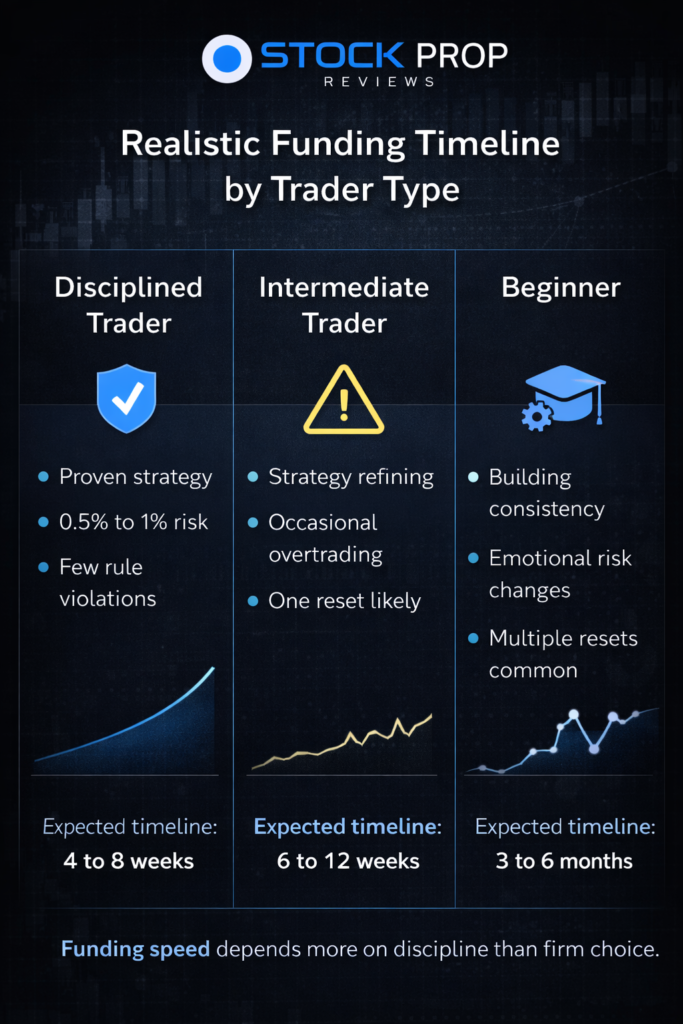
Don’t ask how fast you can pass; instead, ask what group you belong to.
Disciplined trader with a set strategy and a risk of 0.5% to 1%:
Expect it to take 4 to 8 weeks, including the payout.
Intermediate trader is still working on being consistent:
Expect it to take 6 to 12 weeks, with at least one reset.
Beginner moving from a demo to a rules-based environment:
You should expect stable funded results in three to six months.
Anyone who says they can get you guaranteed funding in less than two weeks is either ignoring the chances of failure or taking a lot of risks.
Who Should Avoid Prop Challenges Right Now
If you always move your stop losses.
If you double the size of your position after a win.
If you have trouble accepting a small red day.
You are likely to make your timeline a lot longer.
Models for prop firms reward stability. They punish sudden changes in mood. Funding attempts often turn into repeated resets until risk discipline becomes automatic.
The Direct Answer
How long does it take to get funded prop firm accounts?
The shortest amount of time is about seven trading days.
4 to 8 weeks is a reasonable time frame for disciplined traders.
Realistic for beginners: a few months, with some setbacks.
The company is not the most important thing. It’s how you act when you’re under stress.
FAQs
Is it possible to get money in two weeks?
Yes, but it usually takes a higher risk or very strong market conditions. Most traders who try this fail at least once before they get it right.
Does it take longer to pass a bigger account?
The percentage goals are the same, but the mental pressure is higher. A lot of traders are more hesitant when they have bigger accounts, which can slow things down.
Are one-phase prop firms quicker?
They might be faster in terms of structure, but higher targets and strict drawdown rules often make people fail more often.
Why do traders fail as soon as they get money?
They raise the risk too quickly or don’t get the trailing drawdown rules right. When payouts are possible, emotional pressure goes up.
Is it important to be fast in prop trading?
Consistency is more important than speed. A slower, more stable pass usually means longer survival with funding.