Swing traders often have to hold their positions over the weekend. If you have to close your positions every Friday, you won’t be able to take advantage of multi-day price moves that many trading strategies depend on. This is why traders looking for funded accounts that let them hold trades for longer periods of time are searching for prop firms that are open on weekends.
Some proprietary trading firms allow weekend exposure, but the rule is often misunderstood. Just because you can trade on the weekends doesn’t mean that swing trading is always a good idea. Drawdown models, leverage limits, and how floating losses are figured out are what really matter.
This guide compares prop firms that let you hold positions over the weekend and explains how the rule really changes the way trading works. It is made for swing traders and traders who have money and hold positions for a few days. It doesn’t help scalpers or short-term traders who close their trades within the same trading session very much.
A lot of comparison lists just say if holding on the weekend is okay. How the risk model works with that rule is what matters more. That’s where a lot of traders fail to get money.
What Weekend Holding Means in Prop Trading
Weekend holding means a trader is allowed to keep positions open when markets close on Friday and hold them until trading resumes on Monday.
In normal retail trading this is common practice. In proprietary trading it becomes more complicated because firms manage risk across large numbers of funded accounts.
Markets can reopen with significant price gaps after major events. Central bank announcements, geopolitical developments, and corporate earnings releases can all occur while markets are closed.
If a large number of traders hold leveraged positions in the same direction, the firm itself is exposed to that risk. Because of this, many prop firms prohibit weekend exposure completely.
Others allow it but rely on strict drawdown rules that indirectly limit how traders use it.
Comparison of Prop Firms That Allow Weekend Holding
Several well known CFD prop firms allow weekend exposure under certain account types.
| Prop Firm | Weekend Holding | Profit Split | Max Drawdown | Evaluation Structure |
| FTMO | Allowed | Up to 90% | 10% | Two phase challenge |
| The5ers | Allowed | Up to 100% | 6–10% | Scaling program |
| FundedNext | Allowed | Up to 90% | Around 10% | Two phase evaluation |
| Goat Funded Trader | Allowed | Up to 95% | Around 10% | Multiple account types |
| Phidias Prop | Allowed | Around 90% | Equity based | Smaller program |
These rules look similar on paper. The differences appear once traders begin managing floating positions through weekends.
FTMO and Weekend Exposure
FTMO is one of the longest operating CFD prop firms and many swing traders start their research here.
Weekend holding is allowed during both the challenge and funded stages.
Quick verdict:
FTMO can support swing trading, but the daily drawdown rule requires careful position sizing.
| Rule | Value |
| Daily drawdown | 5% |
| Max drawdown | 10% |
| Profit split | Up to 90% |
| Weekend holding | Allowed |
The important detail is how losses are calculated. FTMO uses a strict daily drawdown limit based on equity. A weekend price gap can push the account below the daily threshold before the trader has a chance to react.
Consider a realistic scenario. A trader finishes Friday with an open trade showing a small floating profit. During the weekend, unexpected political news affects the market. When trading opens Monday, the price gaps sharply in the opposite direction.
Even if the trader followed the original strategy correctly, the account can breach the daily loss limit instantly.
Most competitor lists do not explain this interaction between weekend gaps and daily drawdown calculations.
For traders interested in the broader structure, our detailed FTMO review explains how these rules affect different trading styles.
The5ers and Longer Holding Periods
The5ers is often viewed as one of the more swing-friendly prop firms because its programs focus on slower scaling and lower leverage.
Weekend holding is generally allowed across most accounts.
Quick verdict:
A reasonable environment for swing traders who prefer lower risk per trade and gradual account growth.
| Rule | Value |
| Profit split | Up to 100% |
| Drawdown | About 6–10% |
| Evaluation structure | Scaling model |
| Weekend holding | Allowed |
The drawdown system at The5ers is equity based. Floating losses are counted continuously. This encourages traders to control exposure carefully.
A typical mistake occurs when traders open several positions before the weekend, assuming diversification reduces risk. In reality, many forex pairs are highly correlated. A single macro event can move multiple positions at the same time.
The result is often a sudden equity drop that violates the drawdown limit.
FundedNext and Weekend Trading Flexibility
FundedNext is another firm that allows weekend exposure under most account types. It offers both evaluation programs and instant funding structures.
Quick verdict:
Flexible but traders should carefully read the rules attached to each account type.
| Rule | Value |
| Profit split | Up to 90% |
| Max drawdown | Around 10% |
| Evaluation phases | Usually two |
| Weekend holding | Allowed |
FundedNext accounts often combine static drawdown with strict risk rules. Swing traders may find the environment workable, but evaluation time pressure can still affect decision making.
Swing strategies typically produce fewer setups. Traders who feel forced to meet profit targets quickly often begin entering trades that do not fully meet their criteria.
When those trades are held through the weekend, the risk compounds.
Our FundedNext review looks at how these rules influence trader behaviour during the evaluation phase.
Goat Funded Trader for Swing Strategies
Goat Funded Trader has gained attention in recent years, partly because it markets heavily toward swing traders.
Weekend holding is allowed on most programs.
Quick verdict:
Reasonable flexibility, but traders should still verify drawdown calculations and account conditions.
| Rule | Value |
| Profit split | Up to 95% |
| Max drawdown | Around 10% |
| Evaluation | Multi phase |
| Weekend holding | Allowed |
One practical challenge is evaluation pacing. Swing traders sometimes wait several days between valid setups. During evaluation periods this patience becomes difficult.
Many traders start forcing trades simply to progress through the challenge.
Once the account reaches a losing streak, those forced trades often end up being carried into the weekend without a strong technical reason.
Phidias Prop and Smaller Firms
Phidias Prop is smaller than many competitors but still appears in lists of firms that allow weekend holding.
Quick verdict:
Possible option for swing traders, though traders should consider firm longevity and operational stability.
| Rule | Value |
| Profit split | Around 90% |
| Drawdown | Equity based |
| Weekend holding | Allowed |
Smaller firms sometimes provide flexible rules but have shorter operating histories. For traders planning to hold positions over several days or weeks, consistency of payouts and platform stability become important considerations.
This is a factor many comparison articles overlook.
What Most Competitor Lists Do Not Explain
The weekend rule itself is rarely the real problem.
Three structural factors influence how practical weekend holding actually becomes.
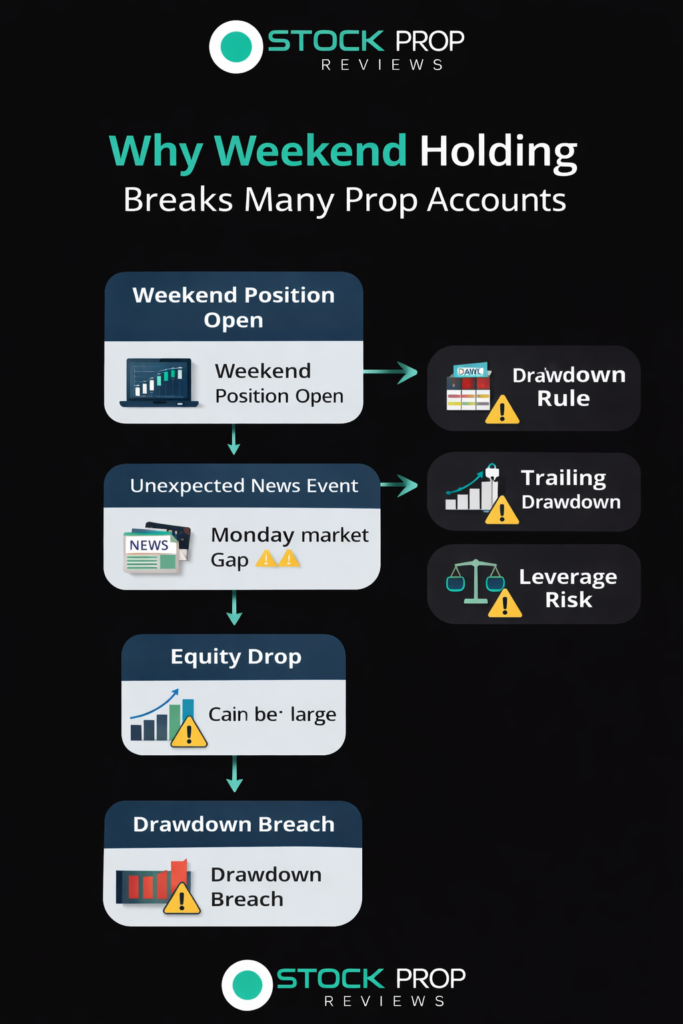
The first is the drawdown model. Trailing drawdown systems can gradually reduce the distance between account equity and the stop-out level. After a profitable trade, traders often lose the breathing room needed for multi-day swings.
The second factor is daily loss limits. A weekend gap can trigger a daily drawdown breach instantly even if the trader did not place any new trades.
The third factor is leverage temptation. Many traders keep using intraday position sizes while holding trades for several days. This increases the chance that a normal weekend gap will exceed the allowed risk.
These mechanics matter far more than the simple statement “weekend holding allowed.”
This becomes especially dangerous with trailing drawdown models, which we break down in detail in our FundingPips review and rule analysis.
Common Trader Mistakes With Weekend Trades
Weekend exposure introduces risks that are not obvious during normal trading hours.
One of the most common mistakes is position sizing. Swing trades usually require wider stop losses because they are based on higher timeframes. Traders who maintain large position sizes from intraday trading expose the account to significant weekend volatility.
Another frequent mistake is ignoring correlation. Traders sometimes hold multiple trades that are indirectly tied to the same macro driver. A single event affecting the US dollar, for example, can move several currency pairs at once.
The final mistake is holding trades without a clear reason. Some traders keep positions open simply because they do not want to close a losing trade before the weekend. This turns a controlled trade into an uncontrolled gamble.
The pattern is common among funded traders who are close to drawdown limits.
Strategy Fit: Who Weekend Holding Works For
Weekend holding is best for strategies that use longer time frames. Most of the time, these systems look at daily or four-hour charts and look for trends that continue over several sessions.
Traders who use breakout strategies or macro-driven setups often benefit from this flexibility because big moves can happen after big news events on the weekend.
The rule doesn’t help scalpers or high-frequency traders much. Their plans rely on short periods of volatility and tight spreads that only happen when the market is open.
Alternatives for Traders Concerned About Gap Risk
Not every swing trader wants to carry positions through weekends.
One approach used by professional traders is closing trades before Friday’s market close and reopening them on Monday if the trend still looks valid. This avoids the risk of weekend gaps while preserving the overall strategy.
Another alternative is trading through regulated stock prop environments rather than CFD firms. Some platforms operate closer to traditional proprietary trading desks.
TradeThePool is one example. It provides access to real stock markets and operates with transparent risk limits rather than complex challenge structures.
For traders who prefer clear rule frameworks, this type of environment may be easier to manage over longer holding periods. Readers can get up to 10% discount when purchasing through our TradeThePool link.
The point is not that one model is better than another. The difference lies in how risk is structured.
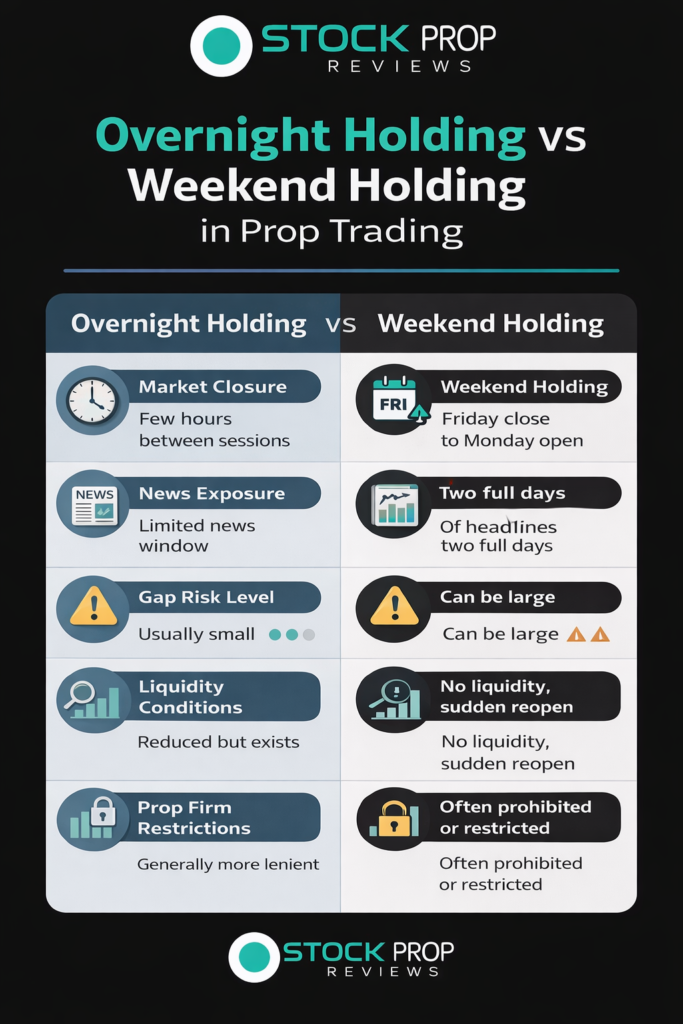
Weekend Holding vs Overnight Positions
A lot of traders think that holding stocks overnight and on the weekend is the same risk.
They are very different from each other.
Overnight positions stay open for a few hours between trading sessions. There isn’t usually a lot of market news during that time.
Weekend exposure lasts for two full days, during which time global events can happen without the market being open. Prices can change quickly and by a lot when trading starts up again.
This difference is why some companies let people trade overnight but not on the weekends.
Psychological Pressure of Weekend Trades
Holding trades through the weekend also changes the psychological experience of trading.
When markets are closed, traders cannot adjust their positions. News headlines during those two days often influence how traders feel about their trades.
Some traders spend the weekend monitoring economic news or social media commentary. By Monday morning they may feel compelled to close positions early simply to remove uncertainty.
This emotional pressure is rarely discussed in prop firm marketing material, but it plays a role in how traders manage risk
The same behavioural shift often appears after traders pass challenges, which we explain in our TopStep review focusing on why traders fail after funding..
Best and Worst Use Cases
Weekend holding can help disciplined swing strategies that work on longer timeframes and use safe risk management. These rules work well for traders who make fewer trades and pay more attention to quality setups.
It doesn’t work as well for traders who need to enter often or use a lot of leverage. In those cases, the extra exposure adds risk without giving any real strategic benefit.
Additional Resources for Prop Traders
These guides may help you understand how different prop firm models work if you are looking into funding options:
- Our review of FTMO talks about the structure of the challenges and where people usually fail.
- The FundedNext review looks at the rules for evaluations and the conditions for payouts.
- The comparison of FTMO and The5ers shows how the two companies are built differently.
- The opinion piece “Why Most Prop Traders Fail Drawdown Rules” looks at the mental errors that cause people to break the rules.
These resources are more about how funded trading works than what the ads say..
FAQs
Which prop firms let you hold on the weekend?
FTMO, The5ers, FundedNext, Goat Funded Trader, and Phidias Prop are some CFD prop firms that let you trade on the weekends. The exact rules depend on the type of account.
Is holding on to a position over the weekend risky in prop trading?
Yes. After news events on the weekend, markets can open again with big gaps. If losses go over the daily or maximum drawdown limits, funded accounts can be breached right away.
Do swing traders always need to hold on to their trades over the weekend?
Not always. Some traders close their trades on Friday and then reopen them on Monday if the trend is still going strong.
Why do a lot of prop firms not allow trades on the weekend?
Companies manage risk for thousands of traders. Events on the weekend can cause sudden price gaps that put both the trader and the firm at risk.
Is it better to hold stocks or forex over the weekend?
There can be gaps in both markets on the weekend. The level of risk depends more on the size of the position, the amount of leverage used, and the overall exposure of the portfolio.
Weekend holding sounds like a simple feature, but it changes the risk profile of a funded account significantly. Traders who understand the interaction between leverage, drawdown limits, and market gaps tend to manage it successfully.
For others, it becomes the fastest path to breaching a prop firm account.