Most traders looking for prop firms to scalp aren’t asking a simple question about the rules. They already know that a lot of companies say scalping is okay. They want to know if scalping can still work in real-life situations like trailing drawdown, spread expansion, execution delays, and pressure after a payout.
This article is for active scalpers and short-term traders who need quick entries, tight stops, and the ability to do things over and over again. It is not for beginners who are still learning how to control their risks, and it is not for swing traders who hold positions overnight.
Scalping in a prop firm can work, but only if the firm’s risk model doesn’t actively punish the behavior that scalping requires. Most traders get stuck on that difference, which is not often explained clearly.
What scalping actually looks like inside a prop firm
Scalping in a personal account and scalping in a funded account are two different games.
Inside prop firms, scalping usually means multiple trades per session, small profit targets, and little margin for execution error. The problem is not the strategy itself. The problem is how firm rules interact with that strategy over time.
A trader can have a positive expectancy system and still fail a challenge because one rule, often trailing drawdown, turns normal variance into a hard stop.
This is why reading “scalping allowed” in a FAQ tells you almost nothing.
Where scalpers really lose funded accounts
Most scalpers who fail don’t blow up their accounts by acting carelessly. They fail quietly, usually after a string of good days.
The most common ways that things go wrong look like this.
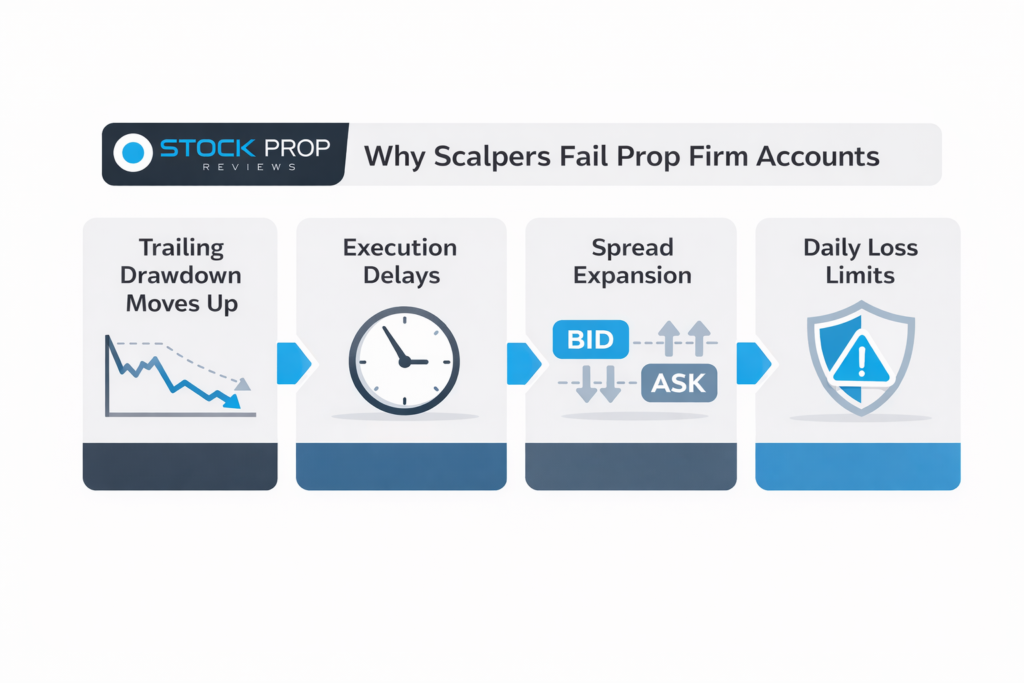
A trader makes a small buffer by winning quickly. The liquidation line gets closer because drawdown trails equity. One exit that takes a little longer, one spike in the spread, or one slip during a volatile time can wipe out more than you thought and the account is gone.
The story is the same in futures companies, but it’s told in a different way. Even though the account is still up for the week, a trader gives back some of their earlier profits during a rough time and hits the daily loss limit.
These aren’t failures of strategy. They are failures in structure.
The rules that matter most for scalping
Four rules are much more important to scalpers than anything else that is written in marketing copy.
The first thing is how to figure out drawdown. The biggest risk for scalpers is trailing drawdown based on unrealized equity. It punishes people who win a lot because every new equity high makes the floor tighter.
The second is how well the execution is done. Exits must be predictable for scalping to work. Small delays or inconsistent fills can completely change the math.
The third question is whether trades are filtered or looked at based on how long they take. Even though some companies say they allow scalping, they may quietly flag or cancel very fast trades.
Handling news and volatility is the fourth thing. A lot of scalpers depend on momentum bursts, but those are often the times that companies limit.
If you want to compare how execution quality and drawdown mechanics differ across funded accounts, our Funded Traders review explores those factors in depth and highlights common pitfalls scalpers run into.
If a company fails on two or more of these points, scalping stops being a trading strategy and starts being a way to stay alive.
CFD prop firms and scalping reality
Most CFD prop firms that focus on retail say in public that scalping is okay. That is usually true on paper.
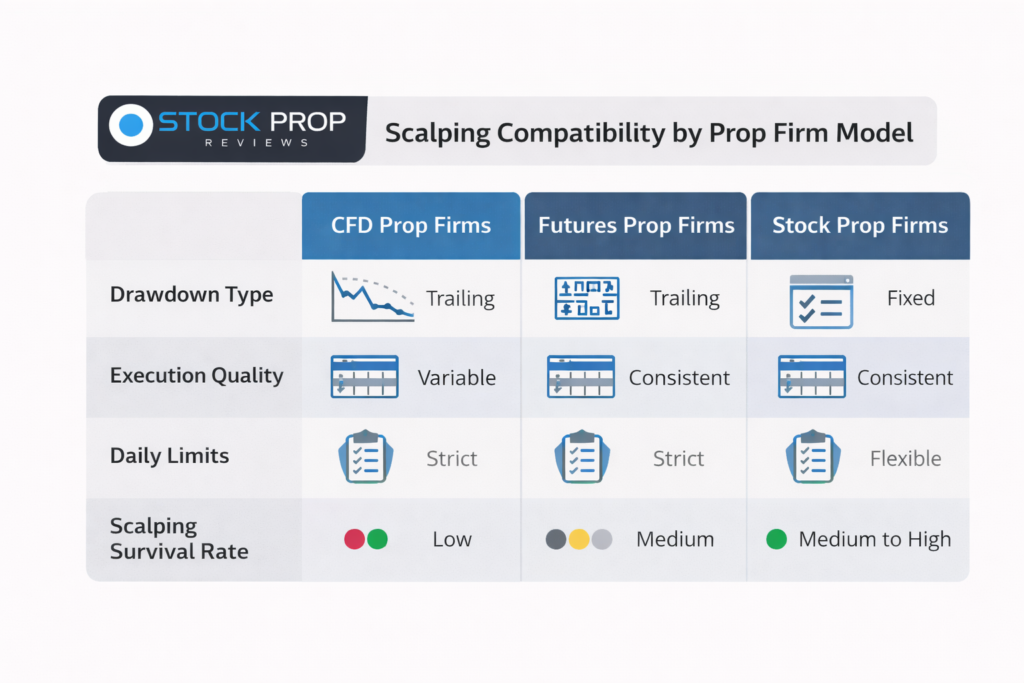
In real life, trailing drawdown, variable spreads, and execution filtering make scalping weak.
A common situation is when a trader makes a small profit over the course of several days and then loses the account on one quick market move where stops fill worse than expected. The company points to the rules, and in a technical sense, they are right.
It doesn’t mean that scalping can’t happen in CFD companies. That means you need to be very disciplined, do it less often, and stay away from times when things are likely to change. A lot of traders don’t realize how mentally hard that gets over time.
Even though it is technically allowed, this environment is hostile for most high-frequency scalpers.
For a broader view on how different prop firms stack up across risk rules, payout, and challenge structures, check our complete prop firm comparison, which helps traders match their style to the right environment.
Futures prop firms and short-term trading
Futures prop firms usually do a better job of executing trades. Scalpers benefit more from centralized order books and clear commissions than from CFD pricing models.
That being said, futures companies add a new pressure point. Limits on daily losses.
A scalper can make money overall, but they can still lose if they give back too much in one session. This makes traders stop trading even when they still have an edge, or trade in very small amounts after losing early on.
Futures companies are better for disciplined session traders than for quick-fire scalpers. The execution is good, but the daily rules require self-control that many scalping styles don’t naturally have.
Regulated stock prop firms and scalping suitability
Stock prop firms that are regulated work in a different way. Risk limits are often set in stone, rules are easier to understand, and trades are based on the exchange.
This doesn’t mean that they are perfect for every scalper, especially those who trade very quickly. However, short-term trading is more predictable because there isn’t an aggressive trailing drawdown.
TradeThePool is one example of a regulated stock prop firm where risk limits are set in stone from the start and don’t change with unrealized equity. That clarity takes away the “invisible pressure” that makes a lot of scalpers overtrade or hesitate.
This structure works better for controlled intraday scalpers who trade liquid US stocks than for ultra-fast strategies that chase ticks.
When readers buy through our TradeThePool link, they can save up to 10%. There are no guarantees, but the rule transparency is very different from what most retail prop firms do.
What competing articles rarely explain
Most articles that compare things end with permission. They name companies and say if scalping is allowed.
They don’t often explain how profit targets make scalpers trade too much, how trailing drawdown changes the risk profile of winning streaks, or how post-payout rule changes quietly change aggressive styles.
They also don’t talk about psychology. Scalping within strict rules puts constant stress on you. That pressure builds up over time and makes execution worse, even for traders who have been doing it for a while.
Traders won’t do well if they ignore this fact.
Common mistakes scalpers make in prop firms
One of the worst things you can do is treat a funded account like a personal account. The rules change everything, but a lot of traders still trade the same way they always have.
Another common problem is pushing size too soon after small wins. That behavior makes drawdown happen faster than traders think in trailing models.
A lot of scalpers also don’t realize how tired they are. Making decisions quickly under pressure from rules raises the number of mistakes, especially after early losses.
None of these are mistakes that beginners make. They happen to experienced traders who don’t realize how structure affects behavior.
Many of the mistakes scalpers make are structural rather than strategic, as we explore in this article on common prop firm mistakes and why traders misunderstand risk rules.
Who should avoid prop firm scalping altogether
Not everyone can use prop firm scalping.
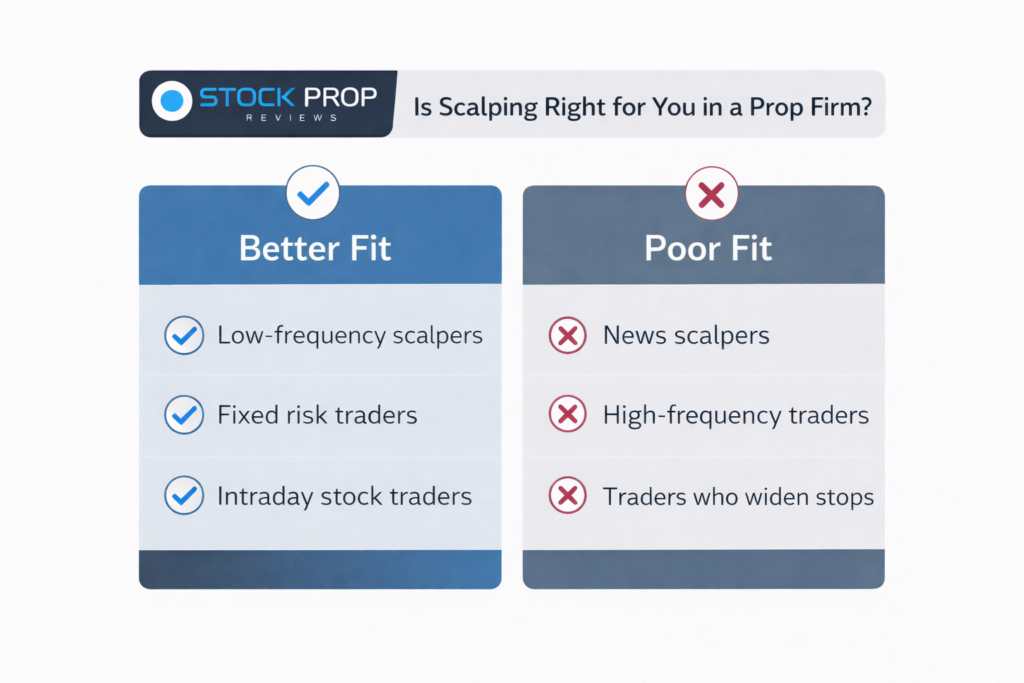
If you use wide stops, trade based on news volatility, or trade based on how you feel, funded scalping is probably going to end badly. Daily limits will be a problem for you if you can’t stop after a losing streak.
Under prop rules, longer holding periods or fewer trades per session often lead to better survival rates.
Practical alternatives to pure scalping
Some traders can change their strategies by going from pure scalps to short-term trades during the day. Holding for 20 to 60 minutes makes you less reliant on execution and keeps your exposure low.
Some people only do one or two high-quality setups a day instead of being active all the time. This fits better with how drawdown works and makes you less mentally tired.
These adaptations often work better than pure scalping in funded environments.
Strategy fit matters more than firm names
The most important thing to remember is that no one company is always good or bad for scalping. Branding isn’t as important as fit.
CFD companies are usually best for scalpers who trade very little and very carefully. Futures companies are good for traders who follow strict daily rules. Structured intraday traders who value clear rules over leverage should use stock prop firms.
No matter how good you are, picking the wrong environment for your style is the quickest way to fail.
The uncomfortable truth about scalping and prop firms
Most prop firms don’t make their rules with scalpers in mind. They allow scalping, but they don’t make it easier for scalpers.
Marketing shows off the winners. Survivorship bias hides the thousands of small failures that happen because of rule friction instead of bad trading.
Knowing that reality doesn’t make trading easier, but it does make expectations more realistic.
Traders who want clear rules and a clear risk should think about regulated stock prop firms like TradeThePool. When people buy through our TradeThePool link, they can save up to 10%. What matters is not promises or leverage, but rules that are easy to understand.
FAQs
Are prop firms really good for scalping?
Some are, but most structures make high-frequency scalping weak over time.
What kind of drawdown works best for scalpers?
Static or end-of-day drawdown is much safer than trailing models that are based on equity.
Are futures prop firms better for scalpers than CFD firms?
Execution is better, but daily loss limits still make it hard for aggressive styles.
Is it usually okay to scalp during news?
Not very often. Many companies limit or punish trading around big news events.
Can beginners do well at scalping in prop firms?
It is not a good idea. The interaction of rules and psychology makes failure likely.