The biggest prop firm risk management myth is simple: traders believe these firms are helping them manage risk like professionals. In reality, they are enforcing survival rules, not teaching risk management.
This matters if you are a beginner trying to pass your first challenge or a funded trader wondering why consistency feels harder than expected. It is not for traders looking for shortcuts or motivation. This is about how the system actually works.
Most articles focus on discipline and psychology. They rarely explain the structural issue. The rules you follow inside a prop firm are not designed to improve your edge. They are designed to control how long your account lasts.
Once you understand that, a lot of common failures start to make sense.
What prop firm risk management really is
A clearer definition
In a personal trading account, risk management is flexible. You decide how much to risk, when to reduce exposure, and when to stop trading.
Inside a prop firm, risk management is fixed. It usually comes down to three main controls:
- Daily loss limits
- Maximum drawdown
- Trailing drawdown
These are not guidelines. They are hard limits. Once breached, the account is gone.
A simple scenario
Let’s say you are trading a $100,000 account with a $5,000 trailing drawdown.
You take a few early losses. Nothing unusual. But your buffer shrinks quickly. Now even normal trades feel risky because you are closer to violation.
Your strategy did not suddenly become bad. The structure made it harder to execute.
This is where many traders start forcing decisions.
Why this myth spreads so easily
Some of the confusion comes from how prop firms show off their model.
Competitors often talk about structured trading, discipline, and protecting their capital. There is nothing wrong with that. But that’s only half of it.
What is often missing:
- The rules are there to protect the company, not you.
- Drawdown models and real strategies can be at odds with each other.
- Just being profitable doesn’t mean you can get money.
So traders think that if they follow the rules, their trading will get better on its own. In practice, they change their strategy just to stay alive.
Where the real conflict begins
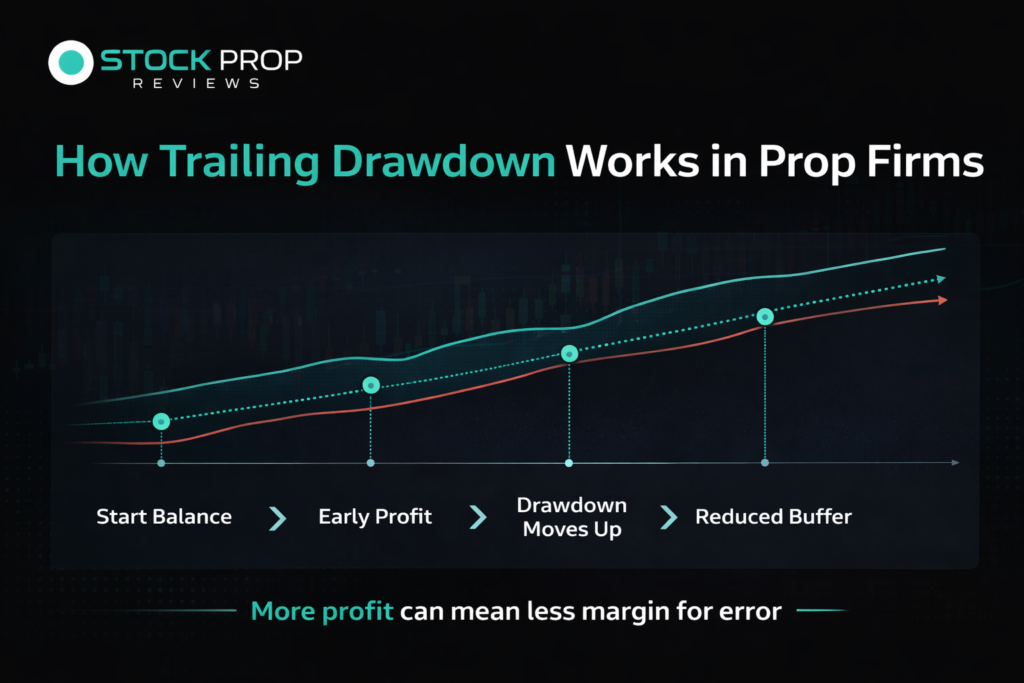
Profits can increase pressure
In normal trading, making money gives you more breathing room.
In many prop firm models, especially with trailing drawdown, the opposite can happen.
You make an early profit. The drawdown level moves up. Your allowed loss stays tight. Now the gap between your balance and violation is smaller than before.
So even though you are up on the account, your margin for error is reduced.
That is not how most traders think about risk.
Daily limits can break good trades
Some strategies need space to work. They mean holding through small losses before things start to go your way.
A strict daily loss limit can end those trades early. This leads to inconsistent execution over time. You close trades not because your setup didn’t work, but because the rule made you do it.
That slowly makes you lose faith in your own system.
Typical rule structure and its real effect
| Rule | What it looks like | What it actually does |
| Daily drawdown | Around 4 to 5 percent | Limits recovery attempts |
| Max drawdown | 8 to 12 percent | Defines how long you survive |
| Trailing drawdown | Moves with equity or balance | Reduces flexibility after profits |
| Profit split | 70 to 90 percent | Matters only if you stay funded |
The key point is this. These rules are not there to help you optimize performance. They are there to limit damage from the firm’s side.
What most competitors don’t explain properly
A lot of information about prop trading only gives basic advice. It doesn’t often talk about how rules change over time.
Early success can work against you
A lot of traders try to make a quick buffer. It makes sense. Make money now, trade safely later.
That logic doesn’t work with trailing drawdown. The more money you make early on, the less risky your future becomes.
Strategy adjustment can destroy your edge
Traders often respond by:
- Reducing position size too much
- Cutting trades early
- Avoiding valid setups after small losses
These adjustments are not part of the original strategy. Over time, the edge disappears.
Passing is not the real challenge
Most traders focus on passing the evaluation. The real difficulty is staying funded under the same rules.
That is where the majority fail.
Why traders actually fail under these rules
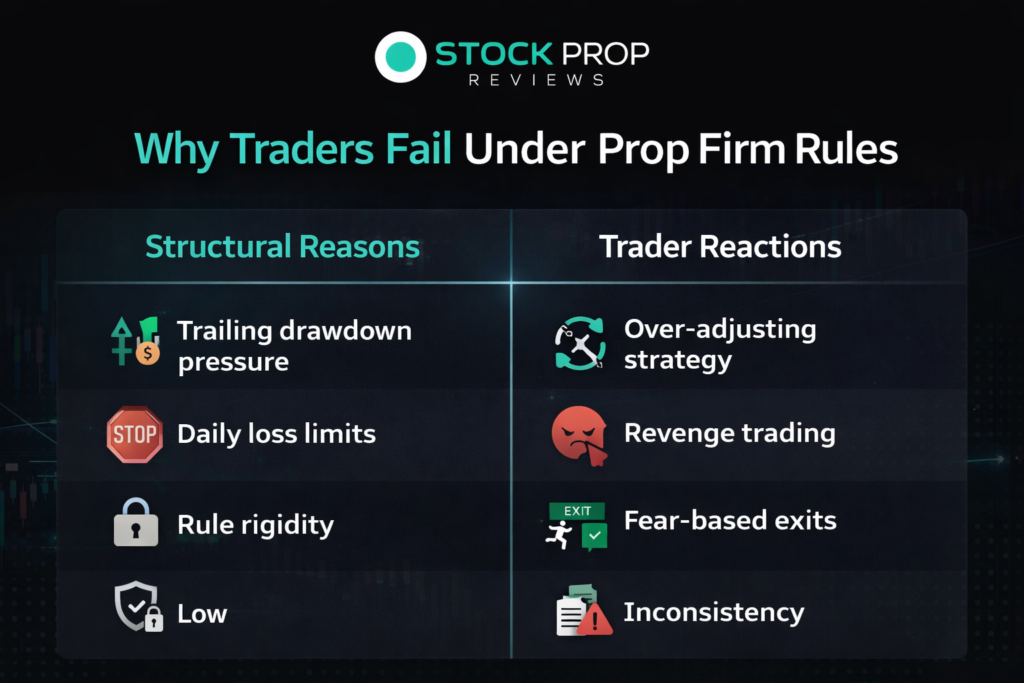
Most of the time, it’s not just bad trading. It happens more often that the trader and the structure don’t match.
Here are some common patterns:
- A good plan that needs more stops
- A trader who takes on more risk after losing to get back on track
- Someone who gets too careful after a drawdown
It’s easy to see why each of these reactions happened. But they get dangerous when they go too far.
The pressure factor is also there. Fees for evaluations, deadlines, and the fear of losing the account all play a role in decision-making. This is not the same as trading with your own money.
Strategy fit matters more than most think
Not every strategy works well when you have to follow the rules of a prop firm.
Plans that don’t always work:
- Swing trading with bigger stop losses
- Trading news with sudden price changes
- Very tight scalping that depends on high frequency
Strategies that tend to change more easily:
- Setups for the day with limited risk
- Trades with a moderate risk-to-reward ratio
- Consistent sizing of positions
Changes are still needed, though. It’s not about finding the best strategy; it’s about finding one that can work with the rules.
The discipline argument, what is true and what is not
Some traders say that prop firms help people stay disciplined. That is somewhat true.
Strict rules can stop people from acting carelessly. They make you accept losses.
But there is a problem.
You can only get better at discipline if you keep playing. A lot of traders fail before they get to that point because the rules show their weaknesses quickly.
So, discipline is a possible result, but it is not certain.
Prop firm trading vs real trading
| Aspect | Prop firm environment | Personal account |
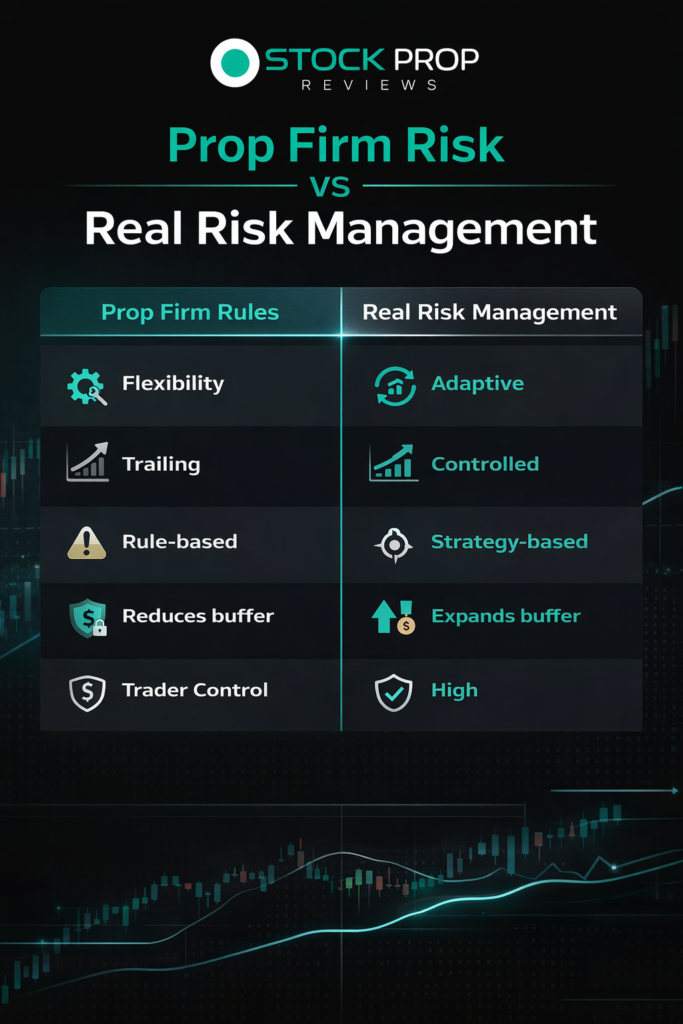
| Risk control | Fixed rules | Flexible |
| Drawdown handling | Predefined limits | Trader decides |
| Strategy freedom | Restricted | Full |
| Pressure level | High | Depends on trader |
| Longevity | Often short | Can be long-term |
This comparison highlights the core issue. Real risk management adapts to market conditions. Prop firm rules do not.
A note on TradeThePool
There are some differences across firms. TradeThePool, for example, operates as a regulated stock prop firm with clearer rule structures and more transparency around risk.
It still has limits, but the environment is closer to real market conditions compared to many CFD-based models.
Readers can get up to 10% discount when purchasing through our TradeThePool link.
That said, the same principle applies. You are working within a system, not learning pure risk management.
Who should think twice before joining a prop firm
This is where many traders go wrong. Prop firms are not for everyone.
You should be cautious if you are:
- Still testing your strategy
- Struggling with consistency
- Relying on high-risk setups
- Easily affected by pressure
In these cases, the rules will likely amplify your weaknesses instead of helping you improve.
Better alternatives for some traders
For a lot of people, a simpler path works better.
You can learn how to control real risks without fake limits with a small personal account. You can change the size of your positions, take a break from trading, and improve your strategy without worrying about having your account closed.
Another choice is structured demo trading. It can help you become more disciplined without putting you in debt if you take it seriously.
These methods may seem slower, but they often lead to more steady progress.
What most traders realize too late
Passing a challenge feels like the goal. It is not.
Staying funded is where everything changes. The same rules that helped you pass can become harder to manage over time.
This is why many traders pass once and then lose the account within weeks.
If your strategy cannot handle trailing drawdown over a longer period, the result is predictable.
For a deeper look at how traders fail after passing, see our breakdown of funded account mistakes and how different rule models compare across firms.
A better way to think about it
Instead of calling it risk management, think of the rules of a prop firm as a way to limit what you can do.
It’s not enough to just trade well. It is to:
- Stay within your limits
- Stay consistent
- Take care of your buffer.
That means you need to think about things differently. You are trying to do well while also staying alive.
Your approach becomes more realistic once you accept that.
Final thoughts
The biggest mistake is thinking that prop firm rules will help you become a better trader.
From the company’s point of view, they are meant to limit risk.
If you use them as a learning tool without knowing what they can and can’t do, you will probably have a hard time. Your chances of success go up if you see them as a limit you have to work within.
That change in how you think is often what makes the difference between failing over and over again and being consistent over time.
FAQs
What is the myth about prop firm risk management?
People think that prop firm rules teach them how to manage risk well, but in reality, they set strict limits that may not work for every strategy.
Why do traders who make money still fail challenges?
Not because they aren’t skilled, but because their strategies don’t follow drawdown rules and daily limits.
Is trailing drawdown a bad thing?
Yes, for a lot of traders. It can make things less flexible after profits and make it harder to do things consistently.
Do prop firms help you stay disciplined?
They can, but only if a trader stays consistent long enough to see the benefits of the structure.
Is it better to trade with a personal account?
Yes, for some traders. It gives you options and lets you manage risk without strict rules.