It may seem strange, but traders who make money fail prop firms all the time. Not new people. Not people who gamble. Traders who have used strategies that work, have a good track record, and have real market experience.
This article is for traders who know how to trade but have trouble with prop firm challenges or funded accounts. It isn’t for someone who is still learning basic ideas like position sizing or risk-reward.
The main problem is easy to understand. The market and prop firms don’t measure success in the same way. You can make money over time and still not follow their rules.
What “profitable” actually means in prop firms
In a personal account, profitability usually means that your equity curve goes up over the course of weeks or months.
In a prop firm, profitability is limited by:
- You must always stay within strict limits on how much you can lose.
- You can’t go over your daily loss limits.
- You need to reach your profit goals without breaking the rules.
- Consistency is often more important than total return.
A trader can make money overall, but they can also lose money if their losses are clustered, their risk is uneven, or they break the rules at the wrong time.
Quick verdict
Profitable traders fail prop firms because their strategy, risk model, and psychology aren’t made for environments with a lot of rules. The edge is there, but the structure shows where it is weak.
The real reason profitable traders fail prop firms
The strategy works, but the environment is different
Most traders get an edge when things are flexible. They give trades time to breathe, recover from losses, and grow when the time is right.
Prop firms take away that freedom.
A swing trader who risks a few percent on each trade could make money over the course of a month. If you have a prop account with a low maximum drawdown, two normal losses can end the account before the edge plays out.
The plan is fine. It just doesn’t fit in with the surroundings.
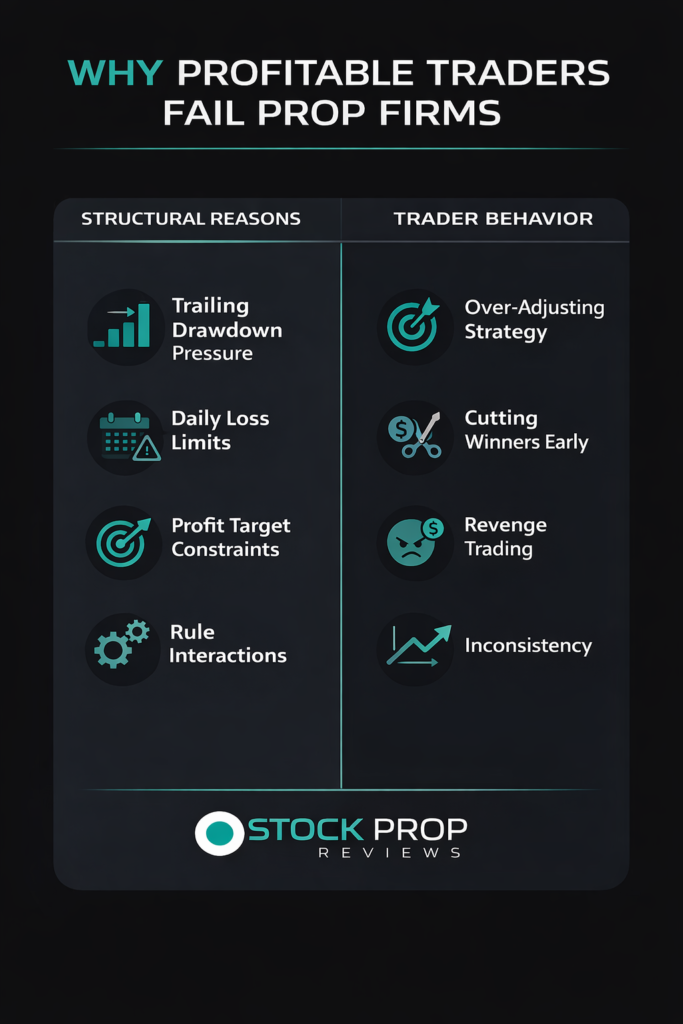
Trailing drawdown punishes normal behavior
Trailing drawdown is one of the least understood rules.
In a personal account, reaching a new high is a good thing. In many prop firms, it tightens your risk ceiling. The more you make, the less room you have to fluctuate.
A common scenario:
You build early profits, feel comfortable, and continue trading the same way. A normal pullback that would be acceptable in your own account now becomes a violation.
This is where many experienced traders get caught. They protect losses well, but they do not protect profits in the same way.
If you have not fully adjusted to this, it will show up quickly during evaluation. We break this down further in our guide on how trailing drawdown actually affects trading decisions.
Daily loss limits distort decision-making
Daily limits seem like a good way to stay safe. They change how traders act in real life.
Traders are careful after a small loss. They start managing the rule instead of the market after two losses. Some people stop trading even when there are good setups. Some people rush into trades to try to make up for lost time before the day is over.
Neither of these ways of trading is how they normally do it.
A strategy that works over a number of trades can fail if losses happen to happen in one session.
Over-adjustment quietly destroys the edge
When traders realise how strict the rules are, they often go too far in the other direction.
They lower their risk too much, leave trades early, and stay away from setups they would normally take with confidence. The outcome is not discipline. It is doubt.
The system that made them money is getting weaker. They are no longer doing it right.
This is one of the hardest problems to see because it seems like the right thing to do, but the equity curve tells a different story.
Evaluation pressure changes execution
Trading a personal account and trading an evaluation are not the same thing for your mind.
In an evaluation, every trade has a result that goes beyond the trade itself. The goal is to pass. That small change changes how people act.
You begin to think in terms of:
- How close you are to the goal
- How much space is left before a rule is broken
- If you should push harder or slow down
This pressure is felt by even the most experienced traders. Instead of making clear mistakes, it often leads to inconsistent execution.
What most articles miss
A lot of articles by competitors talk about discipline, emotions, or bad risk management. Those things are important, but they don’t tell the whole story.
The problem is more structural.
Not every profitable strategy fits prop firms
Some strategies need to be flexible. Some people have to deal with drawdowns before they can recover. These methods can work for personal trading, but they don’t work well with strict rules.
For instance, systems with a high reward-to-risk ratio may have long losing streaks before they work. In a prop firm, those streaks can end the account early.
Prop firms reward consistency over return
A trader who makes steady, smaller gains usually does better than one who has higher returns but doesn’t always get them.
This is why some average traders do well while better traders do poorly. The rules are meant to weed out smooth performance, not peak performance.
Traders underestimate rule interaction
It is not just one rule that causes problems. It is how rules interact.
A trader might be within overall drawdown but breach a daily limit. Or stay within daily limits but get caught by trailing drawdown after a profitable run.
Understanding these interactions is more important than understanding each rule individually.
Common mistakes even experienced traders make
One pattern stands out. Traders treat prop accounts like slightly stricter personal accounts. They are not.
Scaling too quickly is another issue. A trader builds early profit, increases size, and then hits a drawdown that wipes out both gains and account.
There is also the problem of correlation. Taking multiple positions that move together increases risk without always being obvious. Many traders only notice this after the fact.
Another subtle mistake is focusing too much on the profit target. It sounds logical, but it shifts attention away from execution quality. Traders start forcing trades instead of waiting for their edge.
Who should think twice before using prop firms
Prop firms are not a good fit for every profitable trader.
If your strategy requires wide stops, long holding periods, or the ability to recover from drawdowns gradually, you will feel restricted.
Traders who perform best without external pressure also tend to struggle. The structure introduces a layer that cannot be ignored.
In these cases, growing a personal account or choosing a different model may lead to better long-term results.
Strategy fit matters more than skill
Some ways of trading work better than others.
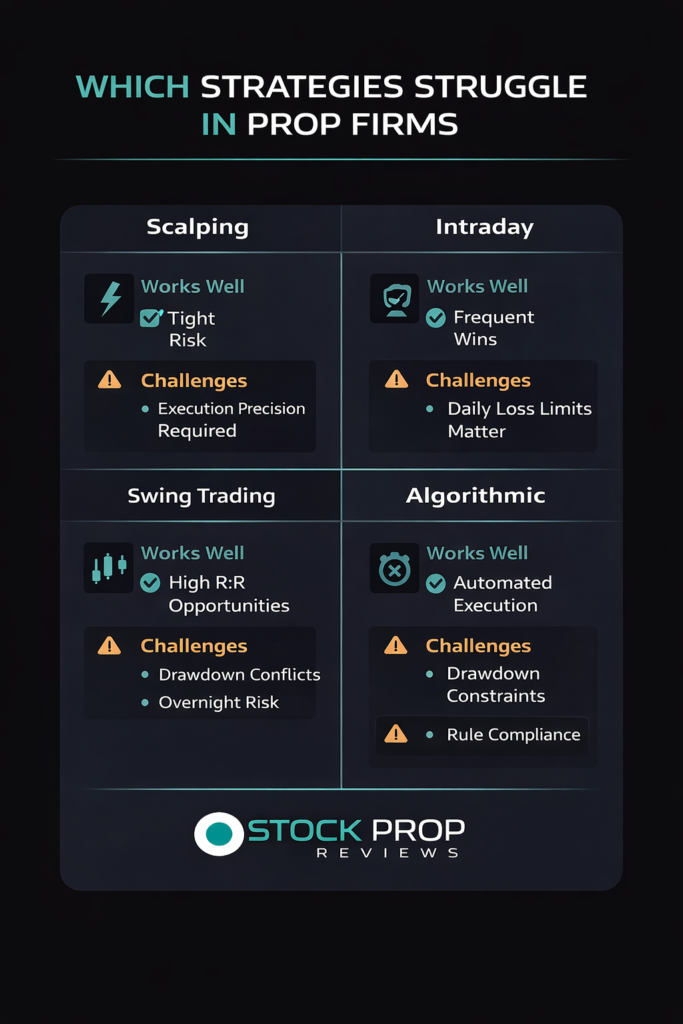
Short-term traders who already use tight risk control usually find it easier to switch. Their method naturally fits with daily limits and rules for drawdowns.
Swing traders have to deal with more problems. When every change in the market affects rule thresholds, it becomes hard to hold positions through normal market noise.
Automated systems also have trouble if they aren’t made to work in prop environments. Many people think that stable execution means ignoring rule constraints. This is why we often see EAs fail in these models, as we talked about in our article about why automated strategies don’t work under prop firm rules.
Retail trading vs prop firm trading
It’s not just the rules that are different. It’s all in your head.
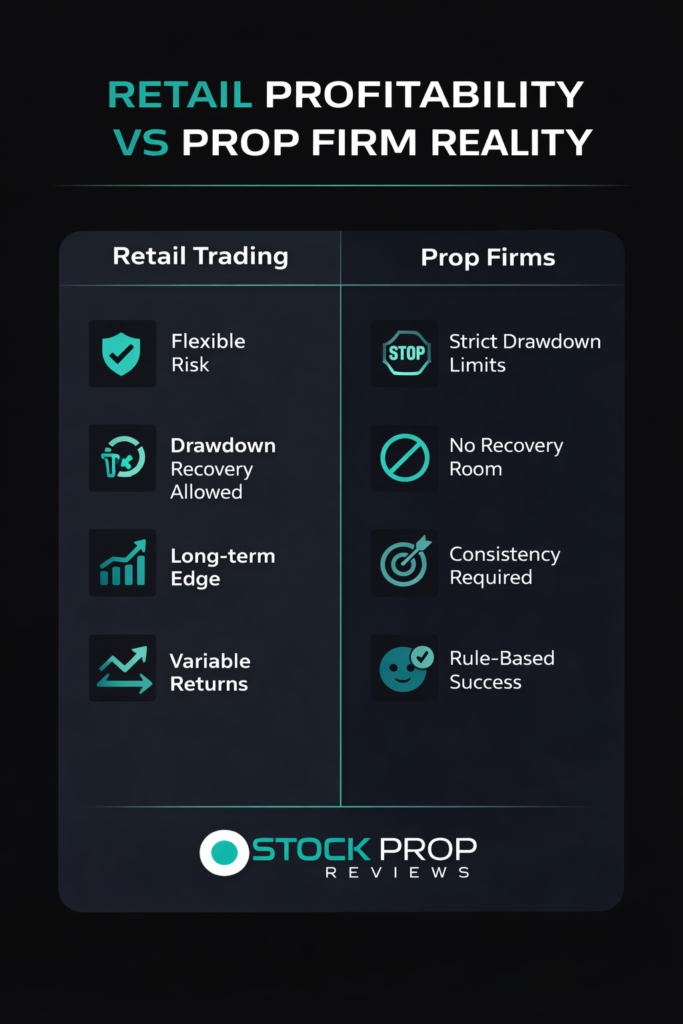
You have a lot of freedom when it comes to managing your account in retail trading. You choose how much risk to take and how to get back on your feet after losing.
Risk is set in stone in prop firms. You have to work within it.
That change may seem small, but it changes everything about how things are done.
Alternatives worth considering
Some traders perform better outside traditional challenge-based models.
Building personal capital is slower but gives full control. You can let your strategy play out without artificial limits.
There are also prop firms with static drawdown instead of trailing models. These tend to suit traders who need more room for normal fluctuations.
Another option is a regulated stock prop environment like TradeThePool. The structure is more transparent, and rules are clearer around risk. It is not easier, but some traders find it more aligned with how they already trade. Readers can get up to 10% discount when purchasing through our TradeThePool link.
A realistic trading example
Consider a trader with a solid system:
- Slight edge over many trades
- Moderate risk per position
- Consistent execution in personal accounts
In a prop firm, they start well. Early profits build confidence. Then a normal losing sequence appears, but it happens within one or two days.
The daily limit gets hit. The account is gone.
The strategy did not fail. The timing of losses did.
This is the part many traders underestimate. Prop firms compress risk into shorter timeframes.
A fair counterpoint
The purpose of prop firms is not to make traders fail. They are meant to handle risk.
People who trade successfully usually change quickly. They stop chasing goals, lower their risk, and focus on being consistent.
They don’t see the prop account as an extension of their own trading; they see it as a separate system.
TradeThePool context
For traders who struggle with CFD-style prop firms, TradeThePool offers a different approach focused on equities and clearer risk parameters.
It does not remove pressure, but it reduces ambiguity around rules. Readers can get up to 10% discount when purchasing through our TradeThePool link.
FAQs
Why do traders who make money fail prop firms?
This is because prop firms only look at long-term profitability, not consistency. A lot of strategies don’t work within these limits.
Is it harder to pass a prop firm than to make money?
Yes, for a lot of traders. The rules put pressure on people and make it harder for them to be flexible, which affects how well they do their jobs.
Is it possible for a good strategy to fail in a prop firm?
Yes. Even if a strategy is generally profitable, it can fail because of drawdown limits, daily caps, or the timing of losses.
What is the most important change that traders need to make?
They need to change how they think about risk. More important than getting the most money back is sizing your positions and being consistent.
Are prop firms worth it for traders who know what they’re doing?
They can be, but only if the trader gets used to the structure. Without that, it’s common to fail over and over again.
Final thought
The uncomfortable truth is that profitability does not guarantee success in prop firms. The environment rewards a specific type of discipline that many traders only develop after failing once or twice.
Understanding that difference early can save both time and capital.