Many traders pass a prop firm evaluation and still ask the same question weeks later: why am I not profitable now? If you pass a prop firm challenge but not profitable, that outcome is more common than most firms or review sites admit. Passing an evaluation shows that you can operate within tight rules for a short period. It does not prove that your strategy, risk control, or mindset will hold up over time. This article is written for beginner and newly funded traders who feel stuck after passing. It is not for people looking for tricks to beat challenges or rush payouts. The goal here is clarity, not motivation.
Quick verdict
Passing a challenge shows that you are following the rules for a short time. To be profitable, you need to be able to handle changing markets, longer drawdowns, and mental fatigue. Those are different abilities.
What a prop firm challenge really tests
A challenge is meant to answer a very specific question: can this trader quickly reach their profit goal without breaking any rules?
It doesn’t check how you trade when things are slow, after you’ve lost a lot of money, or when your best setup is gone for days. It also doesn’t check how you react when profits are available but drawdown limits are getting tighter behind you.
A challenge, in simple terms, tests self-control, not length.
Why passing feels like proof
The feeling of passing is very strong. You took a risk, paid a fee, and succeeded. That feeling of accomplishment can make you think that the hardest part is over when it really isn’t.
The evaluation phase is usually the least mentally hard part of the process. Risk seems limited, time is running out, and losses seem small. The pressure changes once the money is there. The account is important now..
How challenge rules distort behaviour
Most evaluation rules make traders want to optimize their trades for the short term without meaning to.
Profit targets make traders trade more often or make their trades a little bigger than they normally would. Daily loss limits make it better to cut trades short, even if the setup is still good. Time limits force traders to make trades that aren’t very good just to stay busy.
These actions can help you get through a challenge. They often break accounts that have money in them.
What competitors rarely explain
Most articles talk about how to pass, not what happens next. It’s not easy to hear, but a lot of traders lose money when the market is good or because of variance, not edge.
A strategy can hit its profit target in twenty trades and still lose money in two hundred. Challenges are too short to tell the difference between luck and expectation.
Most “how to pass” guides don’t cover that gap.
Real post-pass failure scenarios
The fast-pass trader is a common type. They go by quickly because they are aggressive. Once the money is in, trailing drawdowns get tighter, and the same risk profile can’t last.
Another type is the trader who follows the rules. They make habits that help them avoid daily loss limits instead of maximizing expectancy. When the structure changes, performance falls apart.
A third type of trader is the volatility-dependent trader. Their system works well when there is a lot of news, but it slowly loses money when things are quieter. Challenges don’t usually last long enough to show this.
These are not unusual exceptions. They happen all the time.
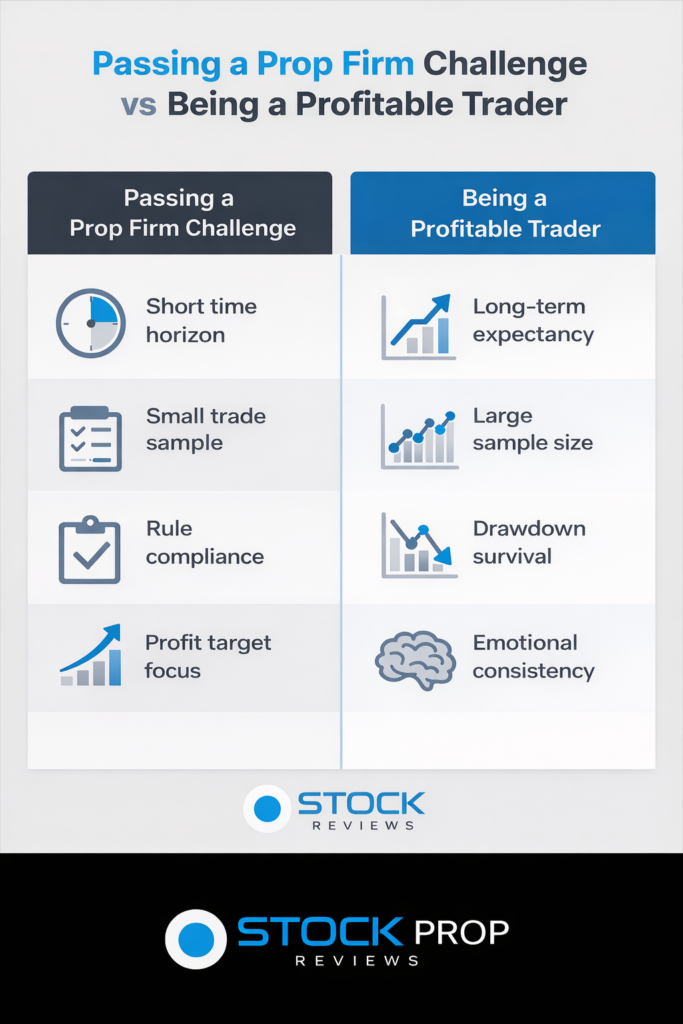
Passing versus profitability
To make money, you need to be consistent in all market conditions, not just for a few weeks. It also means being able to handle drawdowns without changing your behavior.
Most of the time, challenges only have less than thirty trades. That is not enough information to prove anything useful.
This isn’t an opinion. It’s just basic math.
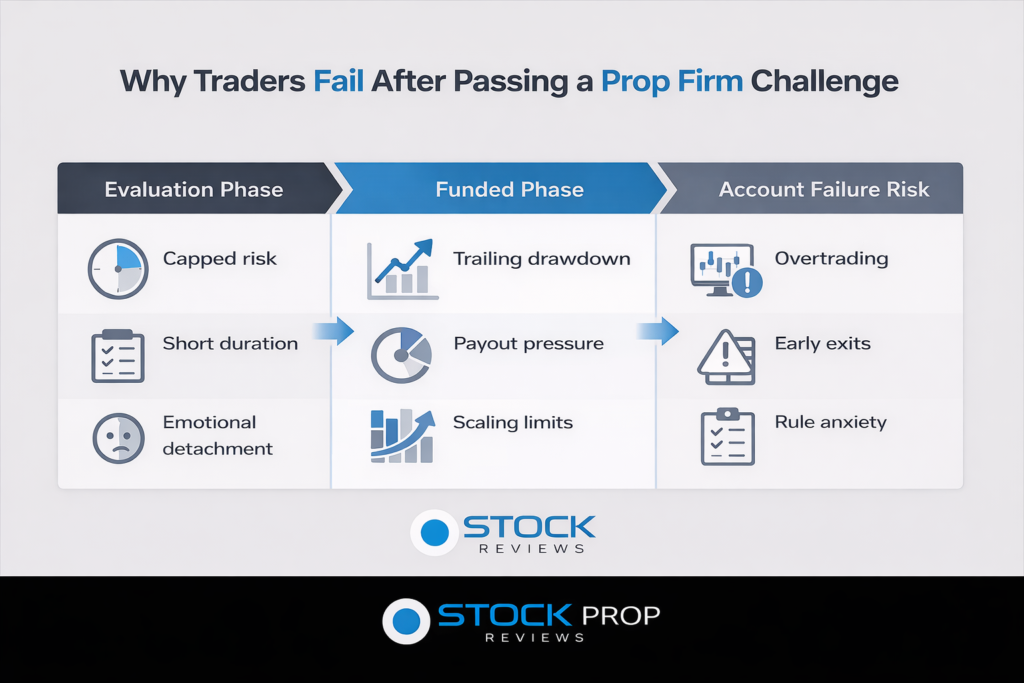
The funded phase is harder, not easier
A lot of traders think that the funded phase is a reward. In real life, it adds more stress.
Trailing drawdowns hurt normal swings in equity. Payout thresholds make it more important to protect open profit than to trade well. Scaling rules make it take longer to get back on track after losing. The account now “counts,” which makes people more emotionally attached.
Most evaluations don’t have any of this.
Strategy fit matters more than passing
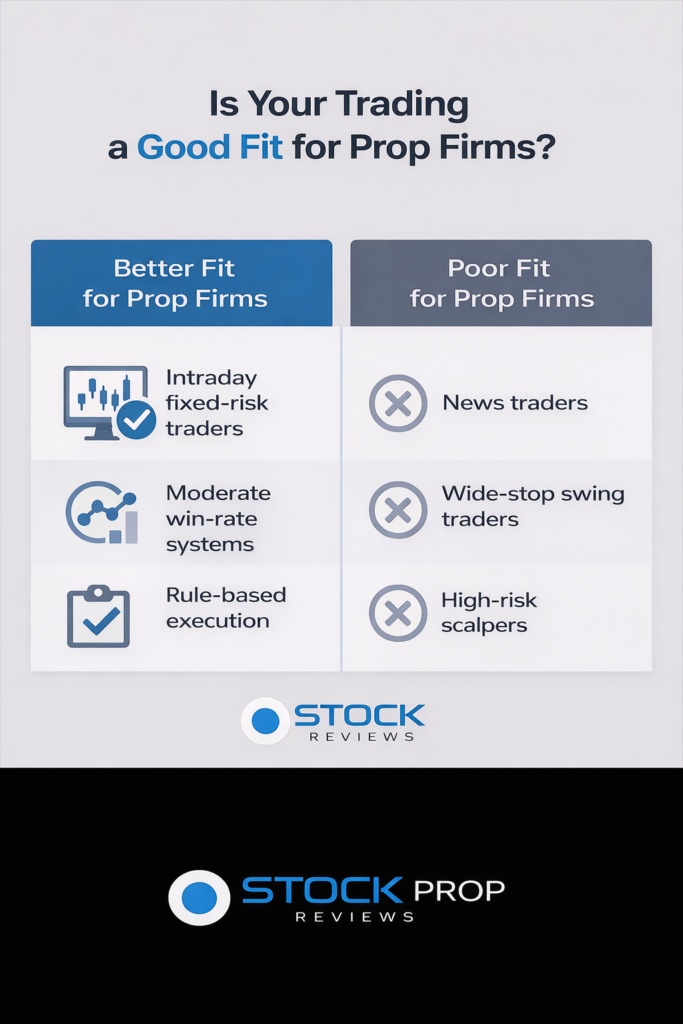
Some strategies just don’t work in prop firms.
Static drawdowns are hard for wide-stop swing systems to deal with. Scalping based on news goes against daily loss limits. Low win-rate trend systems have problems when there isn’t enough time to evaluate them.
Systems that have fixed risk, moderate win rates, and clear session rules tend to last longer. This is about how well you fit, not how skilled you are.
Comparison: challenge success vs funded survival
| Aspect | Evaluation phase | Funded phase |
| Time horizon | Short | Ongoing |
| Risk pressure | Artificial | Continuous |
| Sample size | Small | Large |
| Emotional load | Limited | Persistent |
| Adaptability | Not tested | Required |
Passing does not prepare you for the right-hand column.
Who should avoid prop firm challenges
Not every trader should use prop firms. If your system needs flexibility, time, or big stops, challenges will force you to make compromises that hurt performance.
If you rely on news volatility, don’t trade often, or feel a lot of pressure to make money, stay away from prop firms. These conditions make mistakes worse.
This is not a decision. It is the management of risk.
Better alternatives to consider
Some traders do better when they trade their own money in smaller amounts. Learning is real and free, but growth is slower.
Some people like regulated stock prop firms better because the risk parameters are usually clearer and based on real stocks instead of simulated CFDs. TradeThePool is one example of a regulated stock prop firm that has clear rules and risk limits.
When readers buy through our TradeThePool link, they can save up to 10%.
This is not a recommendation for everyone. For traders who value clarity over speed, this is an option.
CFD and futures prop firms vs stock prop firms
| Feature | CFD/Futures props | Stock prop firms |
| Capital | Simulated | Market-linked |
| Drawdown | Often trailing | Usually fixed |
| Products | Derivatives | Listed stocks |
| Rule clarity | Inconsistent | Generally clearer |
| Psychological load | High | Moderate |
We explore this distinction further in our prop firm comparison article.
What most reviews overlook
A lot of reviews talk about fees, how profits are split, and how quickly payouts happen. Not many people keep track of how traders do after their first withdrawal attempt.
People don’t talk about long-term survival very much because it’s harder to sell. That’s why it’s more important to read detailed reviews of companies and analyses based on facts than to look at pass-rate statistics.
You can see this difference clearly in our FTMO review and our longer article about how many funded traders fail.
The role of psychology and survivorship bias
Most of the traders you see online are still alive. Accounts that don’t work just go away. This makes it seem like passing means being good at something.
When performance drops after funding, understanding survivorship bias helps reset expectations and makes you less likely to blame yourself.
A fair counterpoint
It’s not pointless to pass a challenge. It shows that you can follow rules, take risks for a short time, and work well under pressure.
Those skills are important. They are just not finished.
Profitability is a longer test with fewer ways to cheat.
A practical expectancy example
A trader with a lower win rate but a strong reward-to-risk ratio can make money over time, but they might fail an evaluation because of early drawdown limits.
Another trader may win a lot of trades quickly but then lose a lot when the market changes.
The second profile usually gets rewards for challenges.
Truth versus marketing
The truth is that passing is a filter. The marketing message is that passing proves skill.
Confusing the two is expensive.
Where TradeThePool realistically fits
TradeThePool does not remove risk. It offers a regulated stock prop model with clearer structure and real market exposure. That suits traders who prioritise transparency and defined risk over fast scaling.
Readers can get up to 10 percent discount when purchasing through our TradeThePool link.
No guarantees. No promises.
Best fit and worst fit
Disciplined intraday traders with fixed risk models usually do well in prop firm challenges. High-risk scalpers, news traders, and wide-stop swing systems don’t work well with them.
It’s more important to know what group you belong to than to pass any test.
The real takeaway
Just because you pass a prop firm challenge doesn’t mean you’re making money. It means you passed a test that was meant to weed out bad behavior, not prove that you will live a long time.
Once you know the difference, you will be less frustrated and better at making decisions.
That knowledge saves more accounts than any passing strategy ever could.
FAQs
Does passing a prop firm challenge mean I’m making money?
No. It only shows that the rules are being followed in the short term.
Why do so many traders lose money after getting funded?
Because funded conditions cause drawdowns to be tighter and psychological pressure to last longer.
Are challenges at prop firms good for new traders?
Only if you see it as education and not as income.
How many trades are profitable?
Not dozens, but hundreds
Are stock prop firms that are regulated safer?
Not safer, but often easier to understand, which is better for some traders.