
One-step evaluation prop firms give you money to trade after you pass just one challenge phase. You reached your profit goal while staying within your drawdown and risk limits. After that, you go straight to a funded account.
This model is good for traders who already have a stable system and want to avoid going through the same steps over and over again. It doesn’t work for beginners who are still having trouble. Without a second phase to make changes, mistakes happen quickly and usually end the challenge early.
One thing that a lot of traders don’t get is that one step doesn’t mean easier. It means less space to get better.
Why traders look for one step challenges
Most traders want to speed up the time it takes to get money. It can feel like you’re doing the same thing over and over again with two-step models, especially if you fail late in phase two.
One-step challenges get rid of that repetition. But they also take away the buffer that helps traders adjust.
This actually changes how people act. Traders push harder at first because they know they only have one chance. That often makes people trade too much, especially after a few wins. The rules themselves aren’t the issue. The way traders respond to them is.
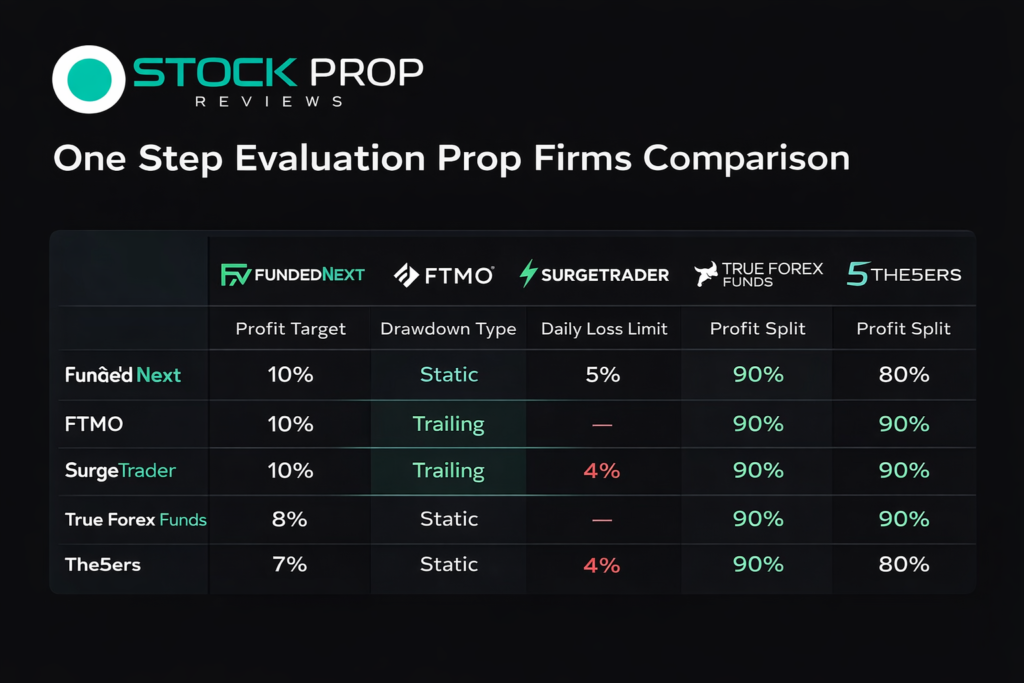
Comparison of one step evaluation prop firms
| Firm | Profit Target | Drawdown | Daily Loss | Profit Split | Key Constraint |
| FundedNext | ~8% | Static | Yes | Up to 90% | News and consistency rules |
| FTMO (one-step variants) | ~10% | Static | Yes | 80–90% | Minimum trading days |
| SurgeTrader | ~10% | Trailing | No | Up to 90% | Trailing equity drawdown |
| True Forex Funds | ~8% | Static | Yes | ~80% | Strict enforcement |
| The5ers (instant funding) | Scaling | Relative | Yes | Scales | Low leverage |
On paper, these look similar. In execution, they behave very differently. The drawdown model is what separates them.
FundedNext one step model
Quick verdict
Reasonable target and structure, but it exposes poor risk control quickly.
Core rules
| Rule | Value |
| Profit Target | Around 8% |
| Drawdown | Static |
| Daily Loss | Yes |
| Profit Split | Up to 90% |
What traders underestimate
An 8% goal seems doable. That perception changes how traders act. A lot of people raise their position size sooner than they usually do.
This is what a normal pattern looks like. A trader makes 3 to 4 percent profit and then starts to push for completion. One big loss hits the daily limit and starts progress over. The problem is not hard. It’s about pacing.
Who it fits
Traders who already set a fixed risk per trade and don’t change the size of their trades based on short-term results.
Who should avoid it
Anyone who tends to get bigger after winning a lot. This model punishes that behaviour.
FTMO one step style accounts
Quick verdict
Well-organised but inflexible. Here, discipline is more important than strategy.
Core rules
| Rule | Value |
| Profit Target | Around 10% |
| Drawdown | Static |
| Daily Loss | Yes |
| Minimum Days | Required |
What competitors miss
The minimum trading days rule sounds simple, but it affects decision making. Traders who normally wait for high-quality setups feel pressure to participate more often.
You end up taking trades you would normally skip. Over time, that reduces edge.
Who it fits
Active intraday traders who already trade regularly and do not rely on selective entries.
Who should avoid it
Swing traders who depend on patience and low frequency.
SurgeTrader one step challenge
Quick verdict
It seems flexible because there is no daily loss limit, but trailing drawdown makes it less forgiving than you might think.
Core rules
| Rule | Value |
| Profit Target | Around 10% |
| Drawdown | Trailing |
| Daily Loss | No |
| Profit Split | Up to 90% |
What traders misunderstand
Not having a daily loss limit makes you feel free. The issue changes to trailing drawdown.
Your drawdown level goes up if you make money early. That makes it harder to handle normal pullbacks. A trade that would normally be okay can now close the account.
A lot of traders get stuck here. They do well at first, but then lose the account during a normal correction.
Who it fits
Traders who keep consistent position sizing from start to finish.
Who should avoid it
Traders who scale aggressively after early gains.
The5ers as an alternative model
Quick verdict
Not a classic one step evaluation, but relevant for traders who want immediate funding.
Core structure
| Rule | Value |
| Profit Target | Scaling model |
| Drawdown | Relative |
| Daily Loss | Yes |
| Leverage | Lower than most forex firms |
What matters here
Less leverage changes what people expect. A lot of traders have trouble not because the rules are strict, but because they feel like returns are taking longer.
They raise the risk of each trade to make up for it. That usually makes things inconsistent.
Who it fits
Traders comfortable with slower growth and tighter risk control.
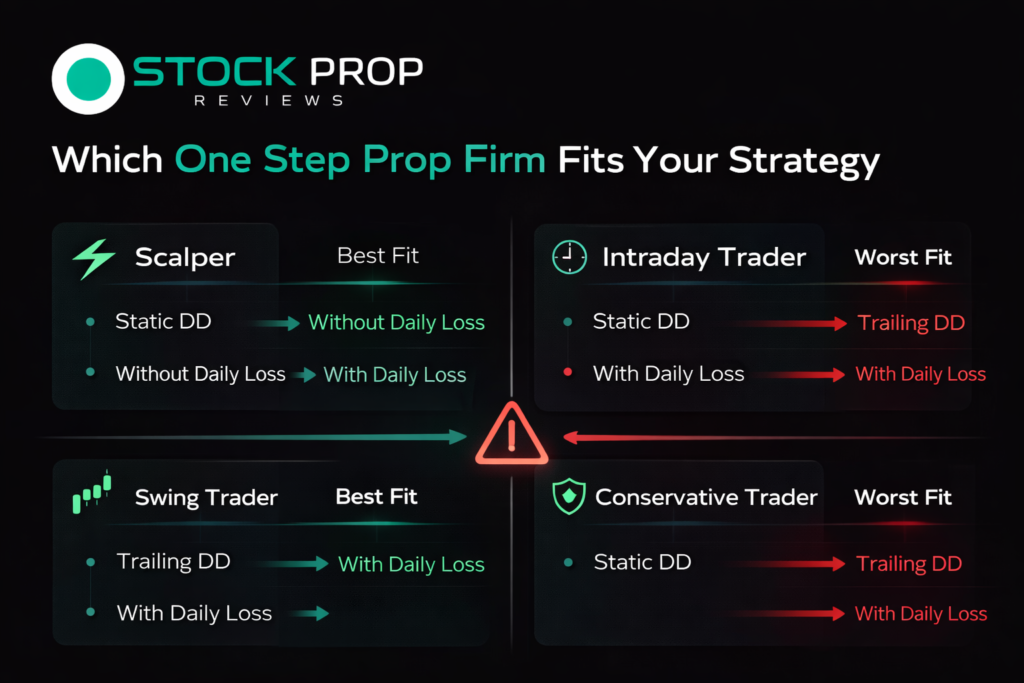
Strategy fit matters more than the firm
Traders’ biggest mistake is picking based on how much they can make or how big their target is. Those are things that are only on the surface.
The real question is how your strategy works with each drawdown model.
Trailing drawdown will hurt you if you depend on compounding quickly. If you don’t trade very often, minimum day rules will make you do things that are hard for you. If you change the size of your trades often, static drawdown and daily limits will show that.
This is why some traders do well with one company and not with another using the same strategy.
What most comparisons leave out
Most articles have rules. Not many of them explain how those rules affect decisions made during live trading.
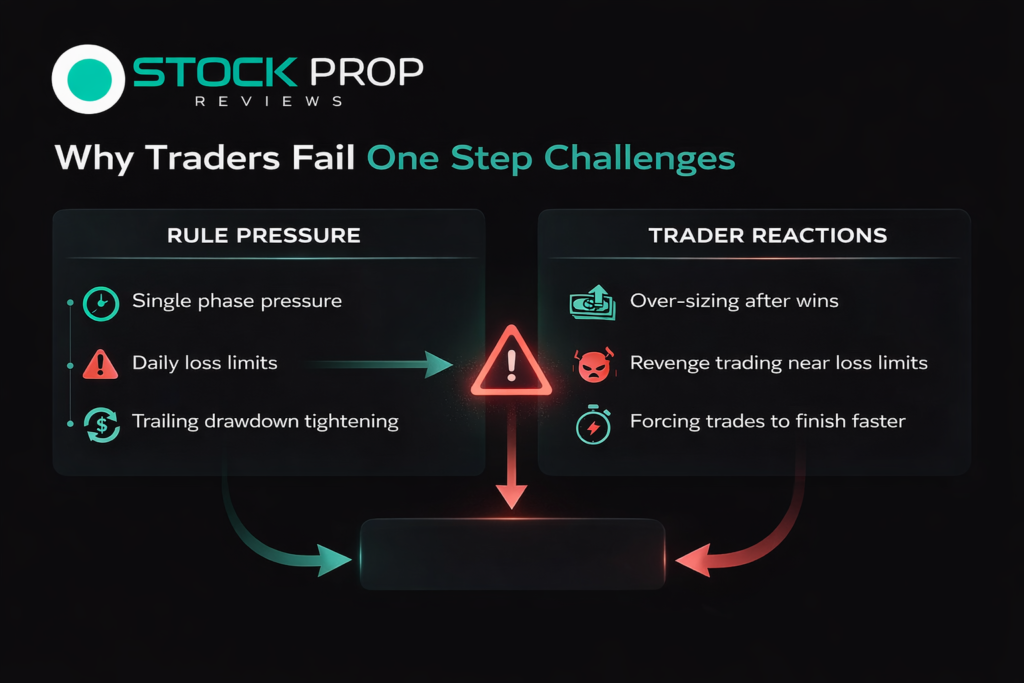
Pressure builds up faster in one-step models. There is no second phase to reset your mind. That makes traders act differently when they win and when they lose.
Traders often think they are closer to their goal after a win than they really are. They get bigger so they can finish faster. They try to get back on track the same day after a loss so they don’t lose any progress. Both actions make it more likely that you will fail.
This pattern can be seen in almost all one-step businesses.
Common mistakes in one step evaluations
The mistakes are consistent, regardless of the firm.
Traders push too early instead of letting the target come naturally. They treat the challenge differently from their normal trading, even if their normal approach is profitable.
Another issue is reacting to the daily loss limit. Instead of stopping when they should, traders try to “use the remaining room,” which usually leads to hitting the limit.
The environment exposes habits. It does not create them.
Alternatives if one step feels too aggressive
Two-step evaluation companies give you time to make changes between steps. This model is more forgiving if your strategy needs time to settle down.
Instant funding takes away targets but adds new limits, such as lower leverage or scaling rules.
Some traders also switch to futures prop firms, where the rules about risk are different and often easier to understand.
There are pros and cons to each option. The right choice depends on how stable your process already is..
A note on TradeThePool
For traders who prefer stocks over forex, TradeThePool offers a regulated environment with clearly defined rules and risk limits.
It is not a one step challenge, but the structure is straightforward and easier to interpret compared to many forex prop firms.
Readers can get up to 10% discount when purchasing through our TradeThePool link.
Reality check on one step prop firms
The idea is speed. The trade-off is pressure.
If your process is already consistent, one step evaluations can work well. If it is not, they tend to expose weaknesses quickly.
The firm itself is rarely the deciding factor. Your behavior under constraint is.
FAQs
Are one-step evaluation prop firms easier?
No. They are quicker, but not easier. The lack of a second phase makes things more stressful.
Which kind of drawdown is harder?
Trailing drawdown is usually harder because it gets harder as you make money.
Can you pass with a small account first?
Yes, and a lot of the time it’s the best way to go. It helps you see how the rules change how you act.
Why do traders fail at one-step challenges?
Most failures happen when people take on more risk after making money early on or when they don’t handle daily loss limits well.
Is one step better than two steps?
It depends on the trader. One step works for consistency. Two-step is good for people who need time to adjust.