Many traders lose a funded account after payout for reasons that have nothing to do with strategy quality. Passing an evaluation and receiving a first withdrawal proves basic competence. Staying funded afterward is a different skill entirely.
This article is for traders who already reached their first payout and want to understand why accounts often fail shortly after. It is not written for demo traders or those still choosing their first prop firm. The focus here is post-payout behaviour, rule pressure, and the quiet mistakes that end funded accounts.
If you searched for why traders lose funded accounts after payout, the answer is rarely one bad trade. It is usually a chain reaction triggered by success.
What “Losing a Funded Account After Payout” Really Means
Losing a funded account after payout means breaching a firm’s risk rules after profits have already been withdrawn. In most cases, the firm does not claw back past payouts. The account is simply terminated, and future earning potential is gone.
What matters is not the loss itself, but how close withdrawals push the account toward drawdown limits.
The Rule Shift Most Traders Underestimate
Traders use margin before they get paid. That margin gets smaller after the payout.
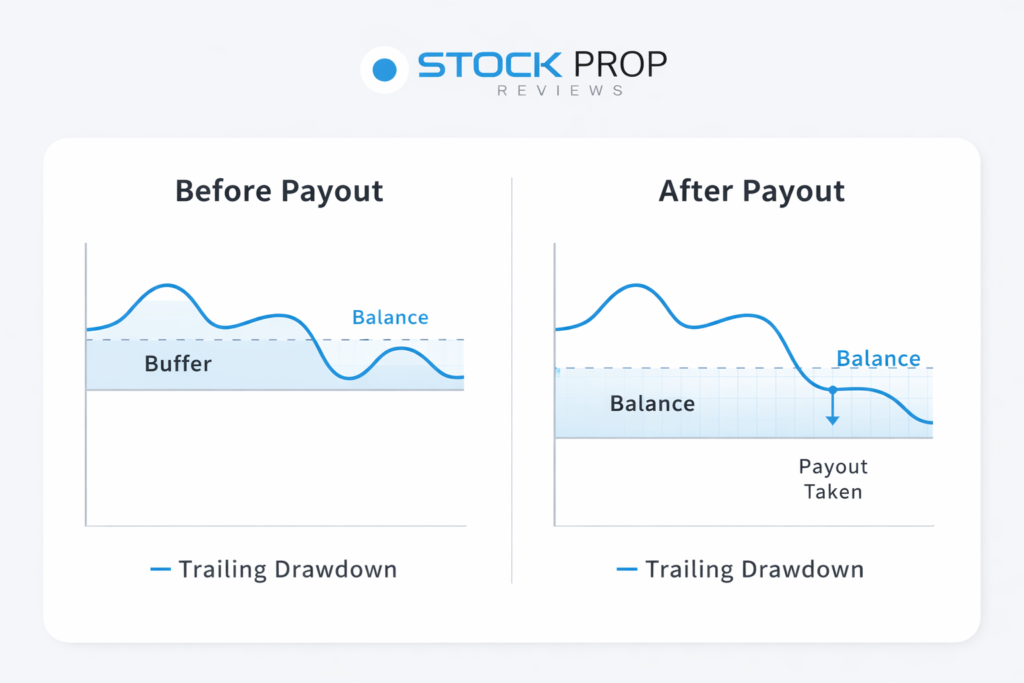
When you take money out of your account, trailing drawdowns, maximum loss limits, and consistency rules don’t reset emotionally. They reset in a way that makes sense mathematically. A lot of traders keep trading as if the buffer is still there.
This one misunderstanding is responsible for a lot of failures after payouts.
Trailing Drawdown After Withdrawal
Trailing drawdown is the main reason why traders lose funded accounts after getting paid.
This is what happens in real trading. A trader builds up a buffer, feels safe, and then takes out their profits. The drawdown level stays the same, but the balance goes down. Days when you normally lose money suddenly become days when you lose your account.
Most articles by competitors explain what trailing drawdown is. They don’t often talk about how dangerous it gets right after a payout.
Daily Loss Limits and Emotional Drift
Another common reason is daily loss limits and too much confidence.
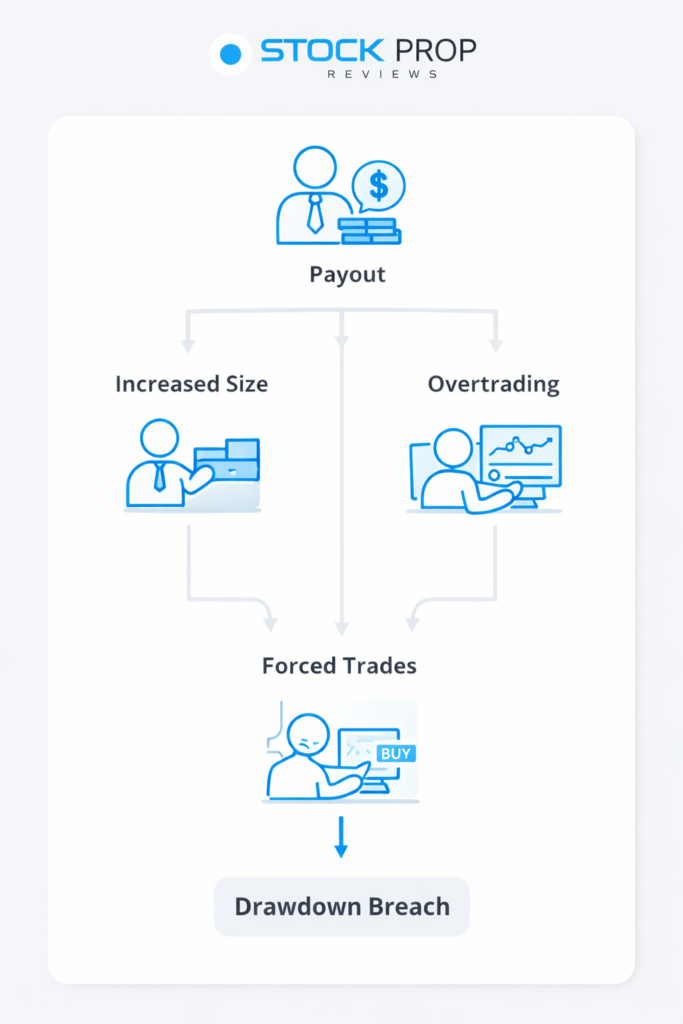
Many traders lose discipline after the first payout without even realizing it. They trade more, get a little bigger, or try to fit more results into fewer days. None of this seems crazy at the time. It seems to work well.
A day full of strong feelings is usually enough to break the daily loss rule and close the account.
Why Traders Change After Getting Paid
Market conditions are not the biggest risk factor. It is a change in behavior.
When money goes into a bank account, traders often stop trading to keep the account safe and start trading to keep their income safe. That change in thinking makes things harder. Trades are required. Losses feel like they affect you. Early cuts go to winners.
This change in the mind isn’t talked about much in prop firm marketing, but it’s very clear in the patterns of funded account failures.
Many of the patterns that cause funded accounts to fail after payout, such as tightening drawdowns and behavioural shifts, are explained in real trader terms in our TopStep review, where funded traders describe how post-funding pressure affects discipline.
Scaling Too Early
The goal of scaling rules is to reward people who are consistent over time. A lot of traders see the first payout as proof that they are ready to grow.
What usually happens instead is that the trader’s position size goes up before they can show that they can handle drawdowns at the new level. A system that worked at smaller sizes breaks down when there is too much pressure, even if the edge is still there.
Scaling does not forgive mistakes made while executing emotionally.
Common Post-Payout Mistakes
Most traders who lose funded accounts after payout make several small mistakes rather than one obvious one.
Risk per trade creeps higher. Trades are taken outside the core session. Stops widen slightly. A recovery trade turns into a second attempt. None of these look serious on their own.
Together, they push the account into a rule violation.
What Competitors Do Not Explain
Competitor articles often talk about what companies do when traders lose money. They talk about resets, rules for payouts, or rules for evaluations.
What they don’t understand is how traders act after they win. Expectations go up as soon as a payment is made. Patience goes down. Discipline is tested in a way that tests don’t.
Most funded accounts fail in that gap.
Strategy Fit Matters More After Payout
Not every strategy can work within the rules set by prop firms.
When people take money out, strategies with low variance and fixed risk tend to do better. When drawdowns get tighter, systems that rely on big pullbacks, recovery trades, or wide stops don’t work as well.
After the payout, the goal changes from growth to survival. Strategies that can’t slow down often kill themselves.
Futures and CFD Firms vs Stock Prop Firms
The structure of the drawdown is very important for survival after the payout.
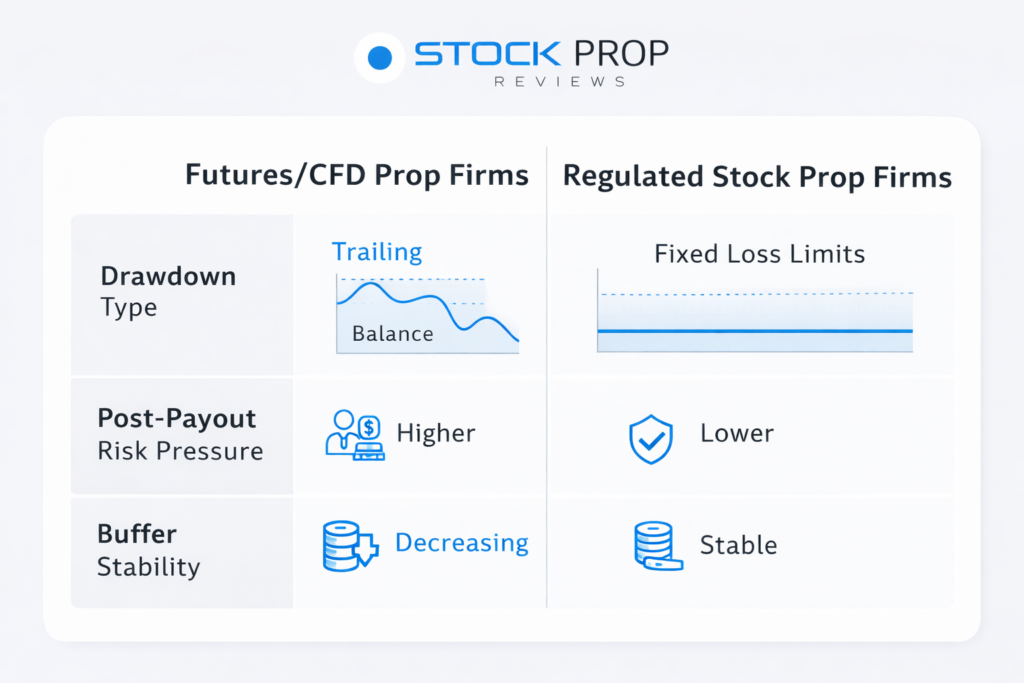
Many futures and CFD companies use trailing drawdowns that keep going even after you take out your profits. Regulated stock prop firms are more likely to use fixed loss limits, which can make things less stressful after payouts.
One reason some traders switch to stock-based firms after failing to get paid out multiple times is this.
Where TradeThePool Fits
TradeThePool operates as a regulated stock prop firm with fixed risk parameters rather than aggressive trailing drawdowns. For traders who struggle with shrinking buffers after payouts, this structure can feel more predictable.
Readers can get up to 10% discount when purchasing through our TradeThePool link. This does not reduce risk or guarantee results. It simply offers clearer rule transparency for stock-focused traders.
Who Struggles Most After First Payout
Some traders aren’t bad at what they do; they just aren’t good at funded trading.
Traders who need to pay for short-term expenses with trading income, trade based on their emotions after withdrawals, or need wide drawdowns often have trouble staying funded. In a lot of cases, personal capital trading is a better fit for them.
This is not a failure. It’s a problem with the fit.
Real Trading Example
A trader gets paid, takes out most of the buffer, and then increases the size to keep the speed of income. There are two average losing trades. The trailing drawdown has been reached.
The plan didn’t change at all. Behavior did.
Internal Context
This pattern aligns closely with issues discussed in our Apex Trader Funding review and Topstep evaluation review. It also connects with broader patterns explained in our prop firm drawdown comparison article and our long-form truth piece on why funded traders fail over time.
Best For and Worst For
After a payout, traders who make it through often make their accounts smaller, lower their expectations, and treat them as if they are fragile.
A lot of the time, traders who fail hurry the second payout and act like the buffer is still there.
FAQs
Why do traders lose funded accounts so often after they get paid?
After a payout, drawdown buffers get smaller, and traders often take on more risk or trade with more pressure. Little mistakes turn into rule violations.
Do prop firm rules change when you take a payout?
Most of the time, the rules stay the same, but when you take money out, it takes up space in your buffer, which makes it easier to hit trailing drawdowns and loss limits.
Is trailing drawdown the main reason traders lose their funded accounts after they get paid?
Yes. Trailing drawdown is the rule that causes the most post-payout account losses, especially when profits are taken out early.
Should traders cut back on their positions after a payout?
Yes, most of the time. Traders can get used to tighter buffers and performance stabilizes after withdrawals when they reduce size.
Is it safer to work for a regulated stock prop firm after they pay you?
Some traders find them easier to deal with than trailing drawdowns after withdrawals because fixed drawdown models are easier to manage.
Final Perspective
If you keep losing funded accounts after a payout, it’s not usually because the rules are too complicated or the company is trying to cheat you. Success changes the way people make decisions.
The real skill of a funded trader is learning to trade smaller, slower, and more defensively after getting paid.