The difference between passing a challenge and keeping a funded account for a long time is funded account psychology. Most traders pay more attention to strategy and risk models. Very few people think about how strict rules will change their behaviour when real money is at stake.
This article is for traders who have money and serious beginners who are thinking about working for a prop firm. People who want to take shortcuts, get services, or flip evaluations quickly should not use it. If you want to know why traders lose funded accounts even when they have good systems, this will help.
The main problem is easy to see. Funded accounts test more than just skill. They check for psychological stability within set risk limits.
If you’re new to the funding ecosystem, it’s useful to first understand how stock prop firms actually work and how traders get funded.
What Funded Account Psychology Really Means
Funded account psychology is the change in behaviour that happens when you trade with strict drawdown rules, daily loss limits, and payout expectations.
You can do the following in a personal account:
- Stop trading for a week
- Take bigger losses
- Put in more money
- Change risk as you see fit
You can’t do that with a funded account. You work under a contract.
That contract changes how decisions are made.
The same trader who calmly holds through a 6% drop in a personal account might panic at a 3% drop in a funded account because the maximum drop is 5%. The plan is still the same. The results have.
Most failures start with that difference.
Why Passing a Challenge Is Misleading
Passing a challenge shows that you can work well under short-term stress. It doesn’t show that you can handle long-term capital while dealing with ongoing risks.
A lot of competitors talk about “funded trader mindset” in a general way. What they often miss is a mismatch in structure.
Real-life example of trading behaviour:
A trader passes a two-part test with a strict 0.5 percent risk per trade. Confidence goes up once the money is there. The risk for each trade goes up to 0.75 percent. That small change makes things a lot more volatile. A short losing streak is now threatening the daily cap.
There wasn’t anything big that happened. No gambling that is careless. Just a little drift.
That drift happens a lot.
You can see how trailing drawdown mechanics make small emotional changes bigger when you look at how strict rule structures work in companies like FTMO, which we talk about in our FTMO review.
Most of the time, the problem isn’t not knowing. It is a slow change in behaviour when under pressure.
The Trailing Drawdown Distortion
Trailing drawdown is one of the most dangerous psychological traps in trading with real money.
Think about this:
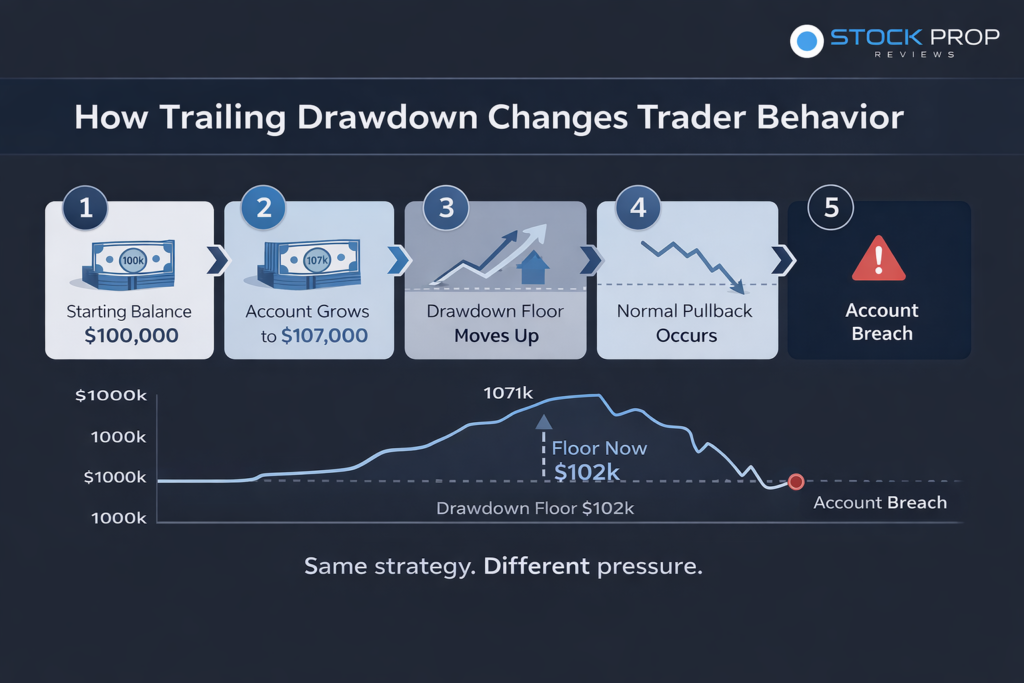
You begin with 100,000.
The most trailing drawdown is $5,000.
You make the account worth 107,000.
Now, the drawdown floor locks are close to 102,000.
A normal 5% drop from the highest equity now ends the account. In a personal account, that same pullback would happen all the time.
This makes people afraid to give back profits. Traders start to cut their winners early. After strong runs, they skip good trades. They manage positions too much.
It’s clear that this is ironic. Trying to protect profits often makes people less likely to expect things to happen.
Discipline is mentioned in most articles by competitors. They don’t often talk about how trailing mechanics change the emotional meaning of making money.
A good example of how CFD funding rules translate into real trading pressure can be seen in our FundingPips rule and payout analysis.
The Daily Loss Cap Pressure
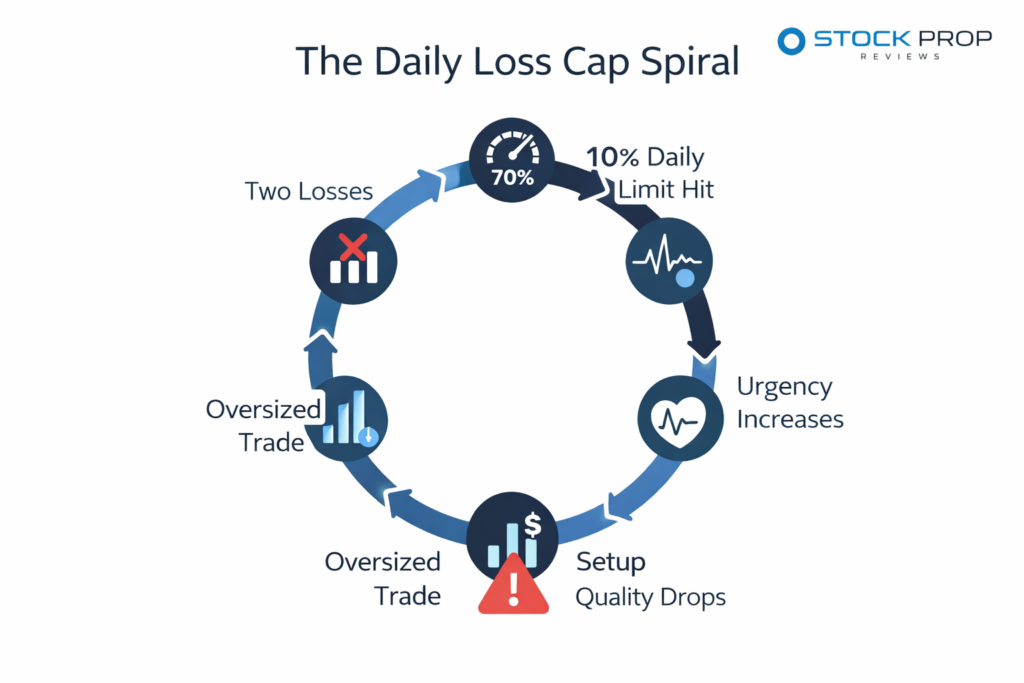
Daily loss limits are there to keep your money safe. They also break decision-making down into time blocks.
When a trader reaches 60 to 70 percent of the daily limit, they need to act quickly. The focus changes from the process to recovery.
“I just need one good deal.”
That sentence has closed more funded accounts than bad strategies have.
The daily reset feature can also make people act like they’re gambling at the end of the session. Traders want things to get better because tomorrow feels like a fresh start.
But the equity in the account doesn’t change. The damage is still there.
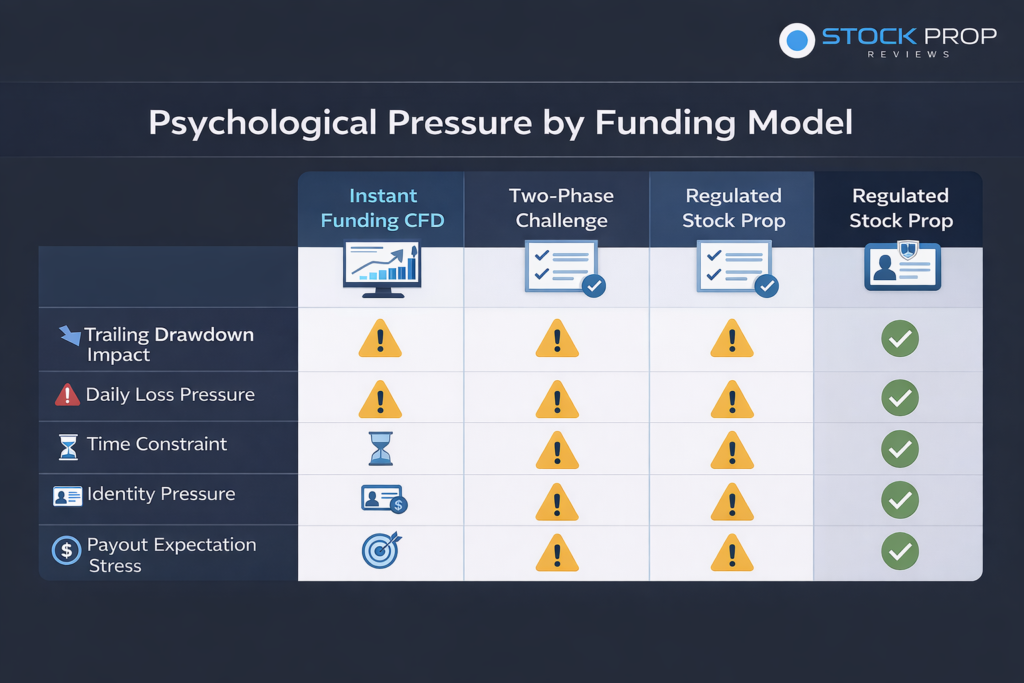
In our larger guide to comparing prop firms, we show how daily caps and trailing drawdowns are different in different models. Marketing isn’t as important as structure.
The Identity Shift Problem
Identity is something that doesn’t come up very often.
When traders get money, they often think of it as a status symbol. They tell their friends. They put up pictures of the screen. They think of themselves in a different way.
That identity makes it harder to deal with losses. Resetting a challenge feels like failing in front of everyone else instead of learning from it.
This attachment to the ego causes:
- Getting too big after wins
- Covering up rule violations
- Not agreeing to scale back after drawdowns
The funded traders who are most consistent see their accounts as contracts, not achievements.
That difference in how you think is small but strong.
Data and Behavioral Reality
Most funded accounts don’t pay out consistently over long periods of time, according to the numbers. Companies don’t publish detailed survival rates, but payout distributions show that a lot of people stop working after the first few months.
Why?
This is because retail trading strategies often see equity swings that are bigger than the limits set by most funded accounts.
A swing strategy that works with 8 to 10 percent drawdown in backtests might not work with a 5 percent maximum rule set.
There is no fraud or conspiracy here. It is filtering by structure.
Companies that get money make rules to stop volatility. A lot of retail traders trade systems that are unstable.
When volatility hits strict limits, psychology breaks down.
Real Scenario From a Funded Trader
Day trader profile
- 1% risk for each trade
- 50% chance of winning
- 2R average winner
He thinks that 6 percent drawdowns are normal in personal trading.
If you have a funded account with a maximum drawdown of 5% and a daily limit of 3%, losing three times in one session will stress you out right away.
By the fourth trade, decisions are made more quickly. The quality of the setup goes down a little. The risk stays at 1%. The account is now almost always being broken into.
He doesn’t stop; he tries to get better. One big trade ends the account.
The strategy expectancy was good after review. The failure was managing sessions under caps.
This pattern happens over and over again in companies.
In our MyFundedFX review, we talked about evaluations where rule pressure often shows risk inconsistency more than strategy weakness. We’ve seen similar behavioural breakdowns.
Who Funded Accounts Are Not For
Traders who rely on payouts to pay their bills shouldn’t use funded accounts.
- Change strategies often
- Get bigger after losing streaks
- Have not kept track of at least 200 live or demo trades
Pressure on income is very dangerous. When rent is based on a payout cycle, the quality of decisions goes down.
When they can, professional traders keep their trading income separate from their survival income.
Strategy Fit Matters More Than Motivation
Different trading styles put different kinds of stress on the mind.
Scalpers get feedback very quickly. More than one trade per session means you reach daily caps faster.
Swing traders have to deal with trailing drawdown conflict. A healthy pullback may go beyond limits even if the long-term direction stays the same.
Futures models with static drawdown can help ease trailing stress. Regulated stock prop firms may have clearer rules and less aggressive trailing mechanics.
Do TradeThePool is one example of a regulated stock prop firm that has clear daily limits and rules about risk. The structure is different from that of many offshore CFD companies. When you buy through our TradeThePool link, you can save up to 10%. The discount isn’t what makes it valuable. It is about knowing how structure fits with your plan.
Choosing the wrong structure puts stress on your mind that isn’t needed.
The Payout Trap
The first payment often changes everything.
Confidence grows. Expectations go up. Traders start to guess how much money they will make in the future.
After one good month, they plan out how much money they will get in the future. That expectation puts a little bit of pressure on you to do well again.
If the next month starts off slowly, people get frustrated. The risk might go up a little. Standards are less strict.
To be consistent, you need to be emotionally flat, not excited.
For traders who make it, payouts are just a side effect, not proof.
Counter Argument: Structure Builds Discipline
It is reasonable to contend that funded regulations foster discipline.
For some traders, strict limits help them stay on track. They stop trading sooner. They pay more attention to size. They are aware of risk.
That is true.
The difference is in how aware you are of yourself. Traders who already know how to control risk adapt well. Traders who rely on their gut are having a hard time.
Accounts that are funded do not teach discipline. They show if it already exists.
Practical Adjustments That Actually Work
One of the easiest psychological buffers is to lower risk below the maximum level. If the daily limit is 3 percent, trading with a risk of 0.5 percent instead of 1 percent makes a big difference in how you feel.
Limiting the number of trades you can make in a session helps you avoid overexposure. You only need two or three good setups.
Setting a hard stop after two losses in a row stops emotional acceleration.
These are not tips for getting people to do things. They are changes to the structure to fit the environment.
In our in-depth TradeThePool review, we stress how being clear about daily limits and risk frameworks can help traders make systems that follow the rules instead of trying to break them.
The Core Truth
Psychology of funded accounts isn’t about thinking positively. It has to do with staying stable in fixed situations.
Most traders don’t realise how rules change the way people make decisions.
They make charts. They get indicators ready. They don’t often get ready for:
- Fear of losing profits
- Daily cap need
- Attachment to identity
- Pressure to pay out
Passing a challenge shows that you are in control right now.
Keeping money is proof that you can control your emotions over the long term.
That’s a different set of skills.
FAQs
What is the psychology of a funded account?
When you trade under prop firm rules like daily loss limits and maximum drawdown limits, your behaviour changes.
Why do traders lose their funded accounts so quickly?
Because rule pressure makes small mistakes with risk worse, especially when you’re losing or after making money early on.
Is trailing drawdown harder than static drawdown?
Yes, for a lot of traders. Trailing structures change how people see profits and pullbacks, which often makes them more afraid of giving back gains.
Are funded accounts good for people who are just starting out?
No, usually. Beginners who are still trying to be consistent may have trouble with strict caps and evaluation pressure.
Can traders handle the pressure of a funded account?
Yes, if they lower their risk, limit their session exposure, and make sure their strategy fits with the rules instead of trading at the maximum limits.