Finding the best prop firms for swing trading is less about brand names and more about rule structure. Most prop firms are built around short-term trading. That creates friction for swing traders who hold positions for days and accept temporary drawdown.
If you trade higher timeframes like H4 or daily and prefer fewer, higher-quality setups, this guide is for you. If you scalp or rely on rapid entries and exits, most of this will not apply.
What makes a prop firm suitable for swing trading
A swing-friendly firm is not simply one that allows overnight trades. Many firms advertise that feature, but their risk models still work against longer holding periods.
The real question is how the firm treats drawdown and open trades.
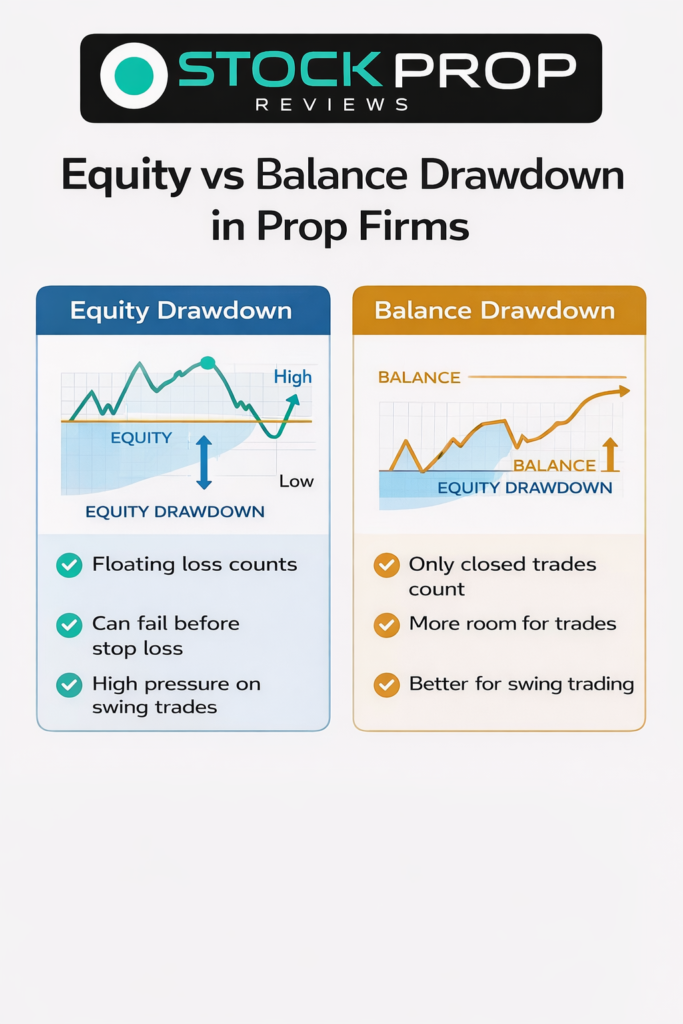
Swing traders usually deal with floating losses before a setup plays out. If a firm calculates risk based on equity instead of balance, those temporary losses can trigger violations even when the trade is still valid.
That is where most traders get caught off guard.
Comparison of the best prop firms for swing trading
| Firm | Overnight | Weekend | Drawdown Style | Profit Split | Practical Limitation |
| FTMO | Yes | Yes | Equity-based daily + static overall | Up to 90% | Daily DD pressure |
| MyFundedFX | Yes | Yes | Trailing or static (depends on plan) | Up to 90% | Trailing DD traps |
| FundedNext | Yes | Yes | Static with consistency rules | Up to 90% | Profit distribution limits |
| The5ers | Yes | Yes | Balance-based | Up to 100% scaling | Slow growth model |
| TradeThePool | Yes (stocks) | Yes | Fixed risk per trade | Varies | Limited asset class |
FTMO for swing trading
People often talk about FTMO first because it lets you hold positions overnight and on weekends. That looks like the perfect thing for swing traders on paper. It works in real life, but only if you keep a closer eye on your risk than you would with your own account.
The daily drawdown is based on equity. That means that floating losses count right away. A trade that goes down before going up can put you in violation, even if your stop loss hasn’t been hit yet.
This is what a common situation looks like. You start a trade with a bigger stop based on how things look for the day. The price goes back up early, your equity goes down, and you reach your daily loss limit. The setup works later, but you’re already out.
A lot of swing traders think their strategy “stops working” inside FTMO for this reason. It’s not the plan. It is the structure of the rules.
If you lower your position size and don’t hold through major news, FTMO will still work. But if your method depends on giving trades space, it will feel limiting.
If you want a more detailed breakdown, check out our analysis of FTMO rules and payout structure. This problem comes up a lot in trader feedback.
MyFundedFX for swing traders
MyFundedFX offers more flexibility in account types, which can help swing traders choose a structure that fits better. The problem is that many traders pick the wrong model without fully understanding the consequences.
Trailing drawdown is the main issue here. As your account grows, your allowed loss tightens. This creates a situation where you can build profit and then lose the account on a normal pullback.
For swing trading, that is a serious drawback. Pullbacks are part of the process.
A trader might build 6 percent profit over several trades. The drawdown level moves up with it. One retracement across open positions wipes out the account, even though the overall strategy remains profitable.
This is not obvious at the start, which is why many traders pass the challenge but struggle to keep the funded account.
There are static options available, and those are generally a better fit. If you are considering this firm, the account type matters more than the brand itself.
Our MyFundedFX vs FTMO comparison goes into more detail on how these differences affect real outcomes.
FundedNext for swing trading
FundedNext sits somewhere in the middle. It allows swing trading and does not rely on trailing drawdown in the same way as some competitors. However, it introduces another layer that swing traders often underestimate.
Consistency rules.
These rules are designed to prevent traders from making most of their profit in one or two trades. That makes sense from the firm’s perspective, but it can conflict with how swing trading works.
Swing traders often wait for one strong setup that delivers a large portion of returns. If that single trade contributes too much to overall profit, it can trigger a rule violation depending on the model.
This creates a subtle pressure to trade more frequently than your strategy requires. Over time, that can degrade performance.
FundedNext works best for traders who already distribute risk across multiple positions rather than relying on a few high conviction trades.
You can explore this further in our full FundedNext review, where consistency rules are broken down with real examples.
The5ers for swing trading
The5ers is one of the few firms that structurally aligns with swing trading.
The key difference is balance-based drawdown. Floating losses do not count until they are realized. That gives trades room to develop without triggering violations during normal market movement.
For swing traders, this changes everything. You can hold positions through short-term noise without constantly watching your equity level.
The trade-off is slower progression. Scaling requires hitting specific milestones, and payouts are not as aggressive early on.
Some traders find this frustrating, especially if they are used to faster challenge models. But from a risk perspective, it is one of the more realistic environments for swing trading.
If your priority is longevity rather than quick funding, The5ers tends to fit better than most firms.
TradeThePool for stock swing trading
TradeThePool operates in a different space, focusing on equities rather than forex. For swing traders who prefer stocks, this often feels closer to a traditional trading environment.
Risk is defined per trade rather than through complex drawdown systems. That makes it easier to plan positions without worrying about hidden rule interactions.
There are still limits, but they are clearer. You know exactly how much you can risk on each position, and there is less ambiguity compared to many forex prop firms.
It is not suitable if you only trade currencies, but for stock swing traders it is one of the more straightforward options available. Readers can get up to 10% discount when purchasing through our TradeThePool link.
Where most comparisons fall short
Most articles by competitors talk about whether trading overnight is allowed. That’s just the surface.
The real problems are deeper. Equity-based drawdown punishes losses that last for a short time. Trailing drawdown makes risk worse at the worst possible time. Rules about consistency get in the way of uneven profit distribution.
These are not small things. They have a direct impact on whether a swing strategy can work at a prop firm.
A company can let people hold things overnight and still not be a good fit.
Common mistakes swing traders make in prop firms
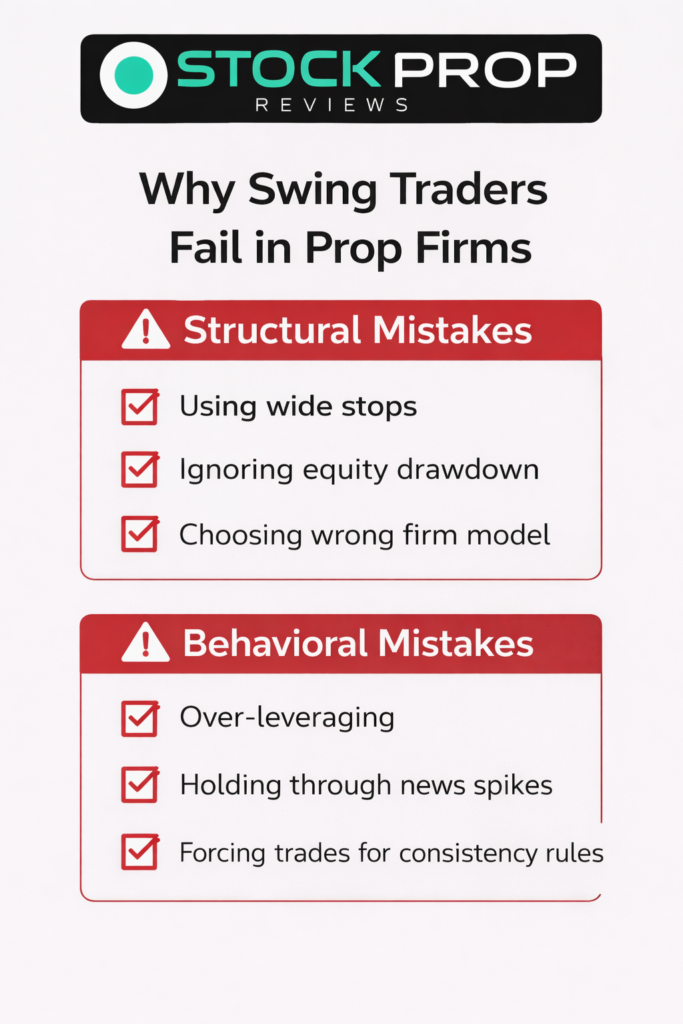
Using the same risk model for both a personal account and a business account is the most common mistake. Swing traders are used to having more room and bigger stops. That way of doing things often leads to early violations in a prop firm.
Another problem is not paying attention to floating drawdown. A lot of traders only pay attention to their stop loss, thinking that as long as it doesn’t get hit, they’re safe. That idea falls apart quickly when you use equity-based rules.
Another trap is holding through news that has a big effect. Even though it is technically allowed, volatility spikes can quickly move equity into areas where it shouldn’t be.
A lot of people don’t realize that there is also a psychological change. Rules for prop firms put pressure on traders to manage their accounts instead of their trades. That often causes people to leave too soon or make too many changes.
Which prop firms actually fit swing trading
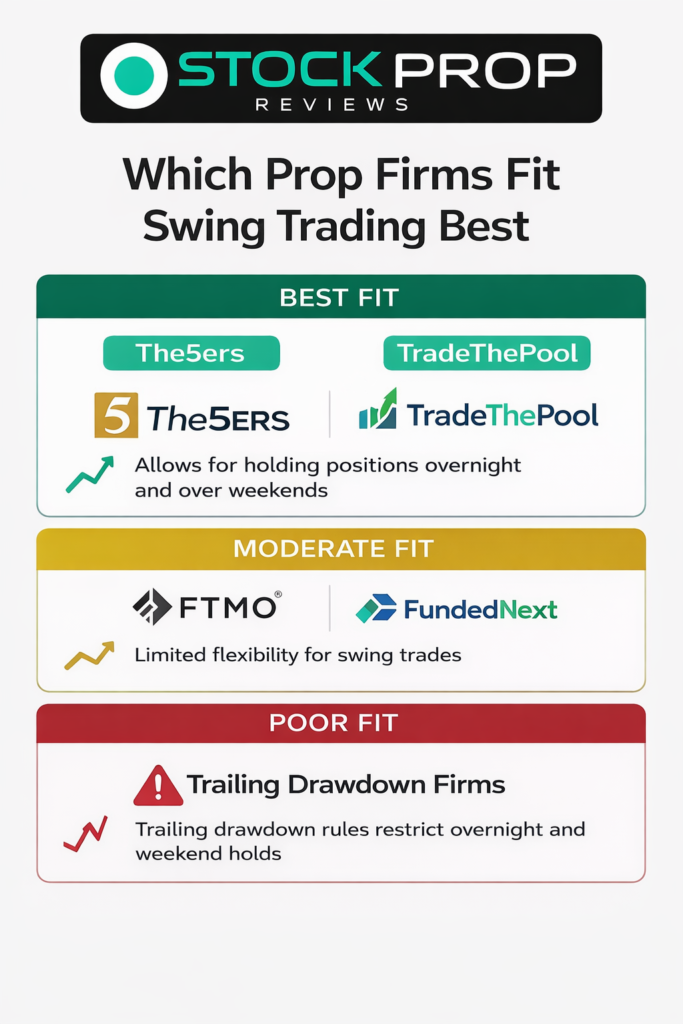
The5ers and TradeThePool tend to align best with how swing traders operate. They allow trades to develop without constant pressure from floating drawdown.
FTMO and FundedNext can still work, but they require adjustments. Position sizing needs to be smaller, and risk must be managed more actively.
MyFundedFX depends heavily on the account type. With trailing drawdown, it becomes difficult to maintain a swing strategy over time.
Are prop firms really suitable for swing trading
There is no simple yes or no.
Most prop firms are designed for higher trading frequency. That does not mean swing trading is impossible, but it does mean you are operating slightly outside the intended use case.
From a data perspective, firms benefit from traders who generate steady activity and predictable risk. Swing trading does not always fit that pattern.
From a trader’s perspective, swing strategies rely on patience and tolerance for drawdown. When rules interfere with that process, performance suffers.
The middle ground is adapting the strategy. Smaller position sizes, tighter risk, and careful firm selection can make it work.
Final thoughts
The best prop firms for swing trading are not necessarily the most popular ones. They are the ones that do not interfere with how your strategy works.
If your system depends on holding trades through short-term drawdown, equity-based rules will always feel restrictive. If you rely on a few strong setups rather than frequent trades, consistency rules can become a problem.
Choosing the wrong firm creates friction that no strategy can overcome.
TradeThePool is worth considering if you trade stocks and want a clearer risk structure. Readers can get up to 10% discount when purchasing through our TradeThePool link.
FAQs
Is it possible to swing trade in prop firms without breaking the rules?
Yes, but it all depends on the model for drawdown. Balance-based systems tend to be more forgiving than equity-based ones.
Which prop firm is best for swing trading?
People often think The5ers is easier because floating losses don’t count toward drawdown in the same way.
Why trailing drawdown doesn’t work for swing trading
This is because it lowers the amount of money you can lose as your account grows, which goes against normal market pullbacks.
Is FTMO a good choice for swing traders?
It can work, but swing traders need to be more careful with their money than they are used to.
Is it better to swing trade with stock prop firms?
In a lot of cases, yes, because the risk structure is easier to understand and less complicated. One example is TradeThePool.