
Crypto prop trading appeals to traders who want leverage, constant market access, and the chance to scale without risking their own capital. This comparison looks at the best prop firms for crypto trading from a trader-first perspective, focusing on rules, drawdowns, and how these firms behave in real market conditions.
This article is written for active crypto traders who already understand leverage, liquidation risk, and volatility. It is not for beginners, gamblers, or traders who expect prop firms to compensate for poor risk management.
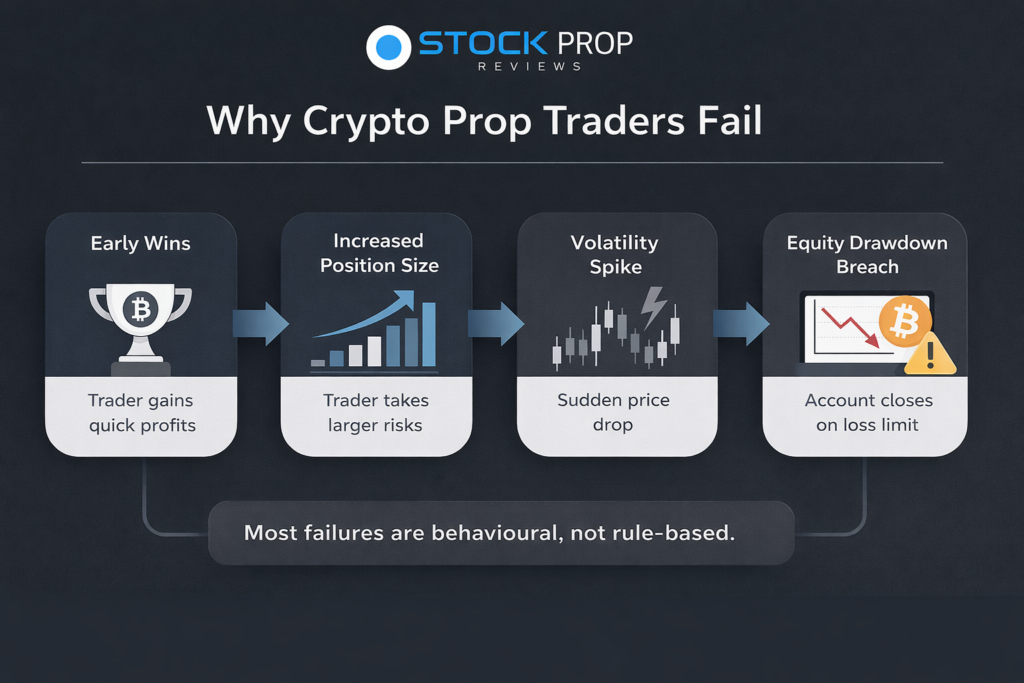
Most traders do not fail crypto prop challenges because the targets are impossible. They fail because crypto markets expose behavioral mistakes faster than any other asset class. That is the reality most competitor articles avoid.
What crypto prop firms really offer
A crypto prop firm gives you access to a funded account, usually one that is simulated or linked to an exchange, with set rules. Traders need to make a profit while staying within their daily loss and drawdown limits. Usually, the trader and the firm split the payouts.
The way drawdown is figured out is what sets crypto prop firms apart from forex or futures firms. A lot of companies use equity-based drawdowns that take into account losses that haven’t happened yet. That means a lot more in crypto than most traders think.
Even if the trade later recovers, a sudden wick can end an account.
If you’re new to funded trading, start with our primer on what stock prop firms are and how they work—it lays out the foundational mechanics that also apply when evaluating crypto-focused models
Who this comparison is for
This comparison is for traders who already trade BTC, ETH, or high-liquidity perpetual contracts and can always keep their position size under control. It works for day traders and swing traders who are okay with taking less risk when the market is volatile.
It is not good for traders who scalp a lot, trade altcoins with low liquidity, or depend on news spikes. The rules of crypto prop firms and those strategies don’t always match up.
How traders actually fail crypto prop challenges
The patterns of failure are the same after looking at hundreds of failed accounts and trader complaints.
Early confidence is the most common problem. A trader makes it through the first few days, gets bigger, and then gets stuck in a routine volatility move. Equity drawdown starts before the trader can do anything about it.
Another common problem is trading too much when there isn’t much liquidity. Cryptocurrency trades all the time, but the amount of money available isn’t always the same. Spreads get bigger, execution gets worse, and small mistakes add up quickly.
The profit target itself doesn’t cause many traders to fail.
Quick verdict
Not everyone will find the same crypto prop firm to be the best. Some companies are stricter but easier to understand. Others are flexible but use vague language in their rules. No matter what company they work for, traders who read the rules carefully and trade small tend to last longer.
By design, crypto prop trading is very risky. Some companies just make that risk easier to deal with.
HyroTrader review for crypto traders
HyroTrader is one of the more established crypto-focused prop firms and connects accounts to real exchanges through API access rather than pure simulation.
The main advantage is rule clarity. Drawdowns are static rather than trailing, which removes one of the biggest failure triggers during volatile markets. Traders know exactly how much they can lose before the account ends.
Where traders struggle is leverage. HyroTrader allows enough leverage to cause rapid losses if sizing is not controlled. Traders who risk more than one percent per trade tend to fail quickly.
This firm works best for disciplined intraday traders who reduce size during high volatility. It performs poorly for emotional traders who increase risk after early wins.
Readers can find a deeper breakdown in our detailed HyroTrader review.
RebelsFunding crypto accounts review
RebelsFunding offers crypto alongside forex and index products. Crypto rules are noticeably stricter than their forex offerings.
Daily loss limits are tight and usually calculated on equity rather than balance. This catches many traders off guard. A position that is technically still open can end the account if price moves too far intraday.
Profit targets are reasonable, but the margin for error is small. Traders who trade less frequently tend to do better here than those who trade every session.
This firm suits swing traders who can hold positions calmly through volatility. It is not friendly to scalpers or news traders.
ForTraders crypto programs review
ForTraders has a lot of different crypto challenge sizes and is often aimed at experienced prop traders who want to get into crypto.
The main problem is how to understand the rules. You need to read carefully about drawdown resets, weekend exposure, and payout conditions. People who skim terms often don’t understand how losses are figured out.
ForTraders isn’t unfair in and of itself, but it does require a lot of attention to detail. Traders who already know how prop firms work have an easier time adapting than people who are new to them.
AltFins style crypto prop models
AltFins is more interested in structured crypto trading models than in open-ended challenges. Risk is tightly controlled, which lowers the potential for big losses but also limits the potential for big gains.
This method annoys aggressive traders, but it helps those who have trouble being disciplined. The chance of making money is lower, but the chance of living is higher.
It works for conservative traders who care more about consistency than quick payouts.
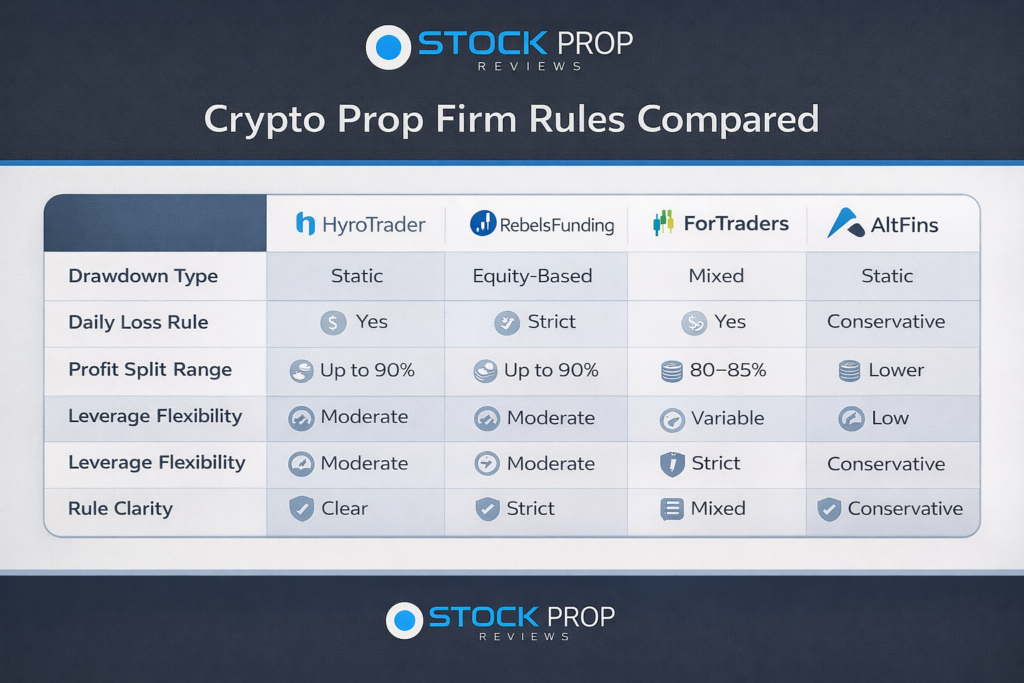
Crypto prop firm rules comparison
| Firm | Drawdown Style | Daily Loss | Profit Split | Leverage | Main Risk |
| HyroTrader | Static | Yes | Up to 90% | Moderate | Volatility spikes |
| RebelsFunding | Equity-based | Strict | Around 80% | Moderate | Tight limits |
| ForTraders | Mixed | Yes | 80–85% | Variable | Rule complexity |
| AltFins | Static | Conservative | Lower | Low | Limited upside |
What most competitors do not explain
Most articles that compare businesses talk about how to split profits and how much money to start with. Drawdown mechanics are more important than these numbers.
The biggest silent account killer in crypto prop trading is equity-based drawdowns. Account resets after payouts are another problem that people don’t think about. Some companies reset balances instead of letting them grow, which changes how much money they make in the long run.
These facts are more important than the big numbers.
Common mistakes traders make
A lot of traders use crypto prop accounts like their own. That is wrong.
Most failures happen because people over-leverage after making early profits, hold on through big macro events without a buffer, and trade during times when there isn’t much liquidity. Another mistake that people often make is thinking that unrealized losses don’t count toward drawdown.
They do a lot.
Who should avoid crypto prop firms
If you trade based on signals, automated bots that don’t have any oversight, or your feelings, you should stay away from crypto prop firms.
Personal capital or a different prop model is safer if you need wide stops or flexible risk rules.
Alternatives worth considering
Some traders don’t like crypto prop firms, but they still want a structured place to work.
TradeThePool is an example of a regulated stock prop firm that works very differently. It focuses on stocks, is regulated, and makes its drawdown and risk rules clear. There is less uncertainty, but also less change..
Readers can get up to 10 percent discount when purchasing through our TradeThePool link. This is not a crypto solution, but many traders prefer it for rule transparency and psychological stability.
Futures prop firms are another option. Our futures prop firm comparison explains how exchange-based risk differs from crypto models.
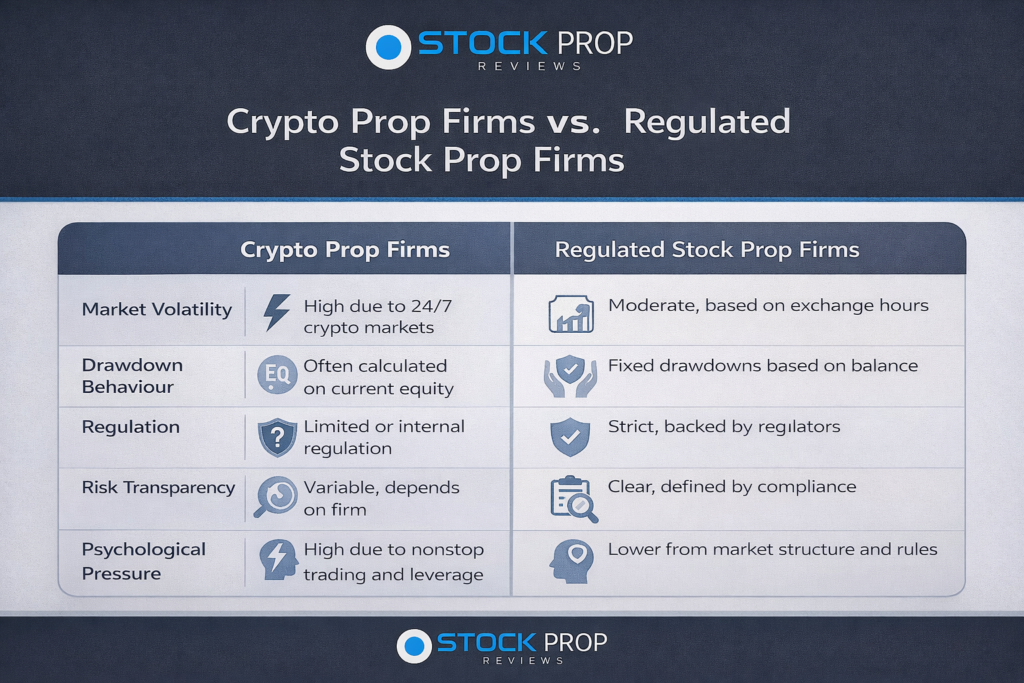
Crypto prop firms vs regulated stock prop firms
Crypto prop firms let you trade all the time and give you a lot of freedom, but they don’t keep an eye on things very well. Regulated stock prop firms trade in structured markets that have rules to follow and clear risk levels.
Crypto rewards flexibility. Stocks pay off for those who are patient.
There is no better model. They fit the personalities of different traders
For an established futures model and a rule-focused evaluation path, see our TopStep review, which breaks down trailing drawdowns and psychological challenges traders face even after passing the evaluation..
Strategy fit analysis
Scalping crypto within the rules of a prop firm is very hard because of spreads and equity drawdown. It works better to swing trade with less leverage. Most crypto prop firm risk engines don’t work well with news trading.
Separating truth from opinion
It is true that traders receive payouts from crypto prop firms. It is also true that most accounts fail due to behavior, not hidden rules.
Claims that all crypto prop firms are scams ignore trader responsibility. Claims that success is easy are equally misleading.
The truth sits between those extremes.
How psychology interacts with crypto prop rules
Crypto makes people more scared and too sure of themselves. The rules of a prop firm quickly show those traits. Traders who can’t cut back on their size after winning or accept small losses don’t last long.
What drawdown actually means in crypto prop trading
The maximum loss that can happen before an account is closed is called drawdown. In crypto, it often includes losses that haven’t happened yet.
A lot of traders think that only closed trades matter. That assumption ends accounts.
Example traders often miss
A trader puts three percent of their money on BTC. Price goes against the position by four percent during the day, which causes equity to go down. The account fails, even though the price goes back up later.
This happens a lot and is not always explained well.
FAQs
Are crypto prop companies real?
Some are open about how they work, while others are less clear about their rules. Legitimacy depends on how clear things are and how often payouts happen.
Are crypto prop firms a good choice for beginners?
No. Beginners should start by trading small personal accounts.
Which crypto prop companies are the safest?
Companies with fixed drawdowns and clear daily loss rules are less likely to fail unexpectedly.
Can trades last overnight?
Yes, but you still have to pay funding fees and equity drawdown.
Is TradeThePool a crypto prop company?
No. BusinessThePool is a stock prop firm that follows the rules. Some traders like it better because the rules are clearer and the market is less volatile. When readers buy through our TradeThePool link, they can save up to 10%.