When you look for low drawdown prop firms, you probably want one thing. You want to be able to trade without being cut off too soon.
That’s true. One of the main reasons good traders fail challenges is because they have strict drawdown rules.
But this is the part that most comparisons get wrong. The percentage isn’t the only thing that counts. It’s how the drawdown is figured out, how daily limits affect it, and how your trading style fits with those rules.
This guide is for traders who already have a system and want to lower the stress on their structures. It’s not for people who want an easier way to pass. Even the most “flexible” companies will quickly close accounts if the rules are not followed.
What Low Drawdown Really Means in Practice
The term sounds simple, but in prop trading it’s often misleading.
Two firms can both offer 10 percent drawdown and feel completely different in live trading.
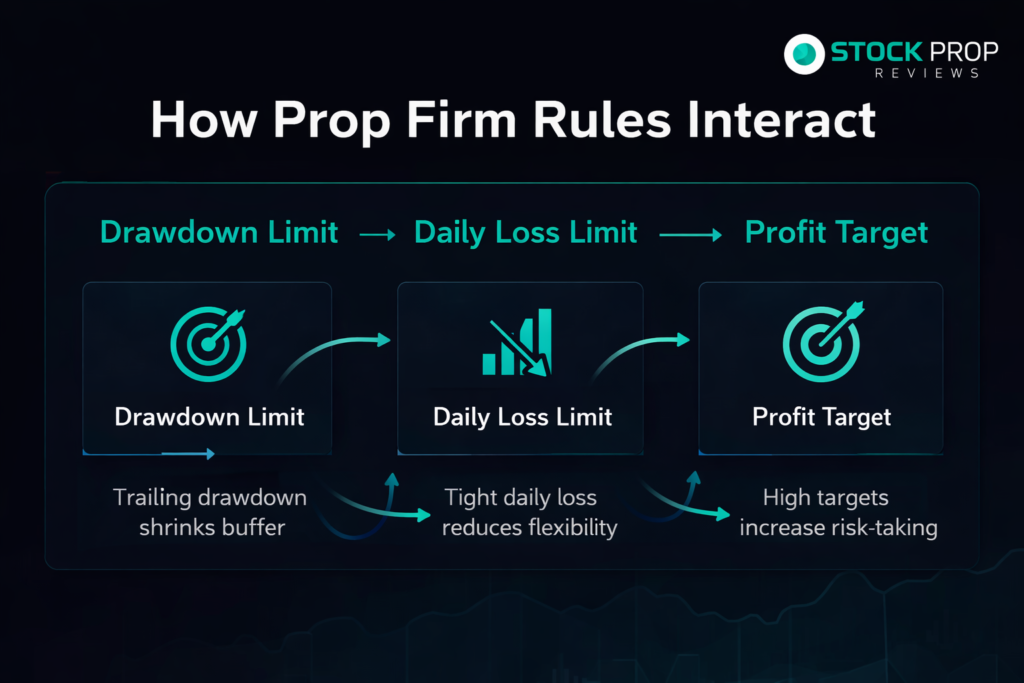
The difference usually comes down to three things:
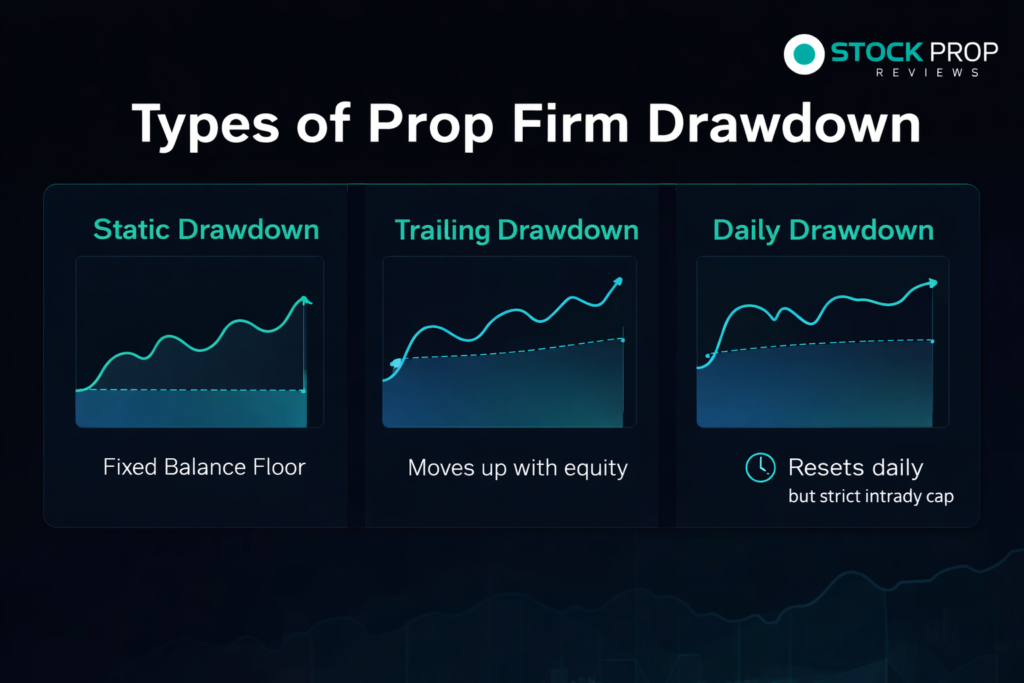
- Whether the drawdown is static or trailing
- Whether there is a strict daily loss limit
- How profit targets are structured
A static drawdown gives you a fixed floor. It does not move as your account grows. Trailing drawdown moves up with your equity, which means your risk tightens as you perform well.
That’s where many traders get caught. They assume they are becoming safer as they gain profit, but in reality their margin for error is shrinking.
Comparison Table: Low Drawdown Prop Firms
| Firm | Drawdown Type | Max Drawdown | Daily Limit | Profit Split | Main Constraint |
| FTMO | Static | 10% | 5% | Up to 90% | Daily loss pressure |
| The Funded Trader | Trailing (varies) | 8–10% | 4–5% | 80–90% | Shrinking risk buffer |
| E8 Funding | Static | 8–10% | 5% | 80% | Faster targets |
| FundedNext | Static | 10% | 5% | 80–90% | Consistency rules |
| TradeThePool | Position-based | Strategy dependent | No fixed % | Up to 80% | Stock-only model |
FTMO
Quick verdict
Structured and predictable, but the daily loss rule is where most accounts end.
How the rules play out
FTMO uses a static 10 percent drawdown, which is why it’s often listed among low drawdown firms. On paper, this looks trader-friendly.
In practice, the 5 percent daily loss limit does most of the damage.
A trader can be in overall profit and still violate the account in a single session. This happens more often than people expect, especially when trades are scaled or held through volatility.
What tends to go wrong
Giving back gains on the same day is a common pattern. You start off strong and feel in charge, but then one or two trades go against you. The daily limit is reached before the total drawdown is even close.
This sets up a mental trap. After making money early on, traders get too cautious, or they rush to make up for losses.
Who this suits
FTMO is best for traders who keep their position sizes the same and don’t let big swings happen during the day. The rules are easy to follow if your equity curve stays pretty smooth from day to day.
Who should avoid it
The daily cap will feel limiting if your strategy includes scaling into trades or reacting to news that is volatile.
Our full FTMO review has a more in-depth look at real pass and fail situations.
The Funded Trader
Quick verdict
Flexible at first glance, but trailing drawdown changes the game over time.
How the rules play out
The Funded Trader offers drawdown in the 8 to 10 percent range, often with a trailing component.
This is where traders misjudge risk. The trailing level rises with your equity. That means a profitable run can actually reduce your allowable loss.
What tends to go wrong
A trader makes a cushion, feels good about it, and then takes a normal pullback. That pullback is now a violation because the drawdown has gone up.
It doesn’t seem like you’re trading too much. It seems like the rules changed while you were there.
Who this suits
People who trade short-term and take profits often and don’t hold through retracements tend to do better with trailing models.
Who should avoid it
Swing traders and trend followers often have trouble here. Their edge comes from letting trades breathe, which is at odds with a tightening drawdown.
E8 Funding
Quick verdict
The structure is clean, but the pressure changes from drawdown to performance speed.
How the rules play out
E8 uses a static drawdown model, which is usually between 8 and 10 percent. That part is easy to understand.
The problem is the profit goal. It often makes traders work harder to get returns than they normally would.
What tends to go wrong
Instead of respecting their usual risk per trade, traders slightly increase size to hit targets quicker. It doesn’t feel aggressive in the moment, but a small shift in risk is enough to hit both daily and total limits.
Who this suits
Traders who already trade at a moderate rate and are okay with keeping their output steady can do well.
Who should avoid it
If you need to be patient and pick your spots carefully, the target structure might make you feel uncomfortable.
FundedNext
Quick verdict
There is a reasonable drawdown on paper, but consistency rules quietly tighten control.
How the rules play out
FundedNext offers static drawdown similar to FTMO. That gives a stable risk boundary.
The difference is the consistency requirement. Profits need to be distributed across trades, not concentrated in a few large wins.
What tends to go wrong
A trader hits the profit target with one or two strong trades. Instead of passing cleanly, they are required to continue trading to meet consistency thresholds.
This increases exposure and creates new chances to violate drawdown rules.
Who this suits
Traders with steady, repeatable setups across many trades tend to fit well.
Who should avoid it
If your strategy depends on occasional high-conviction trades, this structure works against you.
You can read more about this dynamic in our comparison of FTMO vs FundedNext differences.
TradeThePool
Quick verdict
Different approach to risk, closer to how real desks operate, but not for every trader.
How the rules play out
TradeThePool does not rely on fixed percentage drawdown in the same way as forex prop firms.
Risk is tied to position sizing and overall exposure rather than a strict daily equity stop. This changes how trades are managed.
What tends to go right and wrong
Traders often find it easier to hold positions without being cut off by an arbitrary daily limit. At the same time, there is less room for careless sizing because risk is enforced through capital allocation.
Who this suits
Traders who prefer a more realistic environment and are comfortable trading stocks tend to adapt well.
Who should avoid it
If you rely on high leverage or strictly trade forex, this model will feel unfamiliar.
TradeThePool is worth considering if rigid daily limits have been a recurring issue. Readers can get up to 10 percent discount when purchasing through our TradeThePool link.
What Most Comparisons Miss
Most articles only give percentages for drawdowns. That’s just the surface.
It’s hard to figure out how rules work together.
A company might offer a large total drawdown, but it might also have a strict daily limit and a high profit target. Another option is to get rid of the daily limit but use trailing drawdown, which makes it harder for you to change your mind.
These differences are more important to a trader than the headline number.
Where Traders Still Fail With Low Drawdown Firms
Even with more forgiving structures, failure rates remain high. The reasons are usually consistent.
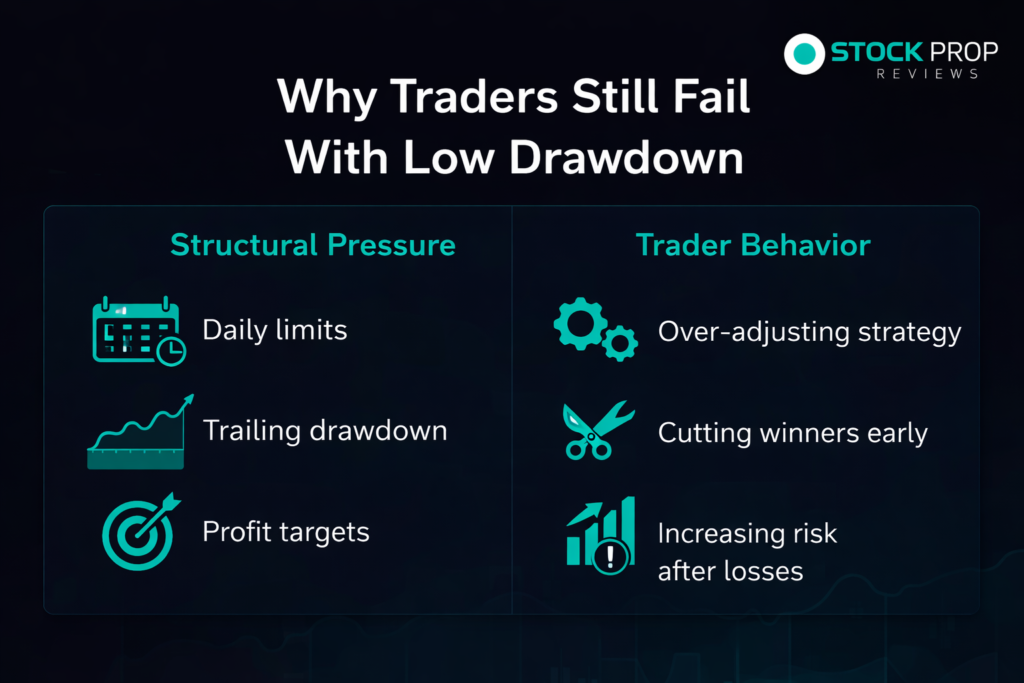
One issue is strategy distortion. Traders change their system to fit the rules instead of choosing a firm that fits their system.
Another is profit protection. After gaining early profits, traders become defensive and start closing trades too soon. This lowers their average win and makes hitting targets harder.
There is also the tendency to increase risk after a losing streak. Even a small increase in size can break the balance between drawdown and recovery.
We explored this in detail in our article on why profitable traders fail prop firms. The pattern is less about skill and more about adaptation under constraints.
Strategy Fit Matters More Than Drawdown
Not all low drawdown firms are better. They work better for certain styles.
Traders who always follow through and have a set amount of risk for each trade usually do best. Their performance fits with the way static drawdown and daily limits are set up.
Traders who depend on flexibility, on the other hand, tend to have trouble. This includes people who scale up quickly, hold on during volatile times, or trade in ways that aren’t always smooth but have a big effect.
One of the most common mistakes is picking a company without thinking about how well it fits.
Best Fit and Poor Fit
Some traders naturally work with these companies, while others always fight the rules.
A good fit usually means that you already follow the rules without having to change how you trade.
When you have to change the size of your trades, your exit strategy, or how often you trade just to stay within the rules, that’s a bad fit. That doesn’t last very long.
Look at the rules of the firm and compare them to your last 20 trades if you’re not sure. Not your ideal trades, but the ones you actually make.
FAQs
What prop company has the least strict drawdown rules?
FTMO and FundedNext are two examples of static drawdown firms that are usually more stable. Trailing drawdown companies often seem stricter, even though their percentages are the same.
Is trailing drawdown worse than static?
Yes, for most traders. Trailing drawdown lowers your buffer as you make money, which can cause you to break the rules without meaning to.
Do companies with low drawdown guarantee better chances of passing?
No. They lower one type of pressure, but they often add more, like stricter goals or rules about how to be consistent.
Why do traders fail even when they can change their drawdown?
Because of daily limits, rule interactions, and mistakes people make, like taking on more risk after losing.
Is TradeThePool better at keeping drawdowns under control?
It can be, especially for traders who like to take on risk based on their positions instead of fixed percentage limits. It all depends on your market and your plan.
Final perspective
Low drawdown prop firms only solve part of the problem.
The traders who last are the ones who know how rules affect their choices as they happen. Not only the percentage, but also how it works.
If you make your strategy fit the company instead of forcing it to fit, the drawdown becomes easier to handle. If you don’t, even rules that are meant to be flexible will start to feel like they are limiting you very quickly.