If you’re looking into copy trading with prop firms, you probably want to use a strategy that works on more than one account. That idea sounds good on paper. In practice, this is one of the simplest ways to get your funded accounts limited or your payouts denied.
This guide is for traders who are already making money and want to grow their business. It’s not for people who are still trying out strategies. Copy trading won’t make things more consistent. It will show it faster.
Most websites only list companies that “allow copy trading.” The real question is not if it is allowed. It’s how companies see your actions when you do them.
What Copy Trading Means Inside a Prop Firm
Copy trading simply means placing the same trades across multiple accounts. That can be done manually, through a copier, or with an EA.
The problem is not the tool. The problem is how identical your trading starts to look.
From a trader’s perspective, it feels efficient. From a firm’s perspective, it can look like one oversized position split across accounts. That is where issues start.
Why Prop Firms Care About Copy Trading
Firms are not worried about you copying your own trades. They are worried about risk concentration and coordination.
If ten accounts take the same trade at the same time with the same size and structure, it behaves like one large account. That breaks the intent of most evaluation models.
There is also a second concern. Some traders try to pass challenges using copied signals or shared strategies. That is why firms monitor patterns, not just rules written on the website.
Comparison: Prop Firms That Allow Copy Trading
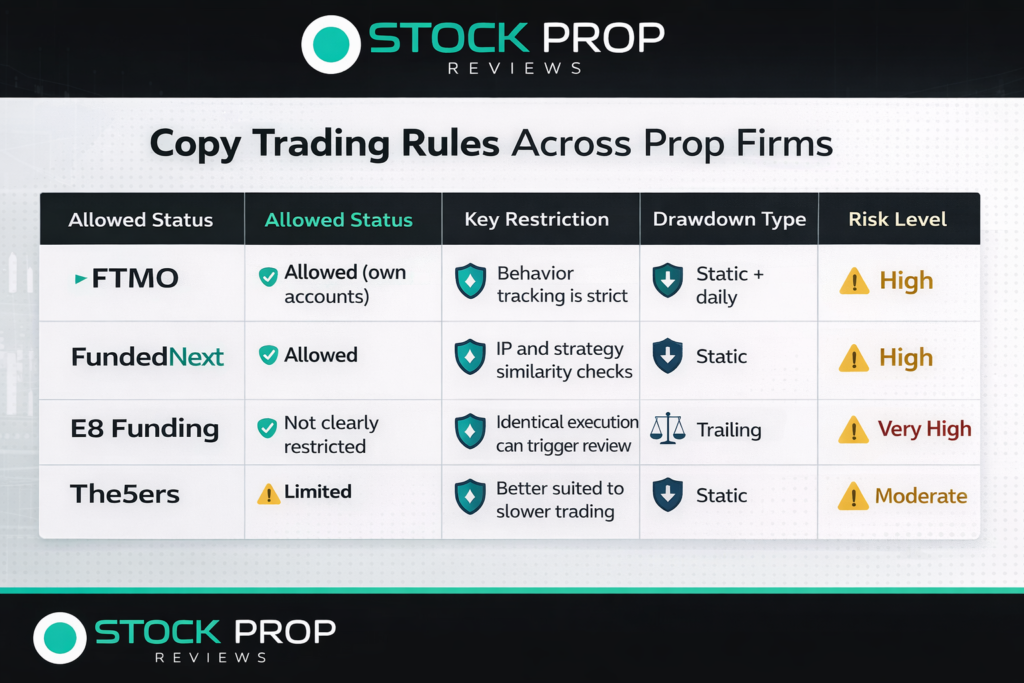
The table below reflects how firms behave in reality, not just what they say in their FAQs.
| Prop Firm | Copy Trading Stance | What Actually Matters | Drawdown Model | Payout Split |
| FTMO | Allowed (own accounts) | Behavior tracking is strict | Static + daily | Up to 90% |
| FundedNext | Allowed | IP and strategy similarity checks | Static | Up to 90% |
| E8 Funding | Not clearly restricted | Identical execution can trigger review | Trailing | Up to 80% |
| The5ers | Limited | Better suited to slower trading | Static | Up to 100% |
Some firms often mentioned elsewhere are no longer reliable or operational. That detail is often outdated in competitor lists.
FTMO: Safe but Not Flexible
FTMO is one of the few firms where copy trading is clearly addressed. You can copy trades between your own accounts. That part is straightforward.
Where traders run into trouble is execution behavior.
If every trade hits the market at the exact same time, with the same lot size and structure, it starts to look automated in a way that raises flags. Even if you are within the rules, your trading can still be reviewed.
A common mistake is scaling too quickly. A trader runs a copier across several accounts without testing how the setup behaves under drawdown. One bad sequence and all accounts drop together.
For a deeper breakdown of how strict rules affect traders, see our analysis of FTMO trading rules explained.
FundedNext: More Flexible, Still Watched
People often think that FundedNext is more laid-back, and in some ways, that’s true. Traders do use copiers and EAs on multiple accounts without any problems right away.
The problem is that monitoring usually happens later, especially when it comes to payouts.
If a lot of accounts have very similar trading patterns over time, it can make you wonder. This is especially important if different people are using the same strategies or if they are sharing them.
A real-life example: a trader uses a VPS to run the same EA setup on several accounts. During the challenge, everything works fine. At the payout stage, the company checks for consistency and marks the setup as too uniform.
That is the part that most articles leave out.
E8 Funding: Where Drawdown Changes Everything
E8 Funding is not openly restrictive about copy trading, but the structure of its rules creates a different risk.
Trailing drawdown changes how copied strategies behave. When you duplicate trades across accounts, you are also duplicating drawdown pressure.
If your strategy hits a losing phase, every account moves toward the drawdown limit at the same time. There is no room to recover gradually.
This is why traders who rely on aggressive systems often fail here. The issue is not copy trading itself. It is how the drawdown model interacts with it.
The5ers: Not Built for Copy-Heavy Setups
The5ers is a different place. It is more about swing trading and consistency over the long term.
There isn’t a lot of advertising for copy trading, and high-frequency execution doesn’t work well here.
If your method relies on tight entries and quick copying across accounts, you will probably have a hard time. That style doesn’t work with the platform.
People who do well here usually use slower strategies with fewer trades and don’t rely on getting the timing just right.
What Most Articles Miss About Copy Trading
The main difference between competitors’ content is that they focus on permission instead of behaviour.
Companies don’t often say “no copy trading.” They watch how you trade instead.
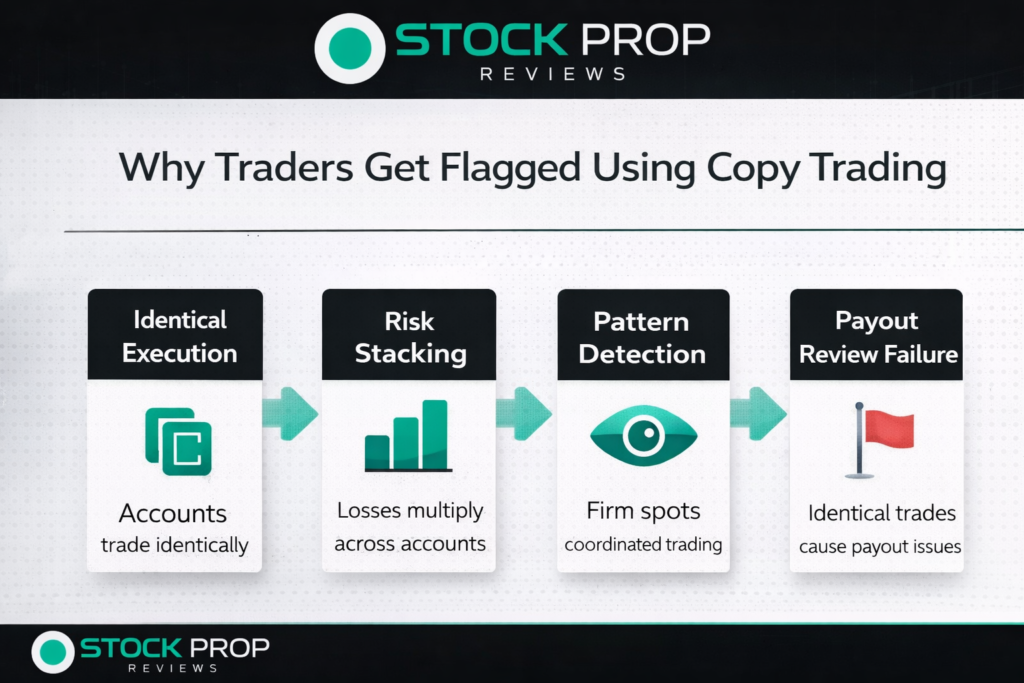
The first problem is that the execution is not always the same. If your trades are the same across accounts down to the second, it can look fake. That by itself can start a review.
The second problem is stacking risks. People who trade think they are spreading their risk by using more than one account. In reality, they are putting all their eggs in one basket. One losing streak has an effect on everything at once.
The third problem is checking the payout. It’s not hard to get through a challenge with a copier. Things get tight when you get paid. Businesses look at trends over time, not just results.
Where Traders Actually Fail
Most failures do not result from violating apparent rules. They come from not understanding how companies judge behaviour.
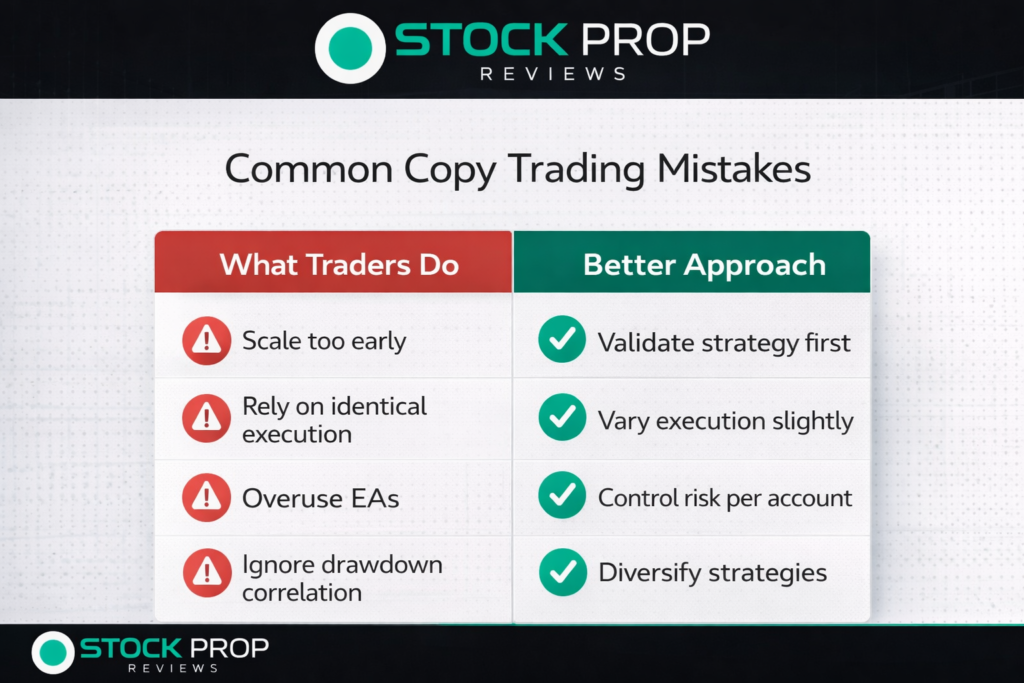
Scaling too soon is a common mistake. A trader finds a setup that works for a few weeks and then copies it to a lot of different accounts right away. No testing is done in different market conditions.
Another problem is that people are too sure of automation. EAs and copiers make things more consistent, but they also take away flexibility. All accounts respond in the same way when the market changes.
There is also a mental part to it. When a lot of accounts are doing the same trades, the pressure goes up. Traders get in the way more, not less. That usually makes things worse.
This is similar to what we talked about in “Why Funded Traders Lose Accounts After Passing.”
Strategy Fit: When Copy Trading Makes Sense
Copy trading works best when the strategy behind it is stable and doesn’t need to be timed perfectly.
Swing traders tend to do better with it because the timing of execution is less important. A few seconds of difference doesn’t change the outcome very much.
If they know how to manage risk and don’t over-scale, systematic traders can also make it work.
It has trouble with scalping, news trading, and high-frequency systems. In those situations, small differences in execution are important, and copying trades can change the results.
Better Ways to Scale
Copy trading is not the only way to grow, and for many traders, it is not the best one.
Some companies have scaling plans that let you earn more money as you do better. That makes it easier to manage and keeps risk in one place.
Instead of copying one strategy across all of your accounts, you could try running different ones on each account. That makes drawdown easier to handle and lowers correlation.
There is also another way to go through stock prop firms. For example, TradeThePool has clear risk limits and a more open structure for execution.
If you buy through our TradeThePool link, you can save up to 10%.
It doesn’t replace forex prop firms, but it does make the rules for copy trading a little easier to understand.
Check out our comparison of the best prop firms for scaling strategies for a bigger picture.
Reality Check: Is Copy Trading Worth It
There is a belief that copy trading is a shortcut to scaling. That belief is misleading.
It can work, but only if the strategy is already proven and the trader understands how firms interpret behavior.
For most traders, it creates more problems than it solves. The gains are limited, and the risks increase quickly.
The traders who succeed with it tend to use it conservatively, not aggressively.
FAQs
Can you copy trade with prop firms?
Some do, but only between accounts that the same trader owns. Even then, behaviour is closely watched.
Can copy trading get you kicked out?
Not directly, but how you use it could cause problems with your account or payouts.
Is copy trading a good idea for beginners?
No. It makes mistakes worse and raises risk without making strategies better.
Why do companies flag trades that are the same?
Because the same execution across accounts can mean that traders are working together or avoiding risk.
What is the safest way to grow in prop firms?
Copying trades is usually less safe than slowly scaling up through one account or using strategies that don’t affect each other.
Copy trading is not a way to get around the rules. It is a controlled feature with limits that most traders only find out about when something goes wrong.