It can feel like the hardest part of the journey to pass a prop firm challenge. But a lot of traders find something surprising afterward. Traders who get money in their accounts change their strategy.
The trading environment changes right after the evaluation ends, which is why this change happens. The goal is no longer to reach a profit goal within a set amount of time. The main things to focus on are keeping the account safe, following the rules for drawdowns, and making sure that payouts are always the same.
This guide is for traders who are getting ready for a funded account or already have one and want to know why strategies change so often after they pass. It talks about the real-world and mental reasons for these changes.
It wasn’t written for traders who want quick ways to pass challenges. The point of this is to explain how funded trading works and why a lot of traders have trouble making the switch.
Understanding Why Funded Traders Change Strategy
When traders say that funded traders change strategy, they usually mean that the way trades are done changes, not that the whole system changes.
The basic setup may stay the same, but a lot of things change:
- size of the position
- how often you trade
- choose a session
- stop loss placement patience around setups
During the evaluation, traders are trying to reach a specific profit goal. After getting money, they are managing risk over a longer period of time. That one difference can make changes necessary.
When the goal is to keep the account alive and make regular payments, a strategy that worked perfectly to reach a 10 percent challenge target may not be the best one.
The Structural Difference Between Challenge Trading and Funded Trading
One reason competitors rarely explain why funded traders change strategy is that they focus heavily on passing evaluations. What happens afterward receives much less attention.
In practice, the two environments are very different.
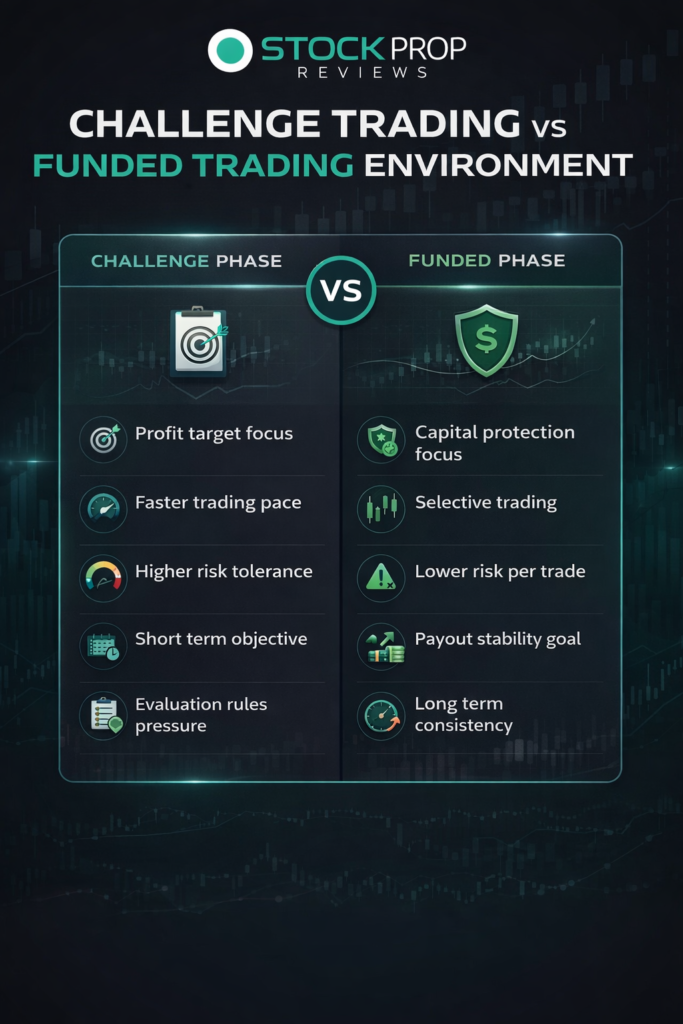
| Factor | Challenge Phase | Funded Phase |
| Primary goal | Reach profit target | Maintain account |
| Risk tolerance | Often higher | Usually lower |
| Trading pace | Faster | More selective |
| Psychological pressure | Passing test | Protecting payouts |
| Drawdown management | Calculated risk | Capital protection |
During a challenge, the trader is solving a defined problem. After funding, the trader is managing risk over an indefinite period.
This shift changes behavior more than most traders expect.
A Common Example From Real Challenge Traders
Consider a trader working through a two step evaluation with a 10 percent target and a 5 percent daily drawdown limit.
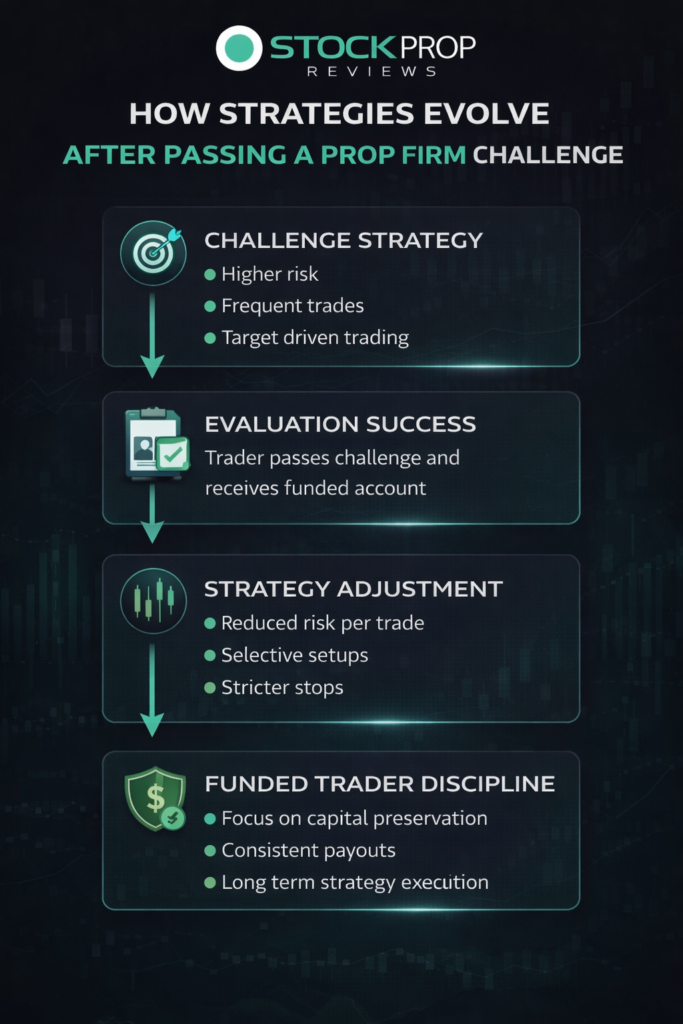
To reach the target efficiently, the trader may risk around one percent per trade and take multiple setups each day. Momentum trades during high volatility sessions help accelerate progress.
Eventually the target is hit and the trader receives a funded account.
Now the mindset changes.
Two losing trades at one percent risk suddenly feel far more dangerous because the trader is protecting an account that can generate real payouts. The same strategy that helped pass the challenge now feels aggressive.
Instead of risking one percent, the trader reduces risk to half a percent or less.
The strategy did not completely change. The risk framework changed, which alters the way the strategy behaves.
The Psychological Shift After Funding
The most powerful reason funded traders change strategy has little to do with indicators or market analysis.
It is psychology.
During a challenge, losing the account usually means paying for another attempt. While frustrating, it is still a defined cost.
After funding, the account represents potential income. Losing it feels very different.
Traders often experience several psychological reactions at this stage:
They become more cautious because the account now represents real opportunity.
They hesitate on trades that would previously have been taken without doubt.
They focus heavily on protecting the account rather than executing the system.
This shift sometimes leads to better discipline. In other cases it leads to hesitation and missed opportunities.
Why Challenge Strategies Sometimes Fail After Passing
Many strategies are unintentionally designed to pass evaluations rather than manage long term accounts.
A trader attempting to reach a target quickly may take several actions that are less sustainable in a funded environment.
Risk per trade may be slightly higher than what is comfortable for long term trading. Trade frequency may also be higher because the trader is trying to accumulate profit faster.
Once funded, these habits can conflict with prop firm rules such as daily drawdown or trailing drawdown structures.
This is one reason traders who pass quickly sometimes lose their funded accounts within the first few weeks.
The issue is rarely the strategy itself. The problem is that the risk model behind the strategy was built for short term results.
What Competitor Guides Often Miss
A lot of prop firm articles talk about how to reach profit goals faster, how to deal with challenges, and how to evaluate your work.
They don’t often explain how to go from passing a challenge to keeping a funded account.
In real life, these two phases need different skills.
Passing is about following the rules in a smart way.
Funded trading is about being consistent when things get tough.
Traders who see this difference early on usually have an easier time adjusting.
People who treat funded accounts the same way they treat challenges often have a hard time.
Typical Adjustments Funded Traders Make
Most traders who get money don’t completely give up on their plan. Instead, they make it better.
The risk per trade often goes down. A trader who risks one percent during evaluation might cut that risk to about half a percent once they have money.
Trade selection also gets more picky. Traders don’t always take every valid setup; instead, they often focus on the ones with the best chances of success.
Another change is that you need to be patient. Many funded traders start to hold trades for a little longer, letting setups grow instead of quickly closing positions to lock in small profits.
These changes make the strategy more likely to help your account last for a long time.
The Influence of Prop Firm Rules
Prop firm rules play a major role in shaping how funded traders operate.
Drawdown structures are particularly important. Firms using equity based drawdowns require stricter risk control because open trades affect the account balance immediately.
Other rules such as consistency requirements can also influence strategy behavior. A trader who generates one large winning day followed by several small days may face restrictions in some firm models.
These structural factors explain why strategy adjustments are sometimes necessary.
Traders often analyze these differences when reading firm reviews such as our detailed look at the FundedNext prop firm review, where drawdown structure and trading flexibility play a major role in strategy compatibility.
Why Some Traders Pass But Still Lose Their Funded Accounts
Passing a challenge does not automatically mean a trader is ready for long term funded trading.
Several situations can create this gap.
Sometimes traders pass during favorable market conditions where volatility supports their strategy. When conditions change, the strategy becomes harder to execute.
In other cases the trader simply used a more aggressive risk model to reach the target quickly.
Without adjusting that risk model, the same approach becomes dangerous under funded conditions.
This pattern is discussed in our analysis of why many prop firm traders fail challenges, where aggressive risk management often leads to short lived success.
Strategy Stability Is More Important Than Strategy Type
A lot of traders think they need a brand new system as soon as they get money in their account.
Most of the time, this isn’t needed.
Most of the time, successful funded traders stick to the same basic strategy. What they change is how risk is used.
To turn a challenge strategy into a long-term funded approach, you need to reduce your position size, limit correlated trades, and stick to strict stop losses.
Switching strategies often means that you are under a lot of stress, not that there is a real technical problem.
A Realistic Timeline for Strategy Adjustment
One mistake new funded traders make is changing their approach too quickly.
A more practical approach is to gather enough trading data before making adjustments.
Many experienced traders prefer to collect at least several weeks of trades before modifying their strategy. This allows them to see how the system performs under real funded conditions.
Quick changes often introduce more problems than they solve.
When Strategy Changes Actually Make Sense
Although stability is important, there are situations where adjusting a strategy is reasonable.
If a system was specifically designed to pass evaluations quickly, it may not suit long term account management.
Certain scalping strategies also struggle under funded conditions because spreads, commissions, and drawdown rules can reduce profitability.
In these situations traders may gradually adapt their strategy rather than switching to a completely different method.
Considering Different Prop Firm Environments
Some traders eventually explore different prop firm models if their strategy conflicts with challenge rules.
Traditional challenge firms focus heavily on short term evaluations and strict drawdown structures.
Other firms take a slightly different approach. TradeThePool, for example, operates as a regulated stock prop firm and focuses on equity trading rather than CFD style challenge accounts.
Because of the transparent rule structure and stock market focus, some traders find it easier to maintain a consistent strategy.
Readers can get up to 10 percent discount when purchasing through our TradeThePool link, though it remains important to evaluate whether stock trading aligns with your existing strategy.
Common Mistakes Traders Make After Passing
Many problems funded traders face come from behavioral changes rather than technical issues.
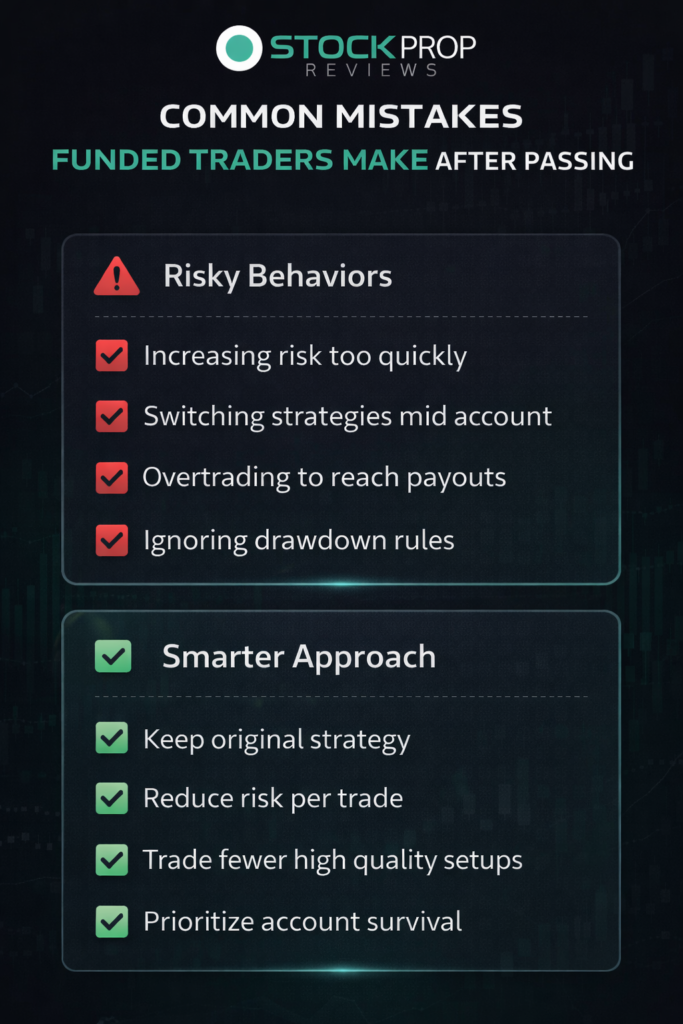
Some traders increase risk too quickly because they believe passing proves their strategy is highly reliable.
Others begin experimenting with new indicators or timeframes instead of sticking to the system that worked during evaluation.
A different group becomes overly cautious. They reduce position size so much that the strategy loses its statistical edge.
All three behaviors come from the same source. The pressure of managing a funded account.
Choosing Firms That Match Your Strategy
People often forget to check if their strategy works with prop firm rules.
Some companies have strict rules about trading news, holding trades overnight, or trading during certain times. These rules can make some strategies harder to use.
For instance, traders who use momentum around economic news may have trouble with companies that don’t allow news trading.
Before picking a company, it’s important to know about these limits.
A lot of traders use resources like our best prop firm comparison guide to look at different options side by side. This guide shows how rule structures affect how people trade.
Why Discipline Matters More Than Strategy
Markets change all the time. Every year, indicators change and new systems come out.
But traders who keep their funded accounts open for the longest periods of time usually have one thing in common. They have a set way of doing things and are very careful about risk.
Sometimes you need to change your strategy, but trying new things all the time doesn’t usually lead to stable results.
It’s much more useful to be able to consistently follow a proven system than to find the next strategy.
Another Perspective on Prop Firm Models
Some traders eventually prefer environments closer to traditional proprietary trading.
Firms such as TradeThePool focus on real equity trading with transparent risk frameworks, which some traders find easier to integrate into long term strategies.
Readers can get up to 10 percent discount when purchasing through our TradeThePool link, though the decision should always depend on the trader’s market preference and strategy compatibility.
FAQs
Why do traders who get money change their strategy after passing a challenge?
Funded traders often change their plans because their goal changes from making money to keeping their capital safe and making consistent payouts under drawdown rules.
Should you change your plan after getting money?
The main strategy should stay the same in most cases. Instead of switching systems completely, traders usually get more out of lowering risk and improving execution.
Why do traders lose money in funded accounts so quickly?
Some common reasons are taking on too much risk too quickly, giving up on the original plan, or trading too much in order to get payouts faster.
Is passing a prop firm challenge a sign that you will be profitable in the long run?
Not always. Passing means that a trader followed the rules for a short time. To be profitable in the long run, you need to manage risk consistently over many trades.
Do the rules of prop firms change how people trade?
Yes. Rules like daily drawdown limits, trailing drawdowns, and trading restrictions can change how strategies are used in funded accounts.
Traders can get ready for the reality of prop trading by knowing why funded traders change their strategies. The first step is to pass the challenge. A funded account will last as long as you keep your discipline, manage risk carefully, and adapt slowly.